Introduction
A system of a linear and a nonlinear equation pairs a line with a curve — most often a parabola — and asks you to find the points where they meet. On the SAT, these questions appear in the Advanced Math domain (≈35% of the section) and test whether you can substitute strategically, produce and solve a quadratic, and connect algebra to the graphical picture of intersections. You may be asked for the coordinates of the solutions, the number of solutions, or a specific coordinate value.
Core Concept
What "solving the system" means geometrically
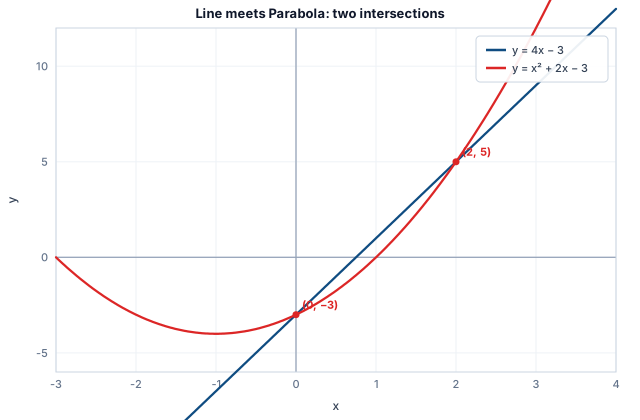
Every solution of the system lies on both graphs at once — it is an intersection point. A line can cross a parabola at 0, 1, or 2 points.
| Discriminant of the resulting quadratic | Intersections |
|---|---|
| 2 real solutions | |
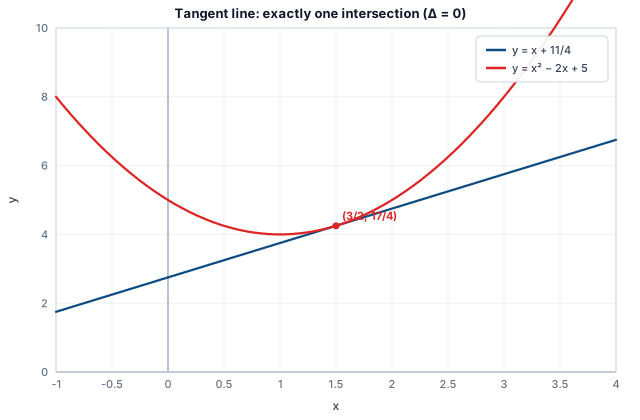
| 1 real solution (line is tangent to parabola) | |
| 0 real solutions (no intersection) |
The substitution strategy
Given (line) and (parabola):
- Substitute the expression for from the line into the parabola equation. Now there is only one variable.
- Collect all terms on one side to get a quadratic set equal to zero.
- Solve by factoring or the quadratic formula.
- Back-substitute each -value into the linear equation to find the matching -value.
- Verify each ordered pair in the original parabola equation.
Key Formulas & Rules
Substitution: Replace in with the linear expression :
Quadratic formula (must be memorized — not on the reference sheet):
where .
Discriminant (determines the number of intersections):
Vieta's formulas (useful shortcut when the question only asks for a sum or product of the -values):
These apply after the system is reduced to .
Note: The discriminant appears in the sibling note "The Discriminant and Number of Solutions," which treats it in depth for single quadratics. Here we apply it specifically to determine how many times a line and a parabola cross.
Worked Examples
Example 1
The system below has two solutions.
What is the sum of the -coordinates of the two solutions?
A) B) C) D)
Step 1 — Substitute. Since both expressions equal , set them equal:
Step 2 — Collect terms.
Step 3 — Factor.
Step 4 — Find the -values using the linear equation :
- : . Check in parabola: ✓
- : . Check in parabola: ✓
Step 5 — Answer the question. Sum of -coordinates: .
Why the distractors fail:
- A) : Records only the -coordinate of the first solution, stopping after .
- C) : Records only the -coordinate of the second solution, stopping after .
- D) : Replaces with (ignores the negative sign) and adds: .
Answer: B)
Desmos check: Graph and . Click the two intersection points; Desmos labels them and . Add their -values: .
Example 2
Which of the following systems of equations has exactly one solution?
A) and
B) and
C) and
D) and
The strategy: for each, substitute the line into the parabola and check the discriminant of the resulting quadratic.
Each system reduces to , i.e. . With , , , the discriminant is:
| Option | Quadratic | Solutions | ||||
|---|---|---|---|---|---|---|
| A | 5 | 5 | 0 | 2 | ||
| B | 5 | 6 | 1 | 1 ✓ | ||
| C | 5 | 7 | 2 | 0 | ||
| D | 4 | 6 | 2 | 0 |
Option B detail: Setting gives . The discriminant is , confirming exactly one solution. Factoring: , so . Verify in parabola: ✓. The line is tangent to the parabola at .
Why the distractors fail:
- A) → two intersections, not one.
- C) → no real intersections. A student who confuses "" with "no solution" might choose this.
- D) Same quadratic as C, same error.
Answer: B)
Desmos check: Enter all four systems one at a time. The graph for option B shows the line touching the parabola at exactly one point; the others show zero or two.
Common Mistakes & Traps
-
Forgetting to rearrange before applying the discriminant. The discriminant applies to the quadratic after full substitution. Applying it to the parabola's original coefficients ignores the line.
-
Sign errors when collecting terms. Moving across the equals sign changes every sign. Double-check the sign of the -coefficient in your combined quadratic.
-
Stopping at -values. The question often asks for -coordinates, a sum, or a product. Always back-substitute and re-read the question.
-
Confusing with . means one solution (tangency). means zero real solutions. These are frequently swapped in SAT distractors.
-
Substituting the parabola into itself. Make sure you substitute the linear expression for into the nonlinear equation, not the other way around.
-
Using Vieta's shortcut on the wrong quadratic. Vieta's applies to the quadratic you get after substitution, not to the original parabola's equation.
Practice Questions
Question 1
How many solutions does the system and have?
A) 0 B) 1 C) 2 D) Infinitely many
Show answer
Answer: B) 1
Substitute:
exactly one solution. At : . Check in parabola: ✓.
Why others fail:
- A) 0: Confuses with no solutions.
- C) 2: Student sees "" and thinks two different roots at .
- D) Infinitely many: Misidentifies the system as having overlapping graphs.
Question 2 (Student-produced response)
The system of equations and has two solutions. What is the sum of the -coordinates of the solutions?
Show answer
Answer: 5
Substitute:
or . Sum .
Verify: : line gives ✓, parabola gives ✓. : line gives ✓, parabola gives ✓.
Desmos check: Graph both equations; click the two intersections. The -labels are and . Their sum is .
Vieta's shortcut: From , sum of roots .
Question 3
For what value of does the line intersect the parabola at exactly one point?
A)
B)
C)
D)
Show answer
Answer: B)
Substitute:
For one intersection, set :
Why others fail:
- A) : Student writes (adds instead of subtracting), getting .
- C) : Student correctly forms but writes , forgetting to divide by .
- D) : Student sets equal to the constant term of the parabola rather than using the discriminant.
Question 4
Which of the following lists the solutions of the system and ?
A) and
B) and
C) and
D) only
Show answer
Answer: A) and
Substitute:
- : . Parabola: ✓
- : . Parabola: ✓
Why others fail:
- B) Uses to compute : , confusing the sign of the second root.
- C) Swaps the - and -coordinates of each solution.
- D) Factors but records only , missing the second solution.
Question 5 (Student-produced response)
For the system and , the two solutions are and . What is the value of ?
Show answer
Answer: 4
Substitute:
- : , so . Check: ✓
- : , so . Check: ✓
Connections
- Solving Quadratic Equations (prerequisite): factoring and the quadratic formula are the core tools once substitution produces the quadratic. Weakness there will surface here.
- Solving Systems: Substitution and Elimination (prerequisite): this note extends that method — the substitution step is identical; the new element is that one equation is nonlinear.
- The Discriminant and Number of Solutions (sibling note): covers in depth for single quadratics; here we apply to the quadratic formed by merging the two equations.
- Absolute Value, Radical, and Rational Equations (sibling note): similar substitution logic applies to other nonlinear types.
- Solving Formulas for a Variable (sibling note): symbolic manipulation skills that keep the algebra clean during the collection step.
- On test day, this skill often combines with interpreting a graph: after solving algebraically, you may be asked to identify which graph correctly shows the number of intersections — your discriminant tells you immediately what to look for.
Figures