Introduction
Quadratic equations are one of the most heavily tested skills in the Advanced Math domain, which accounts for roughly 35% of SAT Math questions. You'll encounter quadratics in pure-algebra form and in real-world contexts, and the SAT will test whether you can choose the fastest method rather than always defaulting to the same one. This note covers all four solution methods and the elegant shortcut formulas for the sum and product of the solutions.
Core Concept
A quadratic equation in one variable has the standard form:
Every such equation has exactly two solutions in the complex numbers (counting multiplicity). The SAT tests four methods for finding those solutions:
| Method | Use when… |
|---|---|
| Factoring | The expression factors over the integers (small, clean coefficients) |
| Taking square roots | The equation has the form or (no -term) |
| Completing the square | and is even; also useful to derive vertex form |
| Quadratic formula | Always works; best when the equation doesn't factor cleanly |
Choosing fast matters. On a timed test, recognize the structure first: if the right side is a perfect square or there's no -term, take square roots immediately. If the trinomial factors in seconds, factor it. Reach for the formula only when needed.
Key Formulas & Rules
Quadratic formula (must be memorized — NOT on the reference sheet):
Completing the square (for ):
Vieta's formulas — if and are the two solutions of :
These let you find the sum or product of the solutions without solving for each one — a major time-saver when the SAT asks for "the sum of all values of " or "the product of the solutions."
Note: The discriminant determines how many real solutions exist. That's covered in the sibling note The Discriminant and Number of Solutions — here we focus on actually finding the solutions.
Worked Examples
Example 1
Which values of satisfy ?
A) and
B) and
C) and
D) and
Solution:
Recognize the structure: The coefficients are small integers — try factoring first.
Find two numbers whose product is and whose sum is : that's and .
Set each factor to zero:
Verify: ✓ and ✓
Why each distractor fails:
- A) and : treated the constant term as instead of , choosing two positive integers with product and difference — giving .
- B) and : factors flipped — .
- D) Both signs wrong — .
Answer: C
Example 2
What are the solutions of ?
A)
B)
C)
D)
Solution:
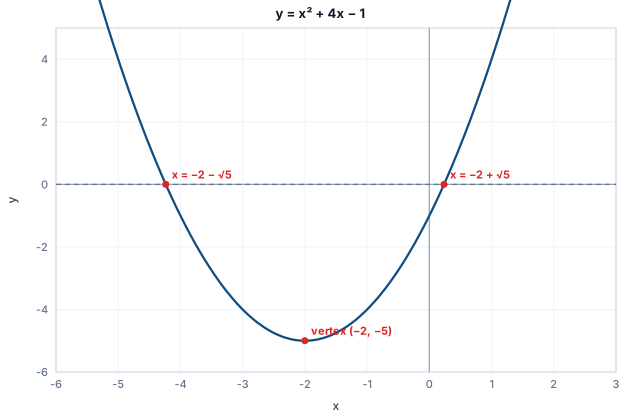
Recognize the structure: and is even — completing the square is efficient.
Add to both sides:
Verify (sum and product check): Sum ✓. Product ✓.
Desmos check: Graph and read the two -intercepts. They appear at approximately and , matching .
Why each distractor fails:
- B) : wrote instead of — flipped the sign of the half-coefficient.
- C) : added only (not ) to the right side, giving .
- D) : applied the quadratic formula and reached , then divided only the by while leaving the undivided (partial division of the numerator — see Common Mistake #4), yielding instead of the correct .
Answer: A
Common Mistakes & Traps
-
Sign error in the quadratic formula. The numerator is , not . When is negative, is positive — work this out explicitly each time.
-
Forgetting when taking square roots. gives , yielding two solutions. Students who write only lose one answer.
-
Not adding to both sides when completing the square. When you add to the left, you must add the same value to the right.
-
Dividing by only partially. In the quadratic formula, divides the entire numerator , not just the term.
-
Confusing Vieta's sum and product. The sum is (note the negative sign) and the product is (no negative sign unless is negative). Many students mix up which formula gets the minus sign.
-
Stopping at one solution. Quadratics have two solutions. If you factor and find one root, don't forget the second.
-
Applying the quadratic formula without . If , divide the whole equation by before completing the square, or keep careful track of in the formula. Dividing by only instead of in the formula is a very common SAT distractor.
Practice Questions
Question 1 (Student-produced response)
For the equation , what is the product of its two solutions? Enter your answer as a fraction or decimal.
Show answer
Answer: (or 1.333…)
Solution: By Vieta's product formula, the product of the solutions equals .
To verify by factoring: , giving and . Product ✓.
Acceptable entries: 4/3 or 1.33 (the test accepts any correctly rounded or truncated decimal, but 4/3 is exact).
Question 2 (Multiple choice)
What is the sum of the solutions of ?
A)
B)
C)
D)
Show answer
Answer: A
Solution: By Vieta's sum formula: .
To verify: factor , giving and . Sum ✓.
Why other options fail:
- B) : used instead of — dropped the negative sign.
- C) : found only one solution () and stopped.
- D) : used the product formula and mistook it for the sum.
Question 3 (Multiple choice)
What are the solutions of ?
A)
B)
C)
D)
Show answer
Answer: A
Solution: The equation is already in perfect-square form — take square roots immediately.
Verify: ✓.
Why other options fail:
- B) : correct process but failed to simplify .
- C) : sign error — moved 3 to the right with the wrong sign ( instead of ).
- D) : computed (confused — took instead of ).
Question 4 (Multiple choice)
Which of the following gives the solutions of ?
A)
B)
C)
D)
Show answer
Answer: A
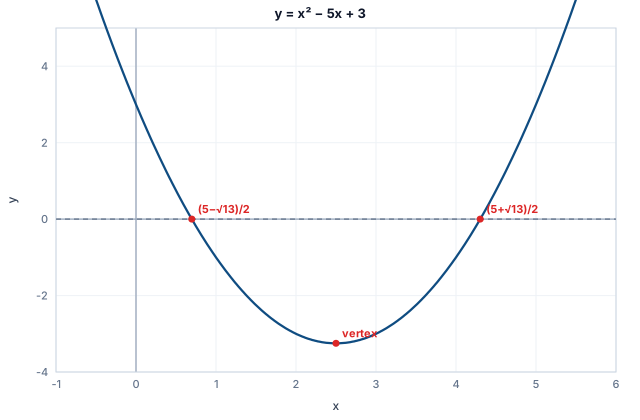
Solution: The equation doesn't factor over the integers (no integer pair multiplies to and sums to ), so use the quadratic formula with , , :
Verify (Vieta's): Sum ✓. Product ✓.
Desmos check: Graph and read the -intercepts. They fall near and , which match .
Why other options fail:
- B) : used instead of in the numerator (dropped the negative-of-negative).
- C) : computed (used instead of , i.e., ignored that the formula subtracts).
- D) : divided only by instead of — dropped the factor of 2 in the denominator.
Question 5 (Student-produced response)
If and , what is the value of ?
Show answer
Answer: 3
Solution: Isolate directly — no -term means taking square roots is the fastest method.
Since , the answer is .
Verify: ✓.
Connections
- Prerequisite — Factoring Polynomials: Factoring quadratics rests on recognizing factor pairs and the AC method. Review that skill if factoring trinomials with feels slow.
- Sibling — The Discriminant and Number of Solutions: Once you know how to solve, that note covers how many real solutions exist and what the discriminant tells you about the graph.
- Sibling — Systems of Linear and Nonlinear Equations: Substituting a linear expression into a quadratic produces a quadratic equation — every method here applies there.
- Sibling — Solving Formulas for a Variable: Sometimes the SAT asks you to isolate a squared variable inside a formula, which reduces to taking square roots or the quadratic formula.
- Sibling — Absolute Value, Radical, and Rational Equations: Squaring both sides to eliminate a radical creates a quadratic; you'll need to check for extraneous solutions.
- Geometry connection: The SAT sometimes embeds quadratics in area or distance problems — setting up the equation is half the work; these methods finish it.
Figures