Introduction
Every quadratic equation has a built-in signal — the discriminant — that tells you exactly how many real solutions exist before you solve anything. On the SAT's Advanced Math section (≈35% of the math score), these questions appear in two flavors: compute the discriminant to classify solutions and find the unknown constant that forces exactly one solution. Mastering this single formula unlocks both.
Core Concept
Start from the quadratic formula for :
The expression under the radical, , is the discriminant . It controls everything:
| Number of real solutions | Parabola behavior | |
|---|---|---|
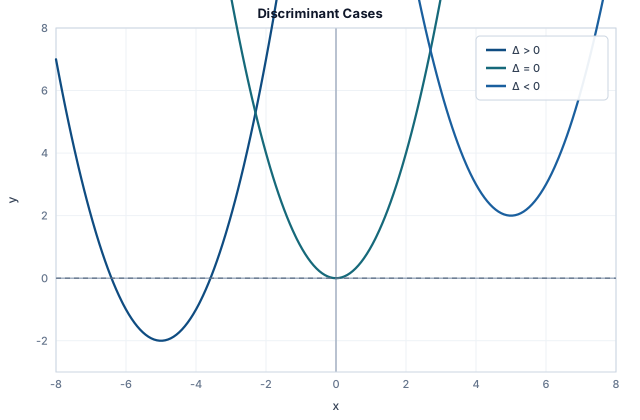
| Two distinct real solutions | Crosses the -axis at two points | |
| One real solution (repeated root) | Touches the -axis at exactly one point (vertex on -axis) | |
| No real solutions | Entire parabola above or below the -axis |
Quick illustration: For , compute → two real solutions ( and ). No solving required beyond the discriminant check.
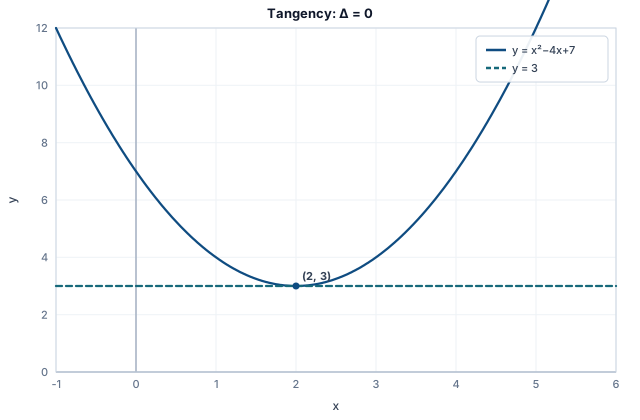
Intersections with horizontal lines: The same logic applies when a parabola meets . Set , rearrange to , then evaluate the discriminant of that new equation.
Key Formulas & Rules
Discriminant (must be memorized — not on the reference sheet):
Classification rules (memorize all three):
Finding the constant for exactly one solution: Set and solve for the unknown. This is the most common SAT use of the discriminant.
Repeated root location: When , the one solution is , which is the -coordinate of the vertex.
The quadratic formula itself is not on the reference sheet — memorize it, or derive it via completing the square.
Worked Examples
Example 1
The equation has exactly one real solution. What is the value of ?
A) B) C) D)
Solution:
For exactly one real solution, set the discriminant equal to zero:
Here , , :
Verify: Substituting gives . One solution: . ✓
Why the other options fail:
- A) : Results from a division error — correctly reaching but dividing by instead of .
- C) : Results from using instead of in the formula: .
- D) : Results from ignoring in the term, treating it as : .
Answer: B)
Example 2
How many distinct real solutions does have?
A) Zero B) Exactly one C) Exactly two D) More than two
Solution:
Identify , , . Compute the discriminant:
Since , the equation has two distinct real solutions.
As a check: , giving and .
Verify : ✓
Why the other options fail:
- A) Zero: Results from treating as instead of : — a sign error on the constant.
- B) Exactly one: Results from correctly computing but misremembering the rule — means two solutions, not one.
- D) More than two: A quadratic (degree 2) can have at most two solutions by the Fundamental Theorem of Algebra.
Desmos check: Type 2x^2+3x-5 in Desmos and count the -intercepts — the graph crosses the -axis at two distinct points, confirming two real solutions.
Answer: C) Exactly two
Common Mistakes & Traps
-
Sign error on : If the equation is , then is negative. Forgetting this when computing is the single most common discriminant error.
-
Dropping from : Students often compute instead of when . Every term in matters.
-
Confusing with : The "one solution" case is , not . The rule " means two solutions" trips up students who associate "positive discriminant" with "one real solution."
-
Solving for the root instead of the constant: When the SAT asks for the value of a constant that gives exactly one solution, set and solve for — do not find the root of the quadratic (that's a separate step).
-
Forgetting to rearrange before applying the discriminant: If the equation is , you must first rewrite it as before reading off , , .
-
Confusing tangency with crossing: "" means the parabola is tangent to the line — it touches at exactly one point without crossing through. "" means the parabola crosses the line at two points.
Practice Questions
Question 1 (Student-produced response)
For what value of does the equation have exactly one real solution? (Assume .)
Show answer
Answer:
Set the discriminant equal to zero with , , :
Verify: . One solution. ✓
Question 2
The graph of is tangent to the -axis (touches it at exactly one point). Which of the following could be the value of ?
A) B) C) D)
Show answer
Answer: B)
"Tangent to the -axis" means . With , :
appears in the options.
Why the other options fail:
- A) : → no -intercepts at all.
- C) : Confuses with ; → two intercepts.
- D) : Results from writing and then setting (not taking the square root).
Desmos check: Type y = x^2 + 6x + 9 and observe the vertex sits exactly on the -axis at .
Question 3
How many times does the parabola intersect the line ?
A) Zero B) Exactly one C) Exactly two D) More than two
Show answer
Answer: B) Exactly one
Set the expressions equal and rearrange:
Compute the discriminant with , , :
means exactly one intersection point. The root is ; check: ✓.
Why the other options fail:
- A) Zero: Results from adding instead of subtracting: , (sign error when rearranging).
- C) Exactly two: Results from computing but misapplying the rule (thinking means two solutions).
- D) More than two: Impossible for an intersection of a parabola and a line (at most 2 points).
Question 4
Which of the following quadratic equations has no real solutions?
A) B) C) D)
Show answer
Answer: C)
Compute each discriminant:
- A: → two solutions
- B: → one solution
- C: → no real solutions ✓
- D: → two solutions
Question 5 (Student-produced response)
How many real solutions does the equation have?
Show answer
Answer:
Discriminant: .
Since , there is exactly one real solution. The repeated root is . Check: ✓.
Note: The equation factors as , confirming a single repeated root.
Connections
- Solving Quadratic Equations (prerequisite): The discriminant lives inside the quadratic formula. Once you know , you proceed to the full formula to find the two roots; if , the root is simply .
- Systems of Linear and Nonlinear Equations (sibling subtopic): When you substitute a linear equation into a quadratic to find intersection points, the resulting equation's discriminant tells you how many intersections exist — a direct application of this note's method.
- Solving Formulas for a Variable (sibling subtopic): Setting up and solving for an unknown constant is an instance of rearranging a formula, a skill reinforced in that note.
- Vertex form and parabola geometry: Because forces the vertex onto the -axis (or the line in horizontal-line problems), strong discriminant fluency supports any SAT question about parabola transformations or minimum/maximum values.
Figures