Introduction
Nonlinear equations in one variable appear throughout the Advanced Math domain, which accounts for roughly 35% of SAT Math questions. This note covers four specific equation types — absolute value, radical, rational, and factored polynomial — and the structural techniques needed to crack each one. You will be expected to recognize which algebraic move unlocks each equation, carry it through cleanly, and reject any extraneous solutions that arise along the way.
Core Concept
Each equation type has a signature move:
| Equation Type | Signature Move | Watch Out For |
|---|---|---|
| Split into two cases | means no solution | |
| Isolate radical, then square both sides | Squaring can create extraneous roots | |
| Multiply both sides by LCD | Values that make are extraneous | |
| Zero-product property | Every factor gives a solution |
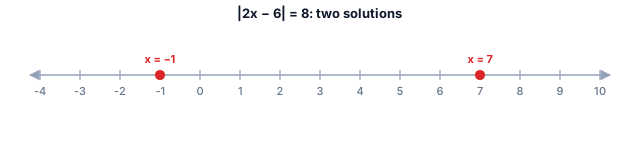
Quick illustration — absolute value:
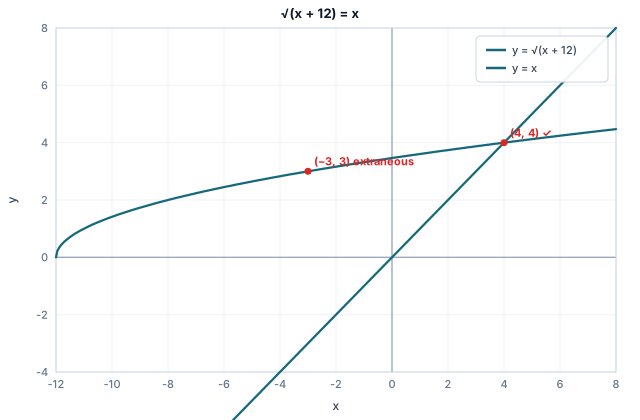
Quick illustration — radical:
Check: ✓
Quick illustration — rational:
Check: ✓
Quick illustration — factored polynomial:
Key Formulas & Rules
Must memorize (not on the reference sheet):
To clear a rational equation — multiply every term by the LCD, then solve the resulting polynomial:
Zero-product property:
Extraneous solution rule: A value is extraneous if it satisfies the transformed equation but not the original. Always substitute back.
Restriction rule for rational equations: Any value that makes a denominator equal zero must be excluded — even if algebra produces it.
Worked Examples
Example 1
The equation has two solutions. What is their sum?
A) B) C) D)
Solution:
Split into two cases:
Case 1:
Case 2:
Check both: ✓ and ✓
Sum:
Why the distractors fail:
- A) : Uses only Case 2 and reports that single value.
- C) : Uses only Case 1, never forms the second equation.
- D) : Applies only and adds the result to itself (), never negating the right side.
Answer: B)
Example 2
What is the solution to ?
A) B) C) D)
Solution:
The radical is already isolated. Square both sides:
Check in the original: ✓
Why the distractors fail:
- A) : Forgot to square 5; set .
- C) : Correctly reached but then wrote (dropped the "divide by 2" step).
- D) : Wrote , ignoring the left side entirely.
Answer: B)
Desmos check: Graph and . The intersection x-coordinate confirms .
Example 3
What is the solution to ?
A) B) C) D)
Solution:
Cross-multiply (equivalent to multiplying both sides by ):
Check restrictions: and . Since , no denominator is zero. ✓
Verify: and ✓
Why the distractors fail:
- A) : Arithmetic error after cross-multiplying; divided by instead of , giving .
- B) : Confused the denominator restriction () with the solution.
- C) : Noted that 5 is the numerator on the left and stopped there — no algebraic work done.
Answer: D)
Common Mistakes & Traps
-
Only writing one case for absolute value. always produces two cases (when ). Students who write only the positive case lose half the solutions.
-
Squaring before isolating. In , you must get first. Squaring creates a cross-term and is far harder to simplify.
-
Forgetting to check for extraneous solutions after squaring. yields and after algebra, but is extraneous because .
-
Not identifying restrictions before solving rational equations. Solve the equation first, but then eliminate any solution that makes a denominator zero.
-
Sign errors in factored equations. From students correctly get , but from some write instead of .
-
Treating in as solvable. An absolute value can never equal a negative number — the equation has no solution.
Practice Questions
Question 1
What is the larger solution to ?
A) B) C) D)
Show answer
Answer: D)
Split into two cases:
Case 1:
Case 2:
Since , the larger solution is .
Check: ✓ and ✓
- A) : The smaller solution — reported Case 2 only.
- B) : Sign error in Case 1: wrote instead of , giving .
- C) : Dropped the negative in Case 2: wrote instead of , giving .
Question 2 (Student-produced response)
What is the value of that satisfies ?
Show answer
Answer:
Square both sides:
Rearrange:
Factor: or
Check : ✓
Check : ✗ — extraneous, reject.
The only valid solution is . Enter 4.
Question 3
What is the sum of all solutions to ?
A) B) C) D)
Show answer
Answer: C)
Multiply both sides by , noting :
Neither equals 3, so both are valid. Sum .
Check : and ✓. Check : and ✓.
By Vieta's formulas, the sum of roots of is — a useful shortcut.
- A) : Reported only as the answer.
- B) : Reported only as the answer.
- D) : Sign error expanding : wrote instead of , producing with roots and , sum .
Question 4
What is the largest solution of ?
A) B) C) D)
Show answer
Answer: D)
Apply the zero-product property to each factor:
Ordering: , so the largest solution is .
- A) : The smallest solution, from the second factor.
- B) : The middle solution, from the third factor.
- C) : Sign error on the second factor: , not .
Question 5 (Student-produced response)
What is the sum of all solutions of ?
Show answer
Answer: (enter 1/2 or 0.5)
Factor , so the equation becomes:
Applying the zero-product property:
Sum
Verify each root in :
- : ✓
- : ✓
- : ✓
Connections
- Solving Linear Equations (prerequisite): Each case of an absolute value equation and each step after clearing a denominator reduces to a linear equation — fluency there is essential.
- Solving Quadratic Equations (sibling): Radical and rational equations often produce a quadratic after transformation; see the Solving Quadratic Equations note for factoring and the quadratic formula.
- The Discriminant and Number of Solutions (sibling): After clearing denominators or squaring, the discriminant tells you how many real solutions to expect before you even solve.
- Systems of Linear and Nonlinear Equations (sibling): Rational and radical expressions also appear as one equation in a two-variable system; the solution method there adds substitution on top of the moves covered here.
- Solving Formulas for a Variable (sibling): The same isolate-and-square or clear-denominator moves appear when rearranging a formula containing radicals or rational expressions.
- On test day, combine: Recognizing a rational equation's LCD instantly, setting up both absolute value cases in one line, and checking for extraneous solutions automatically are the habits that separate 700+ scorers from the rest.
Figures