Introduction
Linear equations in one variable appear throughout the SAT's Algebra domain, which makes up about 35% of the Math section. Most of these questions go well beyond simple two-step equations: you'll face distribution, fractions, decimals, and cleverly disguised structure. This note focuses on fluently solving those multistep forms using the most efficient algebraic approach—not always brute force.
Core Concept
Every legal move on a linear equation keeps both sides equal. You can add, subtract, multiply, or divide the same nonzero quantity on both sides without changing the solution set.
Three scenarios require strategic choices:
1. Distribution
Distribute before collecting like terms.
Watch signs carefully: , not .
2. Fractions and Decimals — Clear First
Fractions: Multiply every term on both sides by the LCD to eliminate all denominators at once.
Decimals: Multiply every term by a power of 10 to convert to integers, or simply collect decimal coefficients directly—both work; pick whichever feels cleaner.
3. Structural Substitution — Treat the Repeated Expression as One Unit
When the same algebraic expression appears more than once, let it be a single variable . This converts a seemingly complex equation into a one- or two-step problem.
Let :
You could expand both sides instead, but the substitution is faster and less error-prone.
Always Check by Substitution
After solving, substitute your answer back into the original equation. A mismatch means you made an algebra error—find it before moving on.
Key Formulas & Rules
| Rule | Statement |
|---|---|
| Addition/Subtraction | If , then and |
| Multiplication | If , then |
| Division | If and , then |
| LCD clearing | Multiply every term on both sides by the LCD |
| Substitution check | Plug answer into the original equation; both sides must agree |
None of these appear on the reference sheet—they are core algebra rules you must know. The reference sheet contains geometric formulas only.
Worked Examples
Example 1
What is the value of ?
A) B) C) D)
Solution
The equation contains a fraction with denominator 3. Multiply every term by 3 to clear it:
Check: and . ✓
Distractor analysis:
- A) : The student multiplied only the fraction term by 3, leaving the standalone 2 and the right side unchanged: . (Incomplete clearing.)
- B) : The student correctly expanded the left side to but distributed the 3 on the right as instead of : . (Sign error.)
- D) : The student made an arithmetic error, computing instead of : . (Arithmetic slip.)
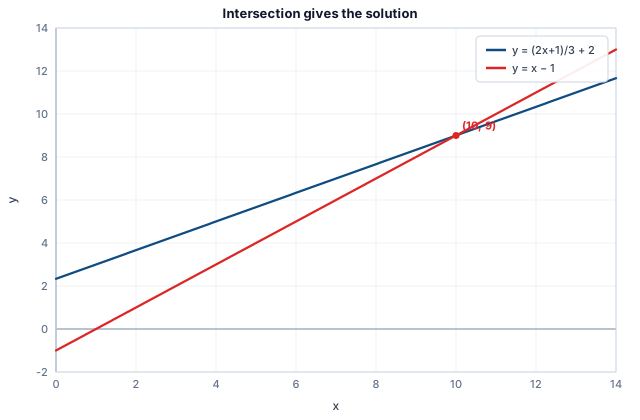
Desmos check: Graph and . The intersection has -coordinate , confirming the answer.
Answer: C)
Example 2 (Student-produced response)
What is the value of ? (Enter as a fraction or decimal.)
Solution
Notice that appears on both sides. Let :
Now substitute back:
Check: and . ✓
Answer: or
Strategy note: Expanding both sides first also works, but spotting the repeated cuts the work in half and reduces sign-error risk.
Common Mistakes & Traps
-
Partial LCD clearing. Multiplying by the LCD but forgetting to apply it to every term—especially to constants on either side. The LCD must hit all terms simultaneously.
-
Sign errors when distributing negatives. , not . This is the single most common algebra error on the SAT.
-
Not converting the whole equation for decimals. If you multiply one term by 10, you must multiply all terms by 10.
-
Missing the structural shortcut. Expanding a repeated expression wastes time and introduces errors. Always scan for a chunk that appears at least twice before you start distributing.
-
Skipping the substitution check. A sign error mid-solution gives a "clean-looking" but wrong answer. Substituting back catches it every time.
-
Confusing no-solution / infinite-solution cases. If variables cancel and you get a false statement like , the equation has no solution. If you get , it has infinitely many solutions. Those cases are covered in the sibling note No Solution, One Solution, or Infinitely Many.
Practice Questions
Question 1
What is the value of ?
A) B) C) D)
Show answer
Answer: C)
Solution: Distribute the decimal: , so . Subtract : . Add 2: , so .
Check: and . ✓
Why each distractor fails:
- A) : The student forgot to multiply by , instead writing , giving , so .
- B) : The student subtracted from both sides of to correctly reach , but then divided by instead of (dropping the negative sign from the coefficient), getting . (Sign error in the division step.)
- D) : The student computed instead of , writing , leading to , so .
Question 2 (Student-produced response)
What is the value of ? (Enter as a fraction or decimal.)
Show answer
Answer: or
Solution: Let :
So .
Check: and . ✓
Acceptable entries: or .
Question 3
What is the value of ?
A) B) C) D)
Show answer
Answer: C)
Solution: The LCD of 4 and 6 is 12. Multiply every term by 12:
Check: . ✓
Why each distractor fails:
- A) : The student correctly multiplied the left side by 12 (giving ) but forgot to multiply the right side by 12, leaving it as 2: .
- B) : The student correctly multiplied the left side by 12 (giving ) but multiplied the right side by 6 instead of 12, getting : . (Inconsistent multiplier on the right side.)
- D) : The student made a sign error distributing , writing .
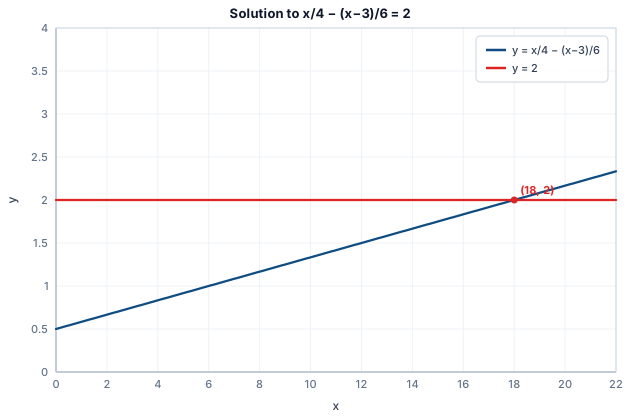
Desmos check: Graph and . The intersection occurs at .
Question 4 (Student-produced response)
What is the value of ?
Show answer
Answer:
Solution: Multiply every term by the LCD, which is 6:
Check: and . ✓
Connections
- No Solution, One Solution, or Infinitely Many (sibling note): Once you can fluently solve, this note extends the skill to interpreting what happens when the variable drops out completely.
- Linear Equations in Context (sibling note): Real-world SAT problems wrap these same equation types in a story; the algebra is identical, but you first need to set up the equation from a description.
- Linear Functions: The solution to is precisely the -coordinate of the intersection of and —a graphical interpretation that Desmos confirms instantly.
- Systems of Linear Equations: Substitution in a system relies on the same single-variable techniques practiced here; mastering this note makes substitution method effortless.
Figures