Introduction
Every linear equation in one variable lands in exactly one of three categories: no solution, one solution, or infinitely many solutions. The digital SAT tests this idea directly in the Algebra domain (≈35% of the section), often by asking you to find the value of an unknown constant that forces a particular category. Mastering this skill also prevents careless errors when solving ordinary equations (covered in the sibling note Solving Linear Equations).
Core Concept
After fully simplifying both sides of a linear equation, it takes one of three forms:
| Simplified form | Meaning | Outcome |
|---|---|---|
| with | One intersection | Unique solution: |
| (true for every ) | Same line | Infinitely many solutions |
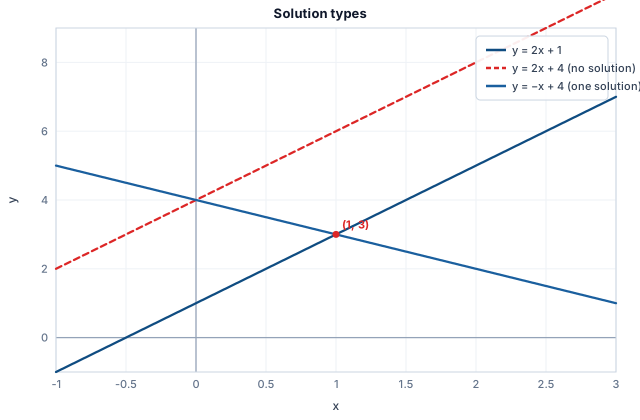
| with (false for every ) | Parallel, never meet | No solution |
The two-step comparison method:
- Simplify both sides completely (distribute, collect like terms).
- Compare x-coefficients and constants on each side.
- Coefficients differ → unique solution (solve normally).
- Coefficients equal AND constants equal → infinitely many solutions.
- Coefficients equal AND constants differ → no solution.
Quick illustration:
Key Formulas & Rules
The general one-variable linear equation after simplification:
| Condition | Result |
|---|---|
| One solution: | |
| and | Infinitely many solutions |
| and | No solution |
Memorize all three rows above — none appear on the SAT reference sheet. The critical insight: the x-coefficients control whether a solution exists; the constants break the tie between "infinitely many" and "none."
Finding a constant :
- For infinitely many solutions: set the x-coefficients equal and the constants equal, then solve both equations for (they must agree).
- For no solution: set the x-coefficients equal (find ), then verify the constants are unequal under that .
Worked Examples
Example 1
For what value of the constant does the equation have infinitely many solutions?
A) B) C) D)
Solution:
Step 1 — Expand the left side:
Step 2 — Compare x-coefficients. For infinitely many solutions, both sides must be identical, so:
Step 3 — Check the constants with : left constant , right constant . ✓ Equal — no further condition is needed.
Verify: Substitute : ✓
Why each distractor fails:
- A) : Results from setting — confusing "infinitely many" with "making the -terms vanish." Gives for .
- C) : Directly reading from the right-side coefficient without dividing by . Gives .
- D) : Sign error — solving instead of . Gives .
Answer: B)
Desmos check: Graph for various using a slider; at the graph collapses to the line , confirming infinitely many solutions.
Example 2
For what value of the constant does the equation have no solution?
A) B) C) D)
Solution:
Step 1 — Expand:
Step 2 — Match x-coefficients (necessary for no solution — parallel lines have equal slope):
Step 3 — Check the constants with : left constant ; right constant . Since , the equation is a contradiction. ✓
Verify: — false for every . No solution ✓
Why each distractor fails:
- A) : No clear computation — student guesses the "neutral" value. Gives , a unique solution.
- C) : Student matches to the right-side constant . Gives , a unique solution.
- D) : Student reads the -coefficient on the right side () and sets . Gives , a unique solution.
Answer: B)
Common Mistakes & Traps
-
Forgetting to fully distribute before comparing. Comparing and without expanding leads to incorrect coefficient matching.
-
Only checking one condition. For infinitely many solutions both the x-coefficients and constants must match. For no solution, the x-coefficients must match and the constants must differ — check both.
-
Confusing "no solution" with "solution is zero." is a perfectly valid unique solution. No solution means the equation is a contradiction, not that equals zero.
-
Reading coefficients off the wrong side. In , the x-coefficient on the left is , not — students frequently skip the factor of .
-
Sign errors when rearranging. After simplifying, moving terms across the equals sign incorrectly leads to the wrong coefficient equation (e.g., solving instead of ).
-
Stopping too early. Finding the value of that makes coefficients equal and declaring "no solution" without verifying that the constants truly differ under that .
Practice Questions
Question 1
For what value of the constant does the equation have infinitely many solutions?
A) B) C) D)
Show answer
Answer: B)
Solution: Compare x-coefficients: . Compare constants: ✓ (always satisfied).
Verify: ✓
Why other options fail:
- A) : Subtracts from both sides incorrectly as . Gives , unique.
- C) : Reads the coefficient directly from the right side without using the equation . Gives , unique.
- D) : Finds but forgets to divide by . Gives , unique.
Question 2 (Student-produced response)
For what value of does the equation have no solution?
Show answer
Answer:
Solution: Expand: .
Match x-coefficients: . Check constants with : left , right . Since , the equation is a contradiction — no solution ✓
Verify: — false for every ✓
Question 3
Which of the following equations has no solution?
A) B) C) D)
Show answer
Answer: B)
Solution: Expand B: — false for every . No solution ✓
Why other options fail:
- A) . Infinitely many solutions (an identity).
- C) . Unique solution.
- D) . Infinitely many solutions.
Question 4
For what value of the constant does the equation have infinitely many solutions?
A) B) C) D)
Show answer
Answer: B)
Solution: Expand left: . Expand right: .
So the equation is . Compare x-coefficients: ✓ (always satisfied). Compare constants: .
Verify: ✓ Infinitely many solutions.
Why other options fail:
- A) : . No solution.
- C) : . No solution.
- D) : Student reads the x-coefficient as the answer. . No solution.
Question 5 (Student-produced response)
For what value of does the equation have infinitely many solutions?
Show answer
Answer:
Solution: Expand the right side: . Compare x-coefficients: ✓ Compare constants: .
Verify: ✓ Infinitely many solutions.
Connections
- Prerequisite — Solving Linear Equations: The mechanical skill of distributing and collecting like terms is assumed here; sharpen that first if the simplification steps feel slow.
- Sibling — Linear Equations in Context: Once you can identify solution types algebraically, real-world SAT problems will embed the same structure in word problems (e.g., "for what price do two plans cost the same amount?") — the comparison method is identical.
- Systems of Linear Equations: The same three outcomes (no solution, unique solution, infinitely many) appear when two equations have the same variable structure. There, the geometric interpretation is explicit: parallel lines never intersect, identical lines overlap everywhere, and transverse lines intersect once.
- Advanced Math connection: Quadratic and polynomial equations can also have zero, one, or two solutions — the discriminant plays the role that coefficient-matching plays here. Recognizing this pattern now builds fluency for those topics.
Figures