Introduction
Linear equations in context show up constantly on the digital SAT — roughly 35% of the Math section is Algebra, and "which equation represents this situation?" is among the most frequent question types you'll see. The skill has two layers: setting up the equation from a word problem, and interpreting what each piece of the equation means in plain language. Nail both, and you'll convert word problems from time-sinks into easy points.
Core Concept
Every linear equation in one variable is a translation of a sentence. The sentence says that two quantities are equal; the equation writes that in math.
The translation toolkit:
| English phrase | Math meaning |
|---|---|
| "a flat fee of " / "an initial amount of " | a constant added (or subtracted) |
| " per unit" / " for each …" | a coefficient; write |
| "total," "result," or "is" | |
| "remaining," "left over" | subtract from a starting value |
| "combined," "together" | add two expressions |
Quick illustration. A streaming service charges a $12 sign-up fee and $9 per month. A subscriber's total cost after months is:
- is the rate — cost per month (the coefficient).
- is the flat fee — paid once regardless of months (the constant).
- is the unknown — number of months (the variable).
- is the total cost (the other side of the equation).
If you know the total is $75, set and solve: months.
Key move: before writing the equation, identify (1) the unknown, (2) the rate, (3) the fixed amount, and (4) what the total equals.
Key Formulas & Rules
These structures cover the vast majority of SAT linear-equation-in-context questions. None are on the reference sheet — you must recognize them from reading the problem.
Starting amount minus a repeated subtraction:
Two quantities set equal (break-even / same-value problems):
The solution is the point where both sides are equal — interpret it as the number of steps (weeks, miles, items…) at which the two expressions match.
Interpretation rule: the solution to the equation is always interpreted in terms of the variable's units — not dollars, not the coefficient. Always re-read the problem after solving to state what actually represents.
Worked Examples
Example 1
A plumber charges a flat fee of $85 for any job, plus $60 for each hour of work. A customer's total bill comes to $325. Which equation can be used to find , the number of hours the plumber worked?
A) B) C) D)
Solution — set it up step by step:
- The unknown is hours worked: .
- The variable cost is $60 per hour: .
- The flat fee is $85, added regardless of hours: .
- The total equals $325.
Equation: .
Solve to verify: . Check: . ✓
Why the distractors fail:
- B) : swaps the roles of $85 and $60 — treats the flat fee as the hourly rate.
- C) : incorrectly applies the hourly rate to both the hours and the flat fee. At , the left side equals .
- D) : subtracts the flat fee instead of adding it, as if the fee were a discount.
Answer: A
Example 2
Maya has $500 in her savings account. She withdraws $40 each week. The equation gives the remaining balance (in dollars) after weeks. What does the value 40 represent in this context?
A) The number of weeks Maya makes withdrawals B) The amount, in dollars, Maya withdraws each week C) The total amount, in dollars, Maya has withdrawn so far D) The balance remaining in the account after one week
Solution — interpret each piece:
- : the starting balance (constant).
- : the number of weeks (variable, matches option A — but A describes , not 40).
- : the coefficient of . It scales with each additional week — it is the per-week withdrawal rate, $40/week.
- : the total withdrawn after weeks (matches option C — but that describes , not 40 alone).
- After week: , so $460, not $40 — so D is wrong.
The value 40 is the rate at which Maya's balance decreases per week.
Answer: B
Common Mistakes & Traps
1. Swapping the rate and the flat fee. If a problem has both a per-unit charge and a one-time fee, students sometimes multiply by the wrong number. Always check: which number changes as the quantity changes? That's the coefficient.
2. Misplacing parentheses. Writing instead of is a frequent structural error. The rate applies only to the variable quantity, not to the fixed fee.
3. Subtracting a fee that should be added. A flat fee paid on top of variable costs is positive. Only subtract it if the problem says it's a discount, refund, or reduction.
4. Interpreting the coefficient instead of the solution. The solution tells you how many of the variable unit. The coefficient tells you the rate. Don't mix them up when answering an interpretation question.
5. Forgetting to include an existing amount. When a problem says "she has already done 3 batches and needs a total of 7," the equation should be , not .
6. Stopping at the equation instead of interpreting the solution. Some questions ask what the solution represents — not just what the equation looks like. Always re-read the variable's definition in the problem.
Practice Questions
Question 1
A car rental company charges $45 per day plus $0.20 per mile driven. Rafael rents a car for one day and is charged a total of $89. Which equation can be used to find , the number of miles Rafael drove?
A) B) C) D)
Show answer
Answer: A
Solution: The daily rate is $45 (flat, paid once), and the per-mile rate is $0.20 (variable). Total = .
Solve: miles. Check: . ✓
Why the others fail:
- B) Swaps the role of $45 and $0.20 — treats the daily flat fee as the per-mile rate.
- C) Applies the $0.20 rate to both the miles and the flat fee: inflates the equation incorrectly.
- D) Subtracts the flat fee instead of adding it.
Question 2 (Student-produced response)
A teacher has a budget of $180 for classroom supplies. She spends $24 on markers and uses the remaining money to buy notebooks that cost $6 each. How many notebooks can she buy?
Show answer
Answer: 26
Solution: Set up the equation for total spending:
Check: . ✓
Enter 26 as your response.
Question 3
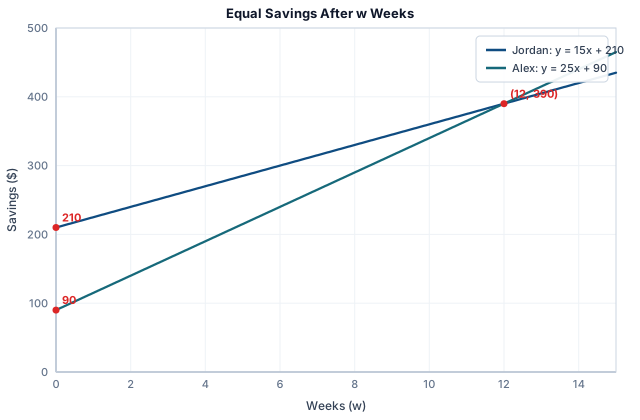
Jordan currently has $210 saved and adds $15 each week. Alex currently has $90 saved and adds $25 each week. The equation can be solved to find . What does the solution represent?
A) The amount of money each friend has when their savings are equal B) The number of weeks after which Jordan and Alex have equal savings C) The combined total savings of both friends D) The difference in weekly savings rates between Alex and Jordan
Show answer
Answer: B
Solution: Solve to confirm is a number of weeks:
After 12 weeks: , so Jordan has $390; , so Alex has $390. ✓
The variable was defined as weeks, so its solution is the number of weeks until their savings match.
Why the others fail:
- A) Describes $390 — what you get by substituting back in, not what itself represents.
- C) Combined savings would require adding both sides, not equating them.
- D) The rate difference is (a fixed number), not the solution .
Desmos check: Graph and . The intersection point is , confirming weeks.
Question 4
Devika is baking cookies for a school event. Each batch makes 24 cookies. She has already baked 3 batches and needs a total of 168 cookies. Which equation can be used to find , the additional number of batches she needs to bake?
A) B) C) D)
Show answer
Answer: B
Solution: The total number of batches is (existing plus additional), and each batch makes 24 cookies:
Check: . ✓
Why the others fail:
- A) : treats as the total number of batches, ignoring the 3 already baked.
- C) : swaps the roles of 3 (number of batches) and 24 (cookies per batch), multiplying by the wrong number.
- D) : subtracts the existing batches instead of adding them — as if Devika owes 3 batches.
Connections
- Prerequisite — Solving Linear Equations: This note focuses on building and interpreting the equation. The mechanics of solving (isolating the variable, clearing fractions, combining like terms) are covered in the Solving Linear Equations note — revisit it if you get the setup right but the algebra wrong.
- Sibling — No Solution, One Solution, or Infinitely Many: Once you can write a linear equation in context, that note extends the skill to situations where the equation has no solution or all values work — another SAT favorite.
- On test day, these skills combine: A problem may ask you to set up the equation and interpret the solution in one question. Write the equation carefully, solve it, then re-read the question to make sure you're answering what's actually asked (the number of weeks? the dollar amount? the number of items?). Don't let a correct equation lead to a wrong final answer because you misread the last line.
Figures