Introduction
Many SAT Advanced Math questions present a multi-variable formula — a physics equation, a geometry rule, a science model — and ask you to rearrange it to express one variable in terms of the others. This subtopic focuses specifically on formulas that contain squares, square roots, and fractions, making the algebra one or two steps more involved than a basic linear rearrangement. Advanced Math accounts for roughly 35% of SAT Math questions, and formula-isolation questions appear in both multiple-choice and student-produced response formats.
Core Concept
The key idea: treat every variable you are not solving for as if it were a known constant (a "parameter"), then undo operations step by step — exactly as you would when solving a linear equation, but with the added moves of squaring and square-rooting.
Order of operations in reverse:
- Isolate the term containing your target variable (add/subtract, then multiply/divide away any coefficients or fractions).
- Undo a square by taking the square root (keep the positive root when the variable represents a physical length or radius).
- Undo a square root by squaring both sides.
- Undo a fraction by multiplying both sides by the denominator.
Quick illustration — isolating from the area of a circle:
Divide both sides by :
Take the positive square root (radius must be positive):
Every step treats and as fixed numbers; the algebra is identical to solving .
Key Formulas & Rules
The following table summarizes the moves used in this note. The circle and triangle formulas in the first two rows are on the SAT reference sheet; everything else must be memorized or is given in the question.
| Formula | Solve for | Inverse Move | Result |
|---|---|---|---|
| , then | |||
| , , then | |||
| , , then | |||
| , , then square | |||
| isolate , take reciprocal |
Must memorize:
- Squaring and square-rooting are inverse operations: if (with ), then (positive root in context).
- If , then .
- To clear a fraction , multiply both sides by .
Worked Examples
Example 1
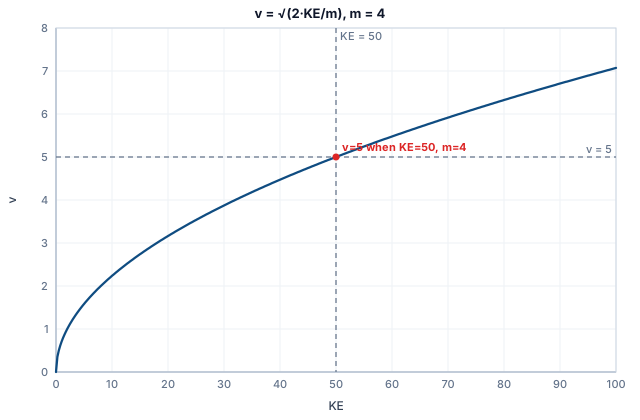
The kinetic energy of a moving object is given by
where is the object's mass and is its speed. Which of the following correctly expresses in terms of and ?
A)
B)
C)
D)
Solution
Step 1 — Multiply both sides by 2 to clear the fraction:
Step 2 — Divide both sides by :
Step 3 — Take the positive square root (speed is non-negative):
Check with , : . Verify: ✓
Why the distractors fail:
- B) — the student divided by instead of multiplying by 2 and dividing by . With the test values: .
- C) — correctly finds but forgets to take the square root. Gives 25, not 5.
- D) — incorrectly multiplies by instead of dividing. Gives .
Answer: A
Example 2
The area of a circular sector is given by
where is the radius and is the central angle measured in radians. Which expression gives in terms of and ?
A)
B)
C)
D)
Solution
Step 1 — Multiply both sides by 2:
Step 2 — Divide both sides by :
Step 3 — Take the positive square root ():
Check with , : . Verify: ✓
Why the distractors fail:
- B) — stops at without taking the square root. Gives 9, not 3.
- C) — divides by instead of multiplying by 2 and dividing by . Gives .
- D) — multiplies by instead of dividing. Gives .
Answer: A
Desmos check: Graph and to confirm at the intersection.
Common Mistakes & Traps
| Trap | What goes wrong | Example |
|---|---|---|
| Stopping at | Correctly isolates the squared term but forgets the final square root | Gets , writes |
| Square-rooting the wrong thing | Takes of only part of the expression | Gets instead of |
| Multiplying instead of dividing | When clearing a coefficient, goes the wrong direction | Gets instead of |
| Squaring instead of square-rooting | Sees in the denominator and squares the left side incorrectly | Ends up with an extra power of |
| Forgetting to isolate first | Applies a square root before the target term is alone | Takes of , getting , then writes — coincidentally correct here, but risky with more complex expressions |
| Sign / direction error with fractions | When rearranging , forgets to subtract before taking the reciprocal | Gets instead of |
Practice Questions
Question 1
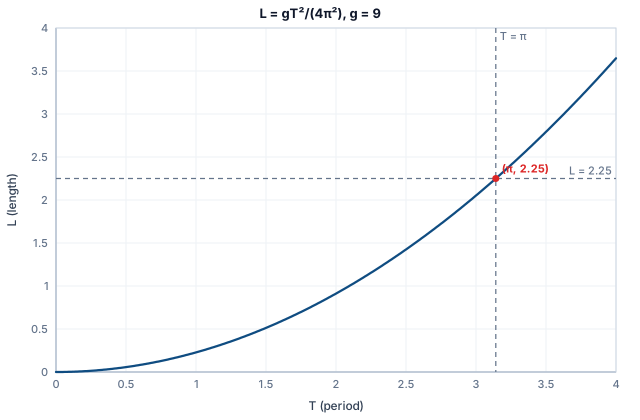
The period of a pendulum is modeled by
where is the length of the pendulum and is the gravitational acceleration. Which expression gives in terms of and ?
A)
B)
C)
D)
Show answer
Answer: A
Solution:
Step 1 — Divide both sides by :
Step 2 — Square both sides to undo the square root:
Step 3 — Multiply both sides by :
Check with , : . Verify: ✓
Why the others fail:
- B) — forgot to square and . Gives .
- C) — took a square root rather than squaring. Gives .
- D) — incorrectly squared as well. Gives .
Question 2
The thin lens equation is
where is the focal length, is the object distance, and is the image distance. Which expression gives in terms of and ?
A)
B)
C)
D)
Show answer
Answer: A
Solution:
Subtract from both sides to isolate :
Take the reciprocal of both sides:
Check with , : . Verify: ✓
Why the others fail:
- B) — the reciprocal of the correct answer. Gives .
- C) — added and in the denominator instead of subtracting. Gives .
- D) — oversimplified; treats the equation as if it were about subtraction. Gives .
Question 3 (Student-produced response)
The Fahrenheit and Celsius temperature scales are related by
If , what is the value of ?
Show answer
Answer: 100
Solution:
Subtract 32 from both sides:
Multiply both sides by :
Verify: ✓
Enter 100.
Question 4
A variable is defined by
where and are positive. Which expression gives in terms of and ?
A)
B)
C)
D)
Show answer
Answer: A
Solution:
Multiply both sides by :
Divide both sides by :
Square both sides:
Check with , : . Verify: ✓
Why the others fail:
- B) — forgot to square . Gives .
- C) — took a square root instead of squaring. Gives .
- D) — inverted the fraction. Gives .
Question 5 (Student-produced response)
The volume of a cone is , where is the radius and is the height. If and , what is the value of ? (The formula for the volume of a cone is on the reference sheet.)
Show answer
Answer: 3
Solution:
Substitute the known values:
Multiply both sides by :
Take the positive square root:
Verify: ✓
Enter 3.
Connections
- Prerequisite — Solving Linear Equations: Every move here (adding, subtracting, multiplying, dividing across an equation) is the same logic you use for linear equations; squares and square roots are just two extra inverse operations layered on top.
- Sibling — Solving Quadratic Equations: When you isolate a squared term and take a square root, you're doing a special case of solving a quadratic . The full quadratic note covers cases where the squared term is not alone (e.g., ).
- Sibling — Absolute Value, Radical, and Rational Equations: Those techniques handle equations where the variable appears inside a radical or as part of a rational expression in more complex ways (e.g., ). This note focuses on rearranging a given formula, not solving for a specific numeric value from a radical equation.
- Sibling — Systems of Linear and Nonlinear Equations: Sometimes you isolate a variable in one equation and substitute it into another — formula isolation is the crucial first step.
- On test day: Formula questions often come with a real-world context (physics, chemistry, geometry). Read the formula carefully, identify which variable the question asks you to isolate, treat the rest as parameters, and work step by step. The built-in Desmos calculator can verify specific numeric answers but cannot rearrange a formula algebraically — the algebra is yours to do.
Figures