Introduction
Radian measure and the unit circle underlie a cluster of SAT problems: converting angle measures, computing arc lengths, and evaluating sine and cosine at benchmark angles. These questions live in the Geometry and Trigonometry domain (≈15% of the test). They reward students who have the key radian values memorized and can reason about quadrant signs without a calculator — though Desmos is always available as a backup.
Scope of this note: converting between degrees and radians, computing arc length with ( in radians), and reading and from the unit circle including quadrant signs. For sector area and more on arc length see Arc Length and Sector Area; for circle equations see Equations of Circles.
Core Concept
Degrees ↔ Radians
A full rotation is or radians. That single equivalence drives all conversions:
To convert degrees → radians: multiply by .
To convert radians → degrees: multiply by .
Quick check: ✓
Arc Length
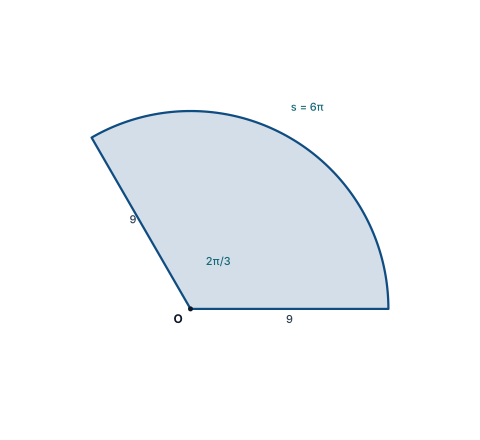
When a central angle (in radians) subtends an arc of radius , the arc length is:
This formula requires in radians. If an angle is given in degrees, convert first.
The Unit Circle
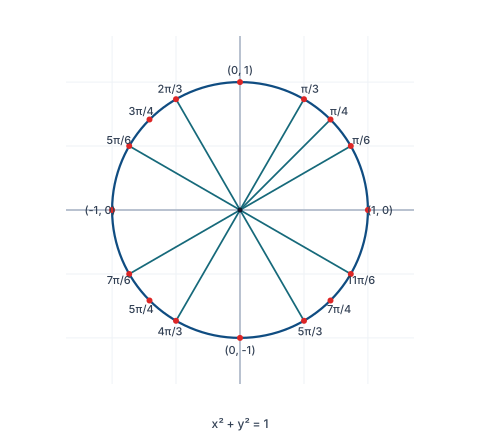
The unit circle is the circle of radius 1 centered at the origin. For any angle measured counterclockwise from the positive -axis, the terminal point on the unit circle has coordinates .
Key benchmark values to memorize:
| (rad) | (deg) | ||
|---|---|---|---|
Quadrant Signs — "All Students Take Calculus"
Use the mnemonic to remember which trig ratios are positive in each quadrant:
| Quadrant | Angles (rad) | Positive |
|---|---|---|
| I | to | All (, , ) |
| II | to | Sine only |
| III | to | Tangent only |
| IV | to | Cosine only |
Reference angle strategy: For any angle not in Quadrant I, find the acute reference angle (the positive acute angle between the terminal side and the -axis), evaluate the trig function at , then apply the correct sign for the quadrant.
Example: — the angle is in Q3 (between and ). Reference angle . . In Q3, cosine is negative, so .
Key Formulas & Rules
Reference sheet note: The arc length formula is not on the SAT reference sheet — memorize it. The relationship radians is also not listed explicitly; derive it from the circumference formula (which is on the sheet) by setting .
Worked Examples
Example 1
What is the radian measure of ?
A)
B)
C)
D)
Solution:
Multiply by the conversion factor :
Why the distractors fail:
- A) : Results from multiplying by (half the correct factor) — a factor-of-2 error: .
- B) : Results from dividing by instead of : .
- D) : Results from multiplying by instead of : .
Answer: C)
Example 2
What is the value of ?
A)
B)
C)
D)
Solution:
Step 1 — Identify the quadrant.
, so the angle is in Quadrant III.
Step 2 — Find the reference angle.
Step 3 — Evaluate at the reference angle.
Step 4 — Apply the quadrant sign.
In Q3, cosine is negative:
Why the distractors fail:
- A) : Correct magnitude, wrong sign — forgot that cosine is negative in Q3.
- B) : Confused cosine with sine (), then correctly negated for Q3.
- C) : Used of the reference angle and also forgot the sign — double error.
Desmos check: Type cos(4π/3) into Desmos (it defaults to radians) and confirm the output is .
Answer: D)
Common Mistakes & Traps
-
Multiplying by the wrong factor. Converting degrees to radians uses ; students often flip it and multiply by , producing a huge number with in the denominator.
-
Forgetting to convert before using . If is given in degrees, plug it into as-is and the arc length will be wildly wrong. Always convert to radians first.
-
Dropping the sign from a quadrant II, III, or IV angle. The reference angle is always positive and acute, but the final value of or may be negative. Skipping the quadrant sign check is the most common error on these problems.
-
Mixing up sine and cosine. On the unit circle the -coordinate is and the -coordinate is — not the other way around.
-
Using the sector area formula for arc length. The sector area is ; the arc length is . They share and but are structurally different.
Practice Questions
Question 1
What is the degree measure of radians?
A)
B)
C)
D)
Show answer
Answer: C)
Multiply by :
Why the other options fail:
- A) : Treats the angle as (i.e., divides by 6 instead of 4).
- B) : Confuses the angle with .
- D) : Multiplies by (uses instead of ): .
Question 2 (Student-produced response)
What is the value of ? Enter your answer as a fraction or decimal.
Show answer
Answer: (also accepted: )
lies in Quadrant II (between and ).
Reference angle: .
.
In Q2, sine is positive, so .
Question 3
A circle has radius . A central angle measures radians. What is the arc length?
A)
B)
C)
D)
Show answer
Answer: B)
Why the other options fail:
- A) : Computes — confused arc length with half the sector formula.
- C) : Uses the diameter () instead of the radius: .
- D) : Applies the sector area formula: .
Question 4
An angle in standard position satisfies . Which of the following must be true?
A)
B)
C) and
D) and
Show answer
Answer: C) and
places in Quadrant III, where both and are negative (only tangent is positive there).
- A) Incorrect — sine is negative in Q3.
- B) Incorrect — cosine is negative in Q3.
- D) Describes Quadrant II (, ), not Q3.
Question 5 (Student-produced response)
What is the value of ?
Show answer
Answer:
corresponds to . The terminal point on the unit circle is .
The -coordinate gives cosine: .
Note: (the -coordinate) — don't mix them up.
Connections
- Arc Length and Sector Area (prerequisite & sibling): is the foundation. The sector area formula is a natural extension — both require in radians.
- Right Triangle Trigonometry (prerequisite): The SOH-CAH-TOA ratios for -- and -- triangles (on the SAT reference sheet) are exactly the Q1 values on the unit circle. Thinking of and as - and -coordinates generalizes those ratios to all four quadrants.
- Circle Theorems: Tangents, Chords, and Angles (sibling): Central angle relationships explored there connect to arc measure in both degrees and radians.
- Equations of Circles (sibling): The unit circle is the special case of the general circle equation — and directly encodes the identity .
- On test day: A question may combine radian conversion with arc length in a single step, or embed a unit-circle value inside a linear equation. Memorizing the benchmark table above means you can read those values without reaching for Desmos — saving time for harder problems.
Figures