Introduction
Circle theorem questions appear in the Geometry and Trigonometry domain, which makes up about 15% of the digital SAT Math section. They test whether you can connect geometric relationships — angles, radii, tangents, and chords — to reach a numerical answer, often inside a right-triangle calculation. This note covers exactly four theorems: the tangent–radius right angle, central vs. inscribed angles, the semicircle angle, and the perpendicular-radius chord bisector. Arc length, sector area, and radian measure are covered in sibling notes.
Core Concept
1. Tangent ⊥ Radius at the Point of Tangency
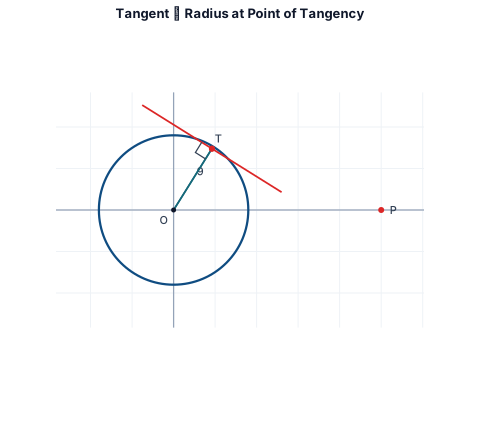
A tangent to a circle touches it at exactly one point, called the point of tangency. The radius drawn to that point is always perpendicular to the tangent. This creates an immediate right triangle whenever an external point is involved.
External point , center , radius , tangent length , and distance :
Also: two tangent segments from the same external point are equal in length ().
2. Central Angle vs. Inscribed Angle
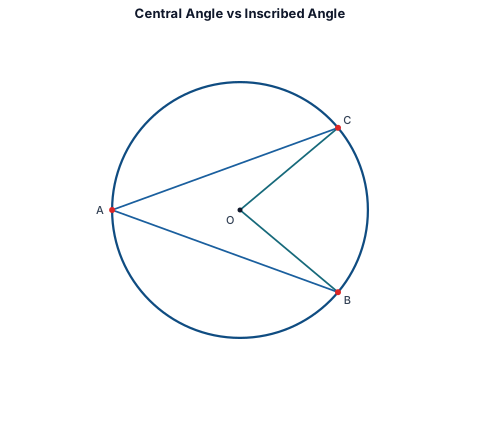
- A central angle has its vertex at the center ; its measure equals the intercepted arc.
- An inscribed angle has its vertex on the circle; its measure is half the intercepted arc, and therefore half the central angle subtending the same arc.
If the inscribed and central angles both intercept arc :
3. Angle Inscribed in a Semicircle = 90°
A diameter subtends an arc of . Any inscribed angle intercepting that arc (i.e., whose two sides meet the endpoints of a diameter) equals .
Shortcut: If is a diameter and is any other point on the circle, then — guaranteed. This turns the triangle into a right triangle and unlocks the Pythagorean theorem immediately.
4. Radius Perpendicular to a Chord Bisects It
If a radius (or any line through the center) is perpendicular to a chord, it cuts the chord into two equal halves. Conversely, the perpendicular bisector of any chord passes through the center. Combined with the radius to either endpoint, this creates a right triangle:
Key Formulas & Rules
| Theorem | Formula / Rule | Source |
|---|---|---|
| Tangent–radius angle | (T = point of tangency) | Memorize |
| External tangent length | Derived (Pythagorean — reference sheet) | |
| Equal tangents | Memorize | |
| Inscribed angle | Memorize | |
| Central angle | Memorize | |
| Semicircle angle | when is a diameter | Memorize |
| Radius ⊥ chord | bisects the chord | Memorize |
| Pythagorean theorem | Reference sheet |
Worked Examples
Example 1
A circle has center and radius . Point lies outside the circle with . A tangent from touches the circle at . What is the length of ?
A) B) C) D)
Solution:
Since is tangent to the circle at , the radius is perpendicular to at . Triangle is a right triangle with the right angle at , hypotenuse , and leg .
Verify: ✓ (This is a 3-4-5 triple scaled by 3.)
Why the distractors fail:
- A) 6 — subtracts the legs linearly: . Ignores the Pythagorean theorem.
- C) — adds the squares instead of subtracting: . This treats as a leg, not the hypotenuse.
- D) 24 — adds the two given lengths: .
Answer: B) 12
Example 2
In a circle with center , the central angle . Point lies on the major arc . What is the measure of inscribed angle ?
A) B) C) D)
Solution:
Inscribed angle and central angle both intercept arc (the minor arc, not containing ). By the inscribed angle theorem:
Desmos check: Graph a circle, plot three points on it with central and inscribed angles — the ratio is consistently 2:1, confirming the relationship.
Why the distractors fail:
- A) 20° — halves the already-halved answer: . Applies the halving rule twice.
- C) 80° — sets the inscribed angle equal to the central angle. Forgets to halve.
- D) 160° — doubles instead of halving: .
Answer: B) 40°
Common Mistakes & Traps
-
Forgetting the right angle is at the tangent point, not at the center. The hypotenuse of the right triangle is always the line from the external point to the center (), not the radius.
-
Confusing inscribed angle with arc measure. The inscribed angle equals half the arc, not the full arc. The central angle equals the arc.
-
Using CM instead of OM in the chord problem. When a radius meets a chord perpendicularly, the relevant leg in the right triangle is the distance from the center to the chord (), not the distance from the chord's endpoint to the foot ().
-
Missing the semicircle right angle. Whenever you see a diameter as one side of a triangle inscribed in a circle, the angle opposite the diameter is — use this immediately to apply the Pythagorean theorem.
-
Applying the inscribed angle rule to the wrong arc. If point is on the minor arc, it intercepts the major arc (and the inscribed angle equals half the major arc). Always identify which arc the angle's sides intercept.
-
Halving twice. Some students see "inscribed angle = half the central angle" and then also halve the inscribed angle again when asked a follow-up — the formula applies once.
Practice Questions
Question 1
A circle has center and radius . A tangent segment from external point touches the circle at , and . What is the length ?
A) B) C) D)
Show answer
Answer: C) 24
Since , triangle is right-angled at .
This is the 7-24-25 Pythagorean triple. Verify: ✓
Why others fail:
- A) 7 — sets tangent length equal to the radius; conflates with .
- B) 18 — linear subtraction: .
- D) 32 — linear addition: .
Question 2 (Student-produced response)
In a circle, is a diameter with length . Point is on the circle, and . What is the length ?
Show answer
Answer: 16
Since is a diameter, the inscribed angle (angle in a semicircle). Triangle is right-angled at , with hypotenuse .
Verify: ✓ (12-16-20 = 3-4-5 × 4)
Question 3
In a circle with center , points , , lie on the circle such that is an inscribed angle intercepting arc . What is the measure of central angle ?
A) B) C) D)
Show answer
Answer: C) 70°
The central angle is twice the inscribed angle intercepting the same arc:
Why others fail:
- A) 17.5° — halves the inscribed angle: . Inverts the relationship.
- B) 35° — sets the central angle equal to the inscribed angle; forgets to double.
- D) 145° — uses the supplementary angle: . Unrelated operation.
Question 4 (Student-produced response)
A circle has center and radius . Chord is perpendicular to radius at point , where lies on . If , what is the length ?
Show answer
Answer: 12
Since and passes through the center, it bisects : .
In right triangle with and :
Verify: ✓ (5-12-13 triple)
Question 5
A circle has center and radius . Chord is perpendicular to diameter at point , where lies on both and . If the distance from to is , what is the length of chord ?
A) B) C) D)
Show answer
Answer: C) 8
is on the circle, so . Since lies on diameter and :
Since , it bisects , so . In right triangle :
Why others fail:
- A) 4 — stops at without doubling; gives only half the chord.
- B) 6 — uses as the half-chord and doubles it: . Confuses the distance from center to chord with the half-chord length.
- D) — uses instead of in the Pythagorean theorem: , then . Fails to find the correct center-to-chord distance.
Connections
- Prerequisite — Angles, Parallel Lines, and Triangle Angle Sums: Inscribed angle proofs use the fact that triangle angles sum to ; isoceles triangles appear constantly because two radii are always equal.
- Sibling — Equations of Circles: The standard form defines the same radius used in tangent and chord calculations; on the SAT these topics merge when coordinates are given.
- Sibling — Arc Length and Sector Area: Central angles (this note) determine what fraction of the circle an arc or sector represents — the two skills combine in multi-step problems.
- Sibling — Radians and the Unit Circle: The inscribed-angle and central-angle relationship applies identically whether angles are in degrees or radians.
- On test day, a single question may chain two theorems: e.g., use the semicircle right angle to find a chord length, then use that chord with the perpendicular-bisector theorem to find the distance from the center to the chord.
Figures