Introduction
Circle equations appear in the Geometry and Trigonometry domain, which makes up roughly 15% of the SAT Math section. Questions ask you to write the equation of a circle from given information, rewrite a messy quadratic by completing the square to reveal the center and radius, determine where a specific point sits relative to a circle, and track how edits to the equation shift or resize the graph. All of these — and only these — are covered here. For arc length, sector area, and circle theorems involving tangents and chords, see the sibling notes in this topic.
Core Concept
Every circle in the xy-plane is the set of all points that are exactly units from a fixed center . That distance condition, written using the distance formula (which is just the Pythagorean theorem), gives the center-radius form:
Reading the equation: The center is and the radius is . The signs inside the parentheses flip: means ; means .
Testing a point : Substitute into the left side:
- Result : the point is on the circle.
- Result : the point is inside the circle.
- Result : the point is outside the circle.
Shifting a circle: Replacing with shifts the circle right by units; replacing with shifts it up by units. Equivalently, the center moves from to while stays the same.
Completing the square: The SAT often presents a circle in the expanded form . To convert it, complete the square for both variables:
Add the same constant to both sides to keep the equation balanced, then read off , , and .
Key Formulas & Rules
| Formula | Source |
|---|---|
| (center-radius form) | Memorize |
| Distance between and : | Derived from Pythagorean theorem (reference sheet) |
| Completing the square: | Memorize |
| Point test: substitute ; compare result to | Memorize |
The Pythagorean theorem is on the reference sheet; the distance formula and circle equation must be memorized.
Worked Examples
Example 1
A circle in the xy-plane has center and radius . Which of the following is an equation of the circle?
A)
B)
C)
D)
Solution:
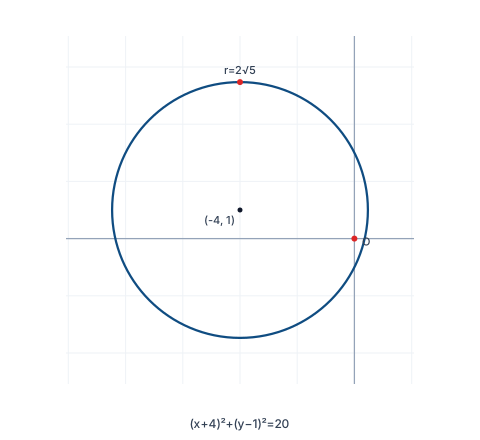
The center is and , so .
Plug into the center-radius form:
Why the distractors fail:
- A: Both signs are flipped ( instead of , instead of ) and the right side shows instead of .
- C: The -term is correct, but uses instead of — a sign error on .
- D: Only the -term sign is wrong: encodes instead of , giving center instead of .
Answer: B
Example 2
The equation represents a circle in the xy-plane. What are the center and radius of this circle?
A) Center , radius
B) Center , radius
C) Center , radius
D) Center , radius
Solution:
Complete the square for and separately.
For : Coefficient of is ; half is ; square is .
For : Coefficient of is ; half is ; square is .
Substitute back and add the constants to both sides:
Center: ; ; .
Why the distractors fail:
- B: Flips the signs on and to get center — a common "forget to flip" error.
- C: Uses the original right-hand side as without adding the completing-the-square constants and .
- D: Reads as rather than taking the square root.
Desmos check: Enter x^2+8x+y^2-2y=3 into Desmos. The graph shows a circle; clicking on it reveals the center and radius, confirming and .
Answer: A
Common Mistakes & Traps
-
Sign flip on center. has center , not or . Always rewrite as and read directly.
-
Forgetting to add completing-the-square constants to the right side. When you add to the left side, you must add the same amount to the right. Missing this step produces a wrong .
-
Confusing with . The equation gives directly. Take the square root to find the radius. SAT options for radius and are both usually listed as traps.
-
Shifting in the wrong direction. Shifting the circle right by changes center to , which changes to . Do not add directly to the expression inside the parentheses.
-
Misidentifying "inside" vs "on." If the point test gives exactly , the point is on the circle — not inside. The SAT specifically designs distractors using points on the circle when you are asked for a point strictly inside.
Practice Questions
Question 1
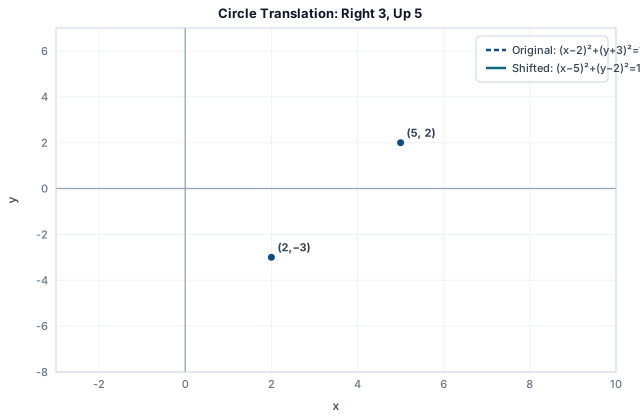
A circle is represented by . The circle is shifted units to the right and units up. Which of the following is the equation of the resulting circle?
A)
B)
C)
D)
Show answer
Answer: A
The original center is . Shifting right and up :
The radius (and therefore ) is unchanged.
New equation: .
Why the others fail:
- B: Adds the shift amounts directly inside the expressions: and , which would encode center — this misunderstands how the equation encodes the center.
- C: Shifts correctly (giving ), but adds the -unit shift directly inside the -expression: , encoding . The net effect on the center's -coordinate is a move from to , i.e., down instead of up .
- D: Correctly updates the center to but then adds the vertical shift amount to : . Translations never change the radius.
Question 2
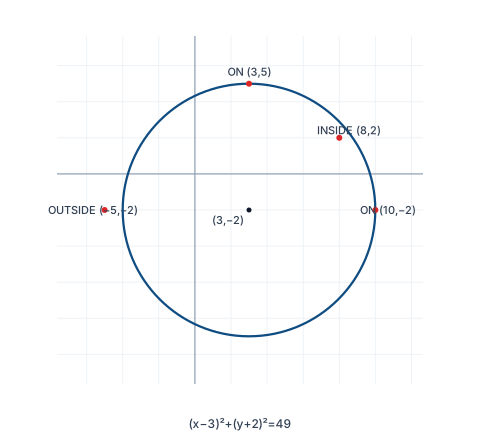
A circle in the xy-plane has equation . Which of the following points lies strictly inside the circle?
A)
B)
C)
D)
Show answer
Answer: C
Substitute each point into and compare with :
| Point | Calculation | Value | Position |
|---|---|---|---|
| On | |||
| On | |||
| Inside | |||
| Outside |
Options A and B are on the circle (not strictly inside); D is outside. Only C satisfies the condition of lying strictly inside.
Question 3
A circle is represented by . If the radius of the circle is doubled, which equation represents the new circle?
A)
B)
C)
D)
Show answer
Answer: B
The original radius satisfies , so . Doubling the radius gives , so .
The center is unchanged.
New equation: .
Why the others fail:
- A: Doubles directly: . But doubling the radius multiplies by (since ), not by .
- C: Squares itself: . This is a "double-squaring" error — confusing with and then squaring.
- D: Doubles the coefficients inside the squared expressions instead of changing . This does not simply scale the radius; it distorts the equation entirely and does not represent a standard circle in center-radius form.
Question 4 (Student-produced response)
The equation represents a circle. What is the radius of this circle?
Show answer
Answer: 5
Complete the square:
Substitute:
So and .
Center: ; Radius: .
Enter in the answer box.
Question 5 (Student-produced response)
The equation represents a circle in the xy-plane. Point is the center of this circle, and point has coordinates . What is the distance from to ? Give your answer as a simplified radical or an integer.
Show answer
Answer:
From the worked example in this note, completing the square gives center .
Distance from to :
Enter in the answer box (or the decimal approximation , rounded to three decimal places, if the problem permits a decimal entry).
Connections
- Pythagorean theorem and special right triangles (prerequisite): the distance formula and the circle equation are both direct applications of . Recognizing a -- or -- Pythagorean triple can let you test points or find radii without a calculator.
- Arc Length and Sector Area (sibling note): once you know from the equation, you can compute arc lengths and sector areas. These skills combine on multi-part problems.
- Radians and the Unit Circle (sibling note): the unit circle is just the special case ; understanding its equation grounds the trigonometric coordinate definitions.
- Circle Theorems: Tangents, Chords, and Angles (sibling note): a tangent from an external point to a circle uses the distance formula alongside the circle equation — both skills work together.
- Completing the square also appears in converting quadratic equations to vertex form (Advanced Math domain), so mastering it here pays double dividends on test day.
Figures