Introduction
Arc length and sector area questions appear in the Geometry and Trigonometry domain, which makes up about 15% of SAT Math. They test one core idea: a central angle cuts off a proportional slice of the circle's circumference and area. That idea lets you set up an equation whether you're finding the arc, the area, the radius, or the angle — and the built-in Desmos calculator can verify your algebra instantly.
Core Concept
A circle with radius has:
- Circumference
- Area
A central angle of degrees covers of the full circle. That fraction applies to both the arc length and the sector area.
Quick illustration: A circle of radius 9 with a 40° central angle.
Both results are simply (fraction of circle) × (full circumference or full area). That single idea handles every variation the SAT tests — including working backward from a given arc length or area to recover or .
Key Formulas & Rules
The formulas below must be memorized — they are not on the SAT reference sheet (though the circumference and area formulas for a full circle are).
| Quantity | Formula |
|---|---|
| Full circumference | (reference sheet) |
| Full circle area | (reference sheet) |
| Arc length | |
| Sector area |
Working backward: If you know or , treat it as the left side of the equation and solve for the unknown.
You do not need to memorize these rearrangements — just set up the original proportion and solve step by step.
Desmos check: Type the equation (e.g. y = (80/360)*2*π*9) into Desmos to confirm the numerical value of an arc length or sector area in one keystroke.
Worked Examples
Example 1
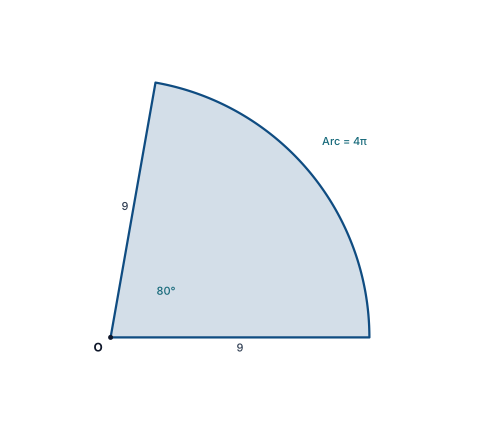
A circle has a radius of 9. A central angle of 80° is drawn. What is the length of the arc cut off by this angle?
A)
B)
C)
D)
Solution:
The arc length formula gives:
Distractor analysis:
- A) — Used instead of for the circumference: . ✗
- B) — Correct. ✓
- C) — Used the diameter (18) as the radius: . ✗
- D) — Computed the full circumference, forgetting the fraction: . ✗
Answer: B)
Example 2
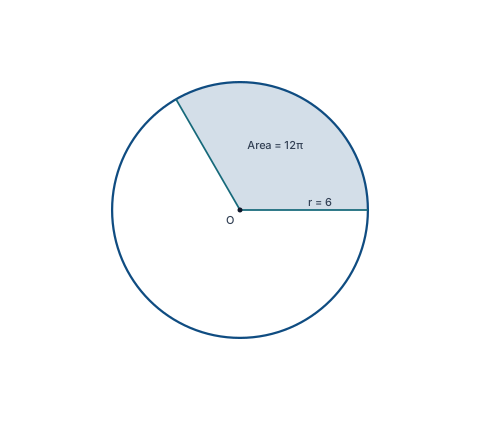
A sector of a circle has a central angle of 120° and an area of . What is the radius of the circle?
A)
B)
C)
D)
Solution:
Set up the sector area formula with the unknown radius :
Multiply both sides by 3:
Verify: ✓
Distractor analysis:
- A) — Flipped the fraction, using 3 instead of : . ✗
- B) — Dropped the fraction entirely and solved : . ✗
- C) — Correct. ✓
- D) — Used the arc length formula instead of sector area: . ✗
Answer: C)
Common Mistakes & Traps
-
Using diameter instead of radius. The formulas require . If the problem gives you a diameter, halve it first.
-
Using instead of for arc length. You need the full circumference , then multiply by the fraction. Forgetting the 2 halves your answer.
-
Swapping the arc length and sector area formulas. Arc length uses ; sector area uses . They're not interchangeable — one is linear in , the other is quadratic.
-
Forgetting to square in the area formula. After isolating , you must take the square root. Stopping at and writing is one of the most common errors.
-
Forgetting the fraction entirely. Using the full circumference or full area without scaling gives the most common wrong answer — and it's always a tempting distractor.
-
Confusing degrees and radians. These formulas use degrees. For radian-based formulas (), see the sibling note Radians and the Unit Circle.
Practice Questions
Question 1 (Student-produced response)
A circle has a radius of 10. A central angle of 36° cuts off a sector. If the area of the sector equals , what is the value of ?
Show answer
Answer: 10
So , giving .
Enter 10 in the SPR box.
Question 2 (Multiple choice)
A circle has a radius of 12. An arc of length is cut off by a central angle. What is the measure of that central angle, in degrees?
A)
B)
C)
D)
Show answer
Answer: C)
Set up the arc length equation:
Divide both sides by :
Why the other options fail:
- A) — Used the sector area formula instead of the arc length formula: . ✗
- B) — Multiplied by 180 instead of 360 when solving: . ✗
- D) — Used 6 (half the correct radius) in the circumference: . ✗
Question 3 (Student-produced response)
A sector of a circle has a central angle of 72° and an area of . What is the circumference of the full circle? (Enter your answer in terms of .)
Show answer
Answer:
Step 1 — Find :
Step 2 — Find the circumference:
Enter 10π in the SPR box.
Question 4 (Multiple choice)
An arc subtended by a central angle of 135° has a length of . What is the radius of the circle?
A)
B)
C)
D)
Show answer
Answer: C)
Verify: ✓
Why the other options fail:
- A) — Treated the arc length as the full circumference: . ✗
- B) — Used the sector area formula instead of arc length: . ✗
- D) — Forgot the factor of 2 in , solving . ✗
Connections
-
Prerequisite — Area and Perimeter: Circle arc and sector calculations build directly on knowing the full circumference and area formulas. Be fluent with those before applying the fraction.
-
Sibling — Radians and the Unit Circle: The radian-based formulas and are equivalent to the degree-based versions here. Once you know both, you can choose whichever the problem's angle is already in.
-
Sibling — Circle Theorems: Tangents, Chords, and Angles: Some problems combine arc length with inscribed-angle or chord theorems. You may first need the central angle from a chord relationship, then plug it into an arc length formula.
-
Sibling — Equations of Circles: The standard-form equation gives you directly — useful when a sector problem is set up in the coordinate plane and the radius isn't stated explicitly.
-
Multi-skill test day scenario: A single SAT problem might give you the sector area and ask for the arc length of the same sector. Solve for from the area equation first, then substitute into the arc length formula — a clean two-step chain.
Figures