CAIE A-Level · Mathematics 9709 · Trigonometry

Trigonometric Identities: tan θ and sin²θ + cos²θ

8 min readSyllabus 1.5FreeBy Uzair Khan

Syllabus objective

Use the identities sinθ/cosθ ≡ tanθ and sin²θ + cos²θ ≡ 1 (e.g. in proving identities, simplifying expressions and solving equations).

Introduction

Trigonometric identities are equations that hold true for all values of the variable (for which both sides are defined). The two identities covered here are the bedrock of A-Level trigonometry: virtually every manipulation, proof, or equation-solving task in the 9709 exam that goes beyond basic ratio work relies on one or both of them. Examiners regularly award method marks specifically for recognising which identity to apply and how to rearrange it — so fluency with these two results is non-negotiable.


Core Concept

The Quotient Identity

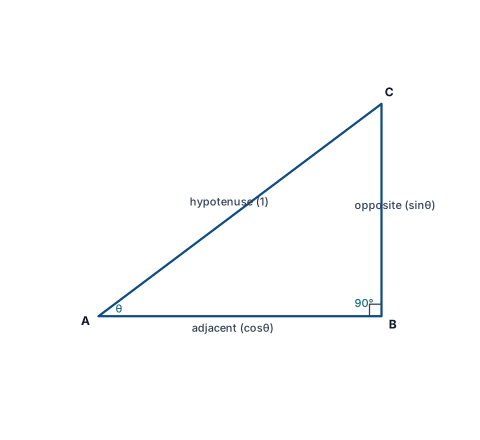
On the unit circle (or from the right-triangle definitions), we have:

sinθ=oppositehypotenuse,cosθ=adjacenthypotenuse\sin\theta = \frac{\text{opposite}}{\text{hypotenuse}}, \quad \cos\theta = \frac{\text{adjacent}}{\text{hypotenuse}}

Dividing gives:

sinθcosθ=oppositeadjacent=tanθ\frac{\sin\theta}{\cos\theta} = \frac{\text{opposite}}{\text{adjacent}} = \tan\theta

This is true for all θ\theta where cosθ0\cos\theta \neq 0 (i.e. θ90°,270°,\theta \neq 90°, 270°, \ldots).

The Pythagorean Identity

On the unit circle, a point at angle θ\theta has coordinates (cosθ,sinθ)(\cos\theta,\, \sin\theta). Since it lies on the circle x2+y2=1x^2 + y^2 = 1:

cos2θ+sin2θ=1\cos^2\theta + \sin^2\theta = 1

conventionally written as sin2θ+cos2θ1\sin^2\theta + \cos^2\theta \equiv 1.

Two Rearrangements You Must Know

These rearrangements are used constantly and must be recalled instantly:

sin2θ1cos2θ\sin^2\theta \equiv 1 - \cos^2\theta
cos2θ1sin2θ\cos^2\theta \equiv 1 - \sin^2\theta

Key Formulae & Definitions

The two fundamental identities:

sinθcosθtanθ(cosθ0)\frac{\sin\theta}{\cos\theta} \equiv \tan\theta \qquad (\cos\theta \neq 0)
sin2θ+cos2θ1\sin^2\theta + \cos^2\theta \equiv 1

Derived rearrangements:

sin2θ1cos2θ\sin^2\theta \equiv 1 - \cos^2\theta
cos2θ1sin2θ\cos^2\theta \equiv 1 - \sin^2\theta

Notation: The symbol \equiv (identity) is preferred over == when the relation holds for all valid θ\theta. In the 9709 exam you may use either, but \equiv signals mathematical precision.


Worked Examples

Example 1 — Proving an Identity

Prove that 1cos2θcos2θtan2θ\dfrac{1 - \cos^2\theta}{\cos^2\theta} \equiv \tan^2\theta.

Step 1: Work on the left-hand side (LHS) only.

LHS=1cos2θcos2θ\text{LHS} = \frac{1 - \cos^2\theta}{\cos^2\theta}

Step 2: Apply sin2θ+cos2θ1\sin^2\theta + \cos^2\theta \equiv 1, so 1cos2θsin2θ1 - \cos^2\theta \equiv \sin^2\theta:

=sin2θcos2θ= \frac{\sin^2\theta}{\cos^2\theta}

Step 3: Write as a square of a fraction:

=(sinθcosθ)2= \left(\frac{\sin\theta}{\cos\theta}\right)^2

Step 4: Apply sinθcosθtanθ\dfrac{\sin\theta}{\cos\theta} \equiv \tan\theta:

=tan2θ=RHS= \tan^2\theta = \text{RHS} \qquad \blacksquare

Example 2 — Solving an Equation

Solve 2sin2θcosθ1=02\sin^2\theta - \cos\theta - 1 = 0 for 0°θ360°0° \leq \theta \leq 360°.

Step 1: The equation mixes sin2θ\sin^2\theta and cosθ\cos\theta. Replace sin2θ\sin^2\theta using sin2θ1cos2θ\sin^2\theta \equiv 1 - \cos^2\theta:

2(1cos2θ)cosθ1=02(1 - \cos^2\theta) - \cos\theta - 1 = 0

Step 2: Expand and collect:

22cos2θcosθ1=02 - 2\cos^2\theta - \cos\theta - 1 = 0
2cos2θcosθ+1=0-2\cos^2\theta - \cos\theta + 1 = 0

Step 3: Multiply through by 1-1:

2cos2θ+cosθ1=02\cos^2\theta + \cos\theta - 1 = 0

Step 4: Factorise as a quadratic in cosθ\cos\theta. Let c=cosθc = \cos\theta:

2c2+c1=(2c1)(c+1)=02c^2 + c - 1 = (2c - 1)(c + 1) = 0

Step 5: Solve each factor:

cosθ=12θ=60°,  300°\cos\theta = \tfrac{1}{2} \quad \Rightarrow \quad \theta = 60°,\; 300°
cosθ=1θ=180°\cos\theta = -1 \quad \Rightarrow \quad \theta = 180°

Answer: θ=60°,  180°,  300°\theta = 60°,\; 180°,\; 300°


Example 3 — Simplifying an Expression

Simplify sin2θ+cos2θ+tan2θcos2θ\sin^2\theta + \cos^2\theta + \tan^2\theta\cos^2\theta.

Step 1: Apply the Pythagorean identity to the first two terms:

sin2θ+cos2θ=1\sin^2\theta + \cos^2\theta = 1

So the expression becomes 1+tan2θcos2θ1 + \tan^2\theta\cos^2\theta.

Step 2: Replace tan2θ\tan^2\theta with sin2θcos2θ\dfrac{\sin^2\theta}{\cos^2\theta}:

1+sin2θcos2θcos2θ=1+sin2θ1 + \frac{\sin^2\theta}{\cos^2\theta} \cdot \cos^2\theta = 1 + \sin^2\theta

Simplified result: 1+sin2θ1 + \sin^2\theta


Common Mistakes & Examiner Pitfalls

MistakeWhy it's wrongCorrect approach
Writing sin2θ=(sinθ)2\sin^2\theta = (\sin\theta)^2 as sinθ2\sin\theta^2sinθ2\sin\theta^2 means sin(θ2)\sin(\theta^2), which is differentAlways write sin2θ\sin^2\theta or (sinθ)2(\sin\theta)^2
Dividing by sinθ\sin\theta or cosθ\cos\theta without checking they're non-zeroYou may lose solutions (e.g. θ=0°\theta = 0°)Factorise instead of dividing
Trying to prove an identity by working on both sides simultaneouslyThis is not valid proof structureWork on one side (usually LHS) and reach the other
Using sin2θ+cos2θ=1\sin^2\theta + \cos^2\theta = 1 to write sinθ+cosθ=1\sin\theta + \cos\theta = 1Taking the square root does not remove the squares like thisThe identity involves squared terms only
Forgetting to apply the identity before solving — leaving a mixed-function equationYou cannot solve an equation with both sin2θ\sin^2\theta and cosθ\cos\theta directlyAlways reduce to a single trig function first
Missing solutions in a given intervalStopping after the principal valueAlways consider all quadrants in the given range

Practice Questions

Q1. Prove the identity: sin2θ1cosθ1+cosθ\dfrac{\sin^2\theta}{1 - \cos\theta} \equiv 1 + \cos\theta

<details><summary>Show answer</summary>

LHS =sin2θ1cosθ= \dfrac{\sin^2\theta}{1 - \cos\theta}

Apply sin2θ1cos2θ\sin^2\theta \equiv 1 - \cos^2\theta:

=1cos2θ1cosθ= \frac{1 - \cos^2\theta}{1 - \cos\theta}

Factorise the numerator as a difference of two squares:

=(1cosθ)(1+cosθ)1cosθ= \frac{(1 - \cos\theta)(1 + \cos\theta)}{1 - \cos\theta}

Cancel (1cosθ)(1 - \cos\theta) (valid since cosθ1\cos\theta \neq 1):

=1+cosθ=RHS= 1 + \cos\theta = \text{RHS} \qquad \blacksquare
</details>

Q2. Solve 3sin2θ=2cosθ3\sin^2\theta = 2 - \cos\theta for 0°θ360°0° \leq \theta \leq 360°.

<details><summary>Show answer</summary>

Replace sin2θ\sin^2\theta with 1cos2θ1 - \cos^2\theta:

3(1cos2θ)=2cosθ3(1 - \cos^2\theta) = 2 - \cos\theta
33cos2θ=2cosθ3 - 3\cos^2\theta = 2 - \cos\theta
3cos2θcosθ1=03\cos^2\theta - \cos\theta - 1 = 0

Using the quadratic formula with c=cosθc = \cos\theta:

c=1±1+126=1±136c = \frac{1 \pm \sqrt{1 + 12}}{6} = \frac{1 \pm \sqrt{13}}{6}
c=1+1360.7676θ39.8°,  320.2°c = \frac{1 + \sqrt{13}}{6} \approx 0.7676 \quad \Rightarrow \quad \theta \approx 39.8°,\; 320.2°
c=11360.4343θ115.7°,  244.3°c = \frac{1 - \sqrt{13}}{6} \approx -0.4343 \quad \Rightarrow \quad \theta \approx 115.7°,\; 244.3°

Answers (to 1 d.p.): θ39.8°,  115.7°,  244.3°,  320.2°\theta \approx 39.8°,\; 115.7°,\; 244.3°,\; 320.2°

</details>

Q3. Simplify sin2θ+sinθcosθcos2θcosθsinθ\dfrac{\sin^2\theta + \sin\theta\cos\theta}{\cos^2\theta - \cos\theta\sin\theta}.

<details><summary>Show answer</summary>

Factor numerator and denominator:

sinθ(sinθ+cosθ)cosθ(cosθsinθ)\frac{\sin\theta(\sin\theta + \cos\theta)}{\cos\theta(\cos\theta - \sin\theta)}

This does not simplify to a standard identity directly, but we can write:

=sinθcosθsinθ+cosθcosθsinθ=tanθsinθ+cosθcosθsinθ= \frac{\sin\theta}{\cos\theta} \cdot \frac{\sin\theta + \cos\theta}{\cos\theta - \sin\theta} = \tan\theta \cdot \frac{\sin\theta + \cos\theta}{\cos\theta - \sin\theta}

Dividing numerator and denominator of the fraction by cosθ\cos\theta:

=tanθtanθ+11tanθ= \tan\theta \cdot \frac{\tan\theta + 1}{1 - \tan\theta}
=tanθ(tanθ+1)1tanθ=tan2θ+tanθ1tanθ= \frac{\tan\theta(\tan\theta + 1)}{1 - \tan\theta} = \frac{\tan^2\theta + \tan\theta}{1 - \tan\theta}
</details>

Q4. Given that sinθ=35\sin\theta = \dfrac{3}{5} and θ\theta is acute, find the exact values of cosθ\cos\theta and tanθ\tan\theta.

<details><summary>Show answer</summary>

Use sin2θ+cos2θ1\sin^2\theta + \cos^2\theta \equiv 1:

cos2θ=1(35)2=1925=1625\cos^2\theta = 1 - \left(\frac{3}{5}\right)^2 = 1 - \frac{9}{25} = \frac{16}{25}

Since θ\theta is acute, cosθ>0\cos\theta > 0:

cosθ=45\cos\theta = \frac{4}{5}

Apply tanθsinθcosθ\tan\theta \equiv \dfrac{\sin\theta}{\cos\theta}:

tanθ=3/54/5=34\tan\theta = \frac{3/5}{4/5} = \frac{3}{4}
</details>

Q5. Prove that (sinθ+cosθ)21+2sinθcosθ(\sin\theta + \cos\theta)^2 \equiv 1 + 2\sin\theta\cos\theta.

<details><summary>Show answer</summary>

Expand the LHS:

(sinθ+cosθ)2=sin2θ+2sinθcosθ+cos2θ(\sin\theta + \cos\theta)^2 = \sin^2\theta + 2\sin\theta\cos\theta + \cos^2\theta

Apply sin2θ+cos2θ1\sin^2\theta + \cos^2\theta \equiv 1:

=1+2sinθcosθ=RHS= 1 + 2\sin\theta\cos\theta = \text{RHS} \qquad \blacksquare
</details>

Connections

Prerequisite knowledge used here:

  • Graphs of Trigonometric Functions — understanding where sinθ\sin\theta, cosθ\cos\theta, and tanθ\tan\theta are positive or negative (CAST diagram) is essential when solving equations and finding all solutions in a given interval.

What these identities unlock next:

  • Further Trigonometric Identities — the double-angle formulae (sin2θ\sin 2\theta, cos2θ\cos 2\theta) are derived by applying these two identities, making this note a direct prerequisite.
  • Solving More Complex Trigonometric Equations — equations involving tan2θ\tan^2\theta are routinely simplified by substituting tan2θsin2θcos2θ\tan^2\theta \equiv \dfrac{\sin^2\theta}{\cos^2\theta} or using the Pythagorean identity in the form sec2θ1+tan2θ\sec^2\theta \equiv 1 + \tan^2\theta (Pure Mathematics 3).
  • Integration and Differentiation of Trigonometric Functions — in later units, sin2θ+cos2θ1\sin^2\theta + \cos^2\theta \equiv 1 appears when verifying derivatives and in integration by substitution.

Figures
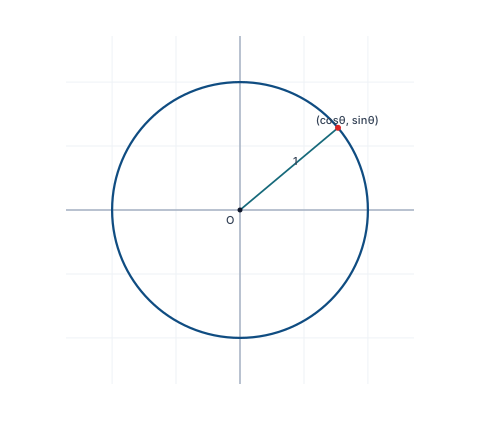
Unit circle showing a point at angle theta with coordinates (cos theta, sin theta), illustrating the geometric origin of both identities.
The unit circle: a point at angle θ has coordinates (cos θ, sin θ). Since x² + y² = 1, we immediately obtain sin²θ + cos²θ ≡ 1.
Right-angled triangle with hypotenuse labelled r, opposite side labelled sin theta times r and adjacent side labelled cos theta times r, showing derivation of the quotient identity.
Right-triangle derivation: dividing opposite by adjacent gives sin θ / cos θ = tan θ.

Keep learning

Explore CAIE A-Level Mathematics tutoring →

View the full Mathematics syllabus →

Part of Novark's free CAIE A-Level Mathematics notes