Introduction
Trigonometric graphs are fundamental to Pure Mathematics 1 and appear repeatedly throughout the 9709 course. Understanding their shapes, key features, and behaviour for angles of any size — positive, negative, and beyond (or radians) — allows you to solve trigonometric equations graphically, identify the number of solutions in a given interval, and interpret transformations. Examiners regularly test whether candidates can produce accurate sketches annotated with correct coordinates, and whether they understand periodicity and symmetry.
Core Concept
The three core trigonometric functions — sine, cosine, and tangent — are defined for all angles, not merely the acute angles of right-angled triangles. By considering angles on a unit circle, each function generates a characteristic wave (or repeating pattern) as the angle varies continuously.
The Sine Function:
- Domain: all real numbers ()
- Range:
- Period: (or rad)
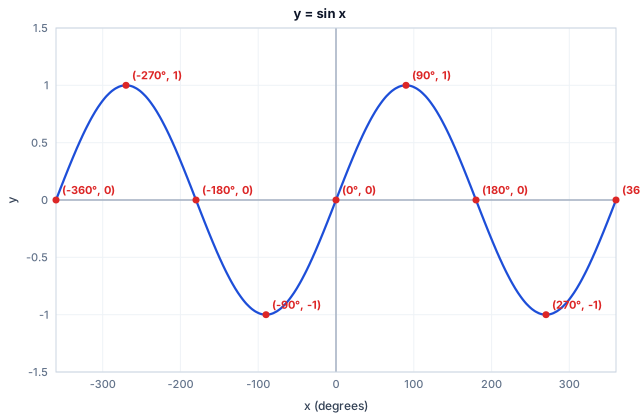
- The graph passes through the origin, rises to a maximum of at (), returns to at (), falls to a minimum of at (), and completes one full cycle at ().
- Symmetry: odd function — (rotational symmetry about the origin).
The Cosine Function:
- Domain: all real numbers
- Range:
- Period: (or rad)
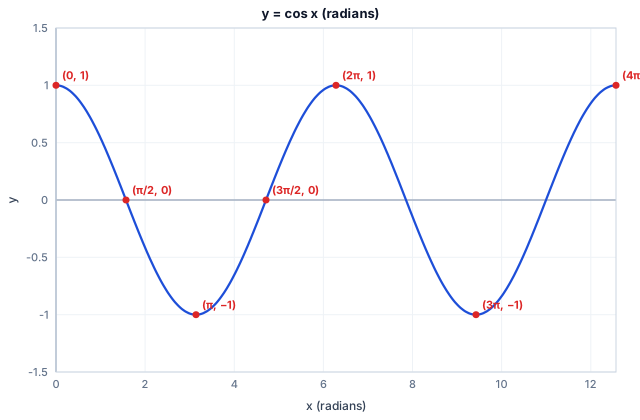
- The graph starts at a maximum of when , falls to at , reaches a minimum of at , returns to at , and completes one cycle at .
- Symmetry: even function — (line symmetry about the -axis).
- Key relationship: ; the cosine graph is the sine graph shifted to the left.
The Tangent Function:
- Domain: all real numbers except for integer (i.e. )
- Range: all real numbers ()
- Period: (or rad) — half that of sine and cosine
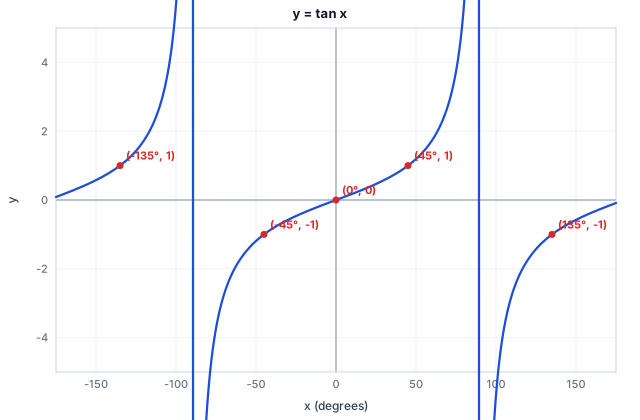
- The graph passes through the origin, increases without bound as , and has vertical asymptotes at
- Symmetry: odd function — .
Key Formulae & Definitions
| Function | Period | Amplitude | Range | Asymptotes |
|---|---|---|---|---|
| None | ||||
| None | ||||
| Undefined |
Worked Examples
Example 1 — Sketching for and reading off solutions
Question: Sketch for and hence state all values of in this interval for which .
Step 1 — Establish key coordinates.
Mark the -intercepts: .
Mark the maxima: and , where .
Mark the minima: and , where .
Step 2 — Draw a smooth, continuous wave passing through all these points, with the curve rising from to and falling symmetrically.
Step 3 — Draw the horizontal line and identify intersections.
Using the calculator (or known value): .
In the range to : solutions are and .
Extend to negative angles using the odd symmetry , so in to :
at and ...
Let's verify directly: ✓ and ✓
Answer:
Example 2 — Sketching in radians and counting solutions
Question: Sketch for and state the number of solutions of in this interval.
Step 1 — Key coordinates in radians:
Step 2 — Sketch a smooth cosine wave over two full periods .
Step 3 — Draw as a horizontal line.
Step 4 — Identify intersections.
.
In : solutions are and .
In (second period): add to each, giving and .
Answer: There are 4 solutions in .
Example 3 — Using the tangent graph
Question: By sketching for , state all solutions of .
Step 1 — Note asymptotes at and ; the curve passes through , , and increases from to in each branch.
Step 2 — Draw . The line crosses the curve once per period.
Step 3 — First solution: .
Second solution (left branch): .
Answer: and .
Common Mistakes & Examiner Pitfalls
- Confusing the period of tan with sin/cos. Tangent has period ( rad), not . Candidates often draw only one solution per for tan equations, halving the answer.
- Forgetting negative angles. When the interval includes negative values (e.g. ), the periodic and symmetry properties must be applied in both directions. Always check the full stated interval.
- Incorrect range endpoints on sketches. Marks are awarded for correctly labelled intercepts and turning points. Leaving a sketch unlabelled loses method marks.
- Asymptotes drawn as solid curves. Asymptotes of must be drawn as dashed vertical lines, not solid ones, and must not be touched by the curve.
- Mixing degrees and radians. If the question states radians, use -based labels on the -axis; if degrees, use degree labels. Mixing the two in one sketch is penalised.
- Amplitude errors for and . The range is ; the graph must never exceed or go below . Drawing peaks above or troughs below is a common sketch error.
Practice Questions
Q1. Sketch for , labelling all intercepts and turning points. Hence solve for .
Show answer
Key points on the sketch: , , , , .
.
Since (negative), solutions lie in the third and fourth quadrants:
Q2. Sketch for and hence solve for .
Show answer
Key points: , , , , .
.
Since cosine is even ():
Q3. Sketch for (excluding the asymptotes), clearly showing the asymptotes. Hence state the number of solutions of in .
Show answer
The sketch has two branches: one for and one for and one for .
Asymptotes at and (dashed vertical lines).
The horizontal line crosses each of the two branches once (once in and once in ).
There are 2 solutions in .
Using the calculator: , so the solutions are approximately:
Q4. How many solutions does have in the interval ? Justify your answer with reference to the graph.
Show answer
The interval covers 3 complete periods of (each period ).
In each period, the horizontal line (which lies strictly between and ) crosses the cosine curve twice (once on the way down from the maximum, once on the way back up).
Total solutions = .
Q5. Sketch and on the same axes for . Write down the -coordinates of the points where the two graphs intersect.
Show answer
The graphs intersect where , i.e. .
These are the only two intersections in . Both intersections occur at .
Connections
- Prerequisite — SOHCAHTOA and exact values: The exact values , , , etc., are essential for annotating graphs precisely and solving equations analytically rather than only by calculator.
- Next — Transformations of trigonometric graphs: Once the parent graphs are mastered, you will apply translations, stretches, and reflections to obtain graphs of , reading off new amplitudes, periods, and phase shifts.
- Next — Trigonometric identities: The identity and are read directly from the graphs' properties and become the foundation for simplifying and proving identities.
- Next — Solving trigonometric equations: The graphical understanding developed here underpins the algebraic method (principal value + symmetry/periodicity) used to find all solutions in a given interval — a major topic in its own right.
Figures