Introduction
In CAIE A-Level Mathematics (9709), a large number of trigonometry questions — from solving equations to proving identities and integrating trigonometric functions — require you to evaluate expressions without a calculator. The syllabus explicitly demands that you know the exact values of , , and for , , , and any related angle obtained by reflection or rotation into other quadrants. Exact values keep answers in surd form, which is always required unless a decimal approximation is explicitly asked for. Memorising these values (and knowing how to derive them) earns marks efficiently throughout the paper.
Core Concept
Deriving the values geometrically
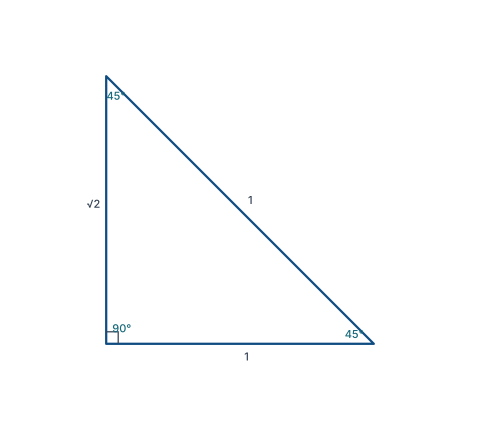
45° — the isosceles right-angled triangle
Take a right-angled isosceles triangle with the two equal legs each of length . By Pythagoras, the hypotenuse is . Both acute angles are .
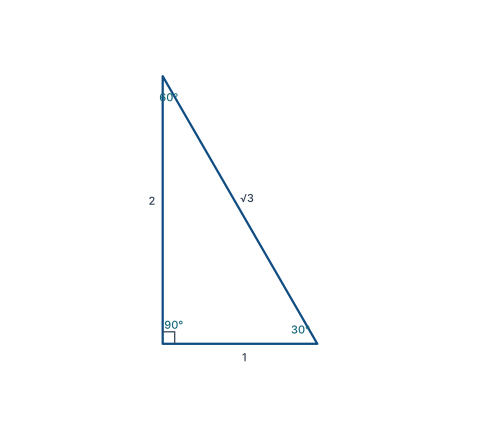
30° and 60° — the equilateral triangle
Take an equilateral triangle with side length . Drop a perpendicular from one vertex to the opposite side. This bisects the base (giving ) and the apex angle. The perpendicular has length (by Pythagoras: ). The two triangles formed each have angles , , .
Reading off from these two triangles gives all six values below.
Related angles and the CAST diagram
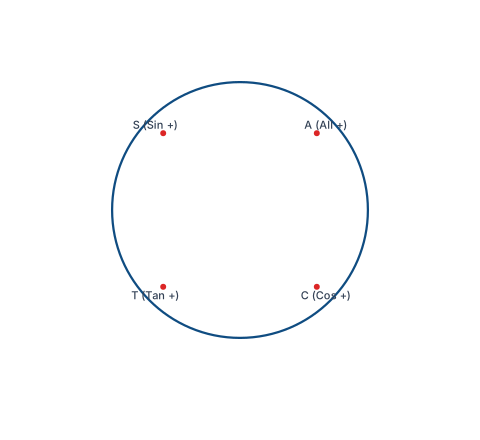
For angles beyond –, use the CAST rule: only the labelled ratios are positive in each quadrant.
- First quadrant (–): All positive.
- Second quadrant (–): Sine positive.
- Third quadrant (–): Tangent positive.
- Fourth quadrant (–): Cosine positive.
The reference angle (the acute angle to the nearest part of the -axis) is used to find the magnitude; the quadrant determines the sign.
| Angle | Related angle | Rule |
|---|---|---|
| , | ||
| , | ||
| , |
Negative angles follow the same pattern: , .
Key Formulae & Definitions
The fundamental exact values
| Angle | |||
|---|---|---|---|
Memory tip: For sine, the values increase with the angle. Cosine is the reverse. Tangent is always .
Boundary (quadrantal) values for completeness
| Angle | |||
|---|---|---|---|
| undefined | |||
| undefined |
Worked Examples
Example 1 — Finding exact values of related angles
Find the exact value of and .
Step 1 — Identify the reference angle.
, so the reference angle is . , so the reference angle is .
Step 2 — Determine the quadrant and sign.
lies in the second quadrant: cosine is negative. lies in the third quadrant: tangent is positive.
Step 3 — Apply the sign.
Example 2 — Evaluating a trigonometric expression exactly
Without a calculator, evaluate .
Step 1 — Find each exact value.
→ second quadrant →
→ second quadrant →
→ second quadrant →
Step 2 — Substitute.
Step 3 — Simplify.
Example 3 — Solving a trigonometric equation using exact values
Solve for .
Step 1 — Recognise the exact value.
, so the reference angle is .
Step 2 — Cosine is negative in the second and third quadrants.
Answer: or .
Common Mistakes & Examiner Pitfalls
-
Swapping sin and cos for 30° and 60°. Remember: (small angle, small value) and (larger angle, larger value). Cosine is the opposite order.
-
Forgetting to rationalise the denominator. Examiners expect or , not or as a final answer.
-
Incorrect sign in a related quadrant. Always identify the quadrant first, then assign the sign. A common error is writing (forgetting the negative in Q2).
-
Using or . These are undefined — do not attempt to assign a value.
-
Mixing degrees and radians. If the question uses radians (e.g. , , ), the exact values are identical in magnitude; apply the same CAST reasoning.
-
Missing solutions in a given interval. When solving equations, always check all relevant quadrants, not just the principal value.
Practice Questions
Q1. Write down the exact value of .
Show answer
, so the reference angle is . is in the fourth quadrant: sine is negative.
Q2. Find the exact value of .
Show answer
Q3. Solve for .
Show answer
Reference angle: , so reference angle .
Tangent is negative in the second and fourth quadrants.
Answer: or .
Q4. Without a calculator, show that .
Show answer
(Note: this is the compound angle formula for — a useful connection.)
Q5. Find all values of in the interval satisfying .
Show answer
Reference angle: , so reference angle .
Sine is positive in the first and second quadrants.
Within :
Answer: or .
Connections
- Prerequisite — Basic right-angle trigonometry (SOHCAHTOA): The geometric derivations of exact values rely directly on reading ratios from labelled right-angled triangles.
- Next — The sine and cosine rules: Problems combining these rules with non-right-angled triangles frequently require exact values at the substitution step.
- Next — Trigonometric identities (): Verifying identities is far cleaner when exact values are substituted without rounding.
- Next — Graphs of trigonometric functions: Recognising the key coordinates on , , uses exact values at the standard angles.
- Next — Solving trigonometric equations: Every equation whose solutions lie at , , (or related angles) demands these exact values; CAST and symmetry arguments build directly on this topic.
- Later — Integration of and (Pure 2): Definite integrals between these special angles yield exact answers only when the exact values are known.
Figures