CAIE A-Level · Mathematics 9709 · Trigonometry

Inverse Trigonometric Functions: Principal Values (sin⁻¹x, cos⁻¹x, tan⁻¹x)

8 min readSyllabus 1.5FreeBy Uzair Khan

Syllabus objective

Use the notations sin⁻¹x, cos⁻¹x, tan⁻¹x to denote the principal values of the inverse trigonometric relations.

Introduction

The trigonometric functions sinx\sin x, cosx\cos x, and tanx\tan x are many-to-one — many different inputs give the same output. This means they do not have inverses unless we deliberately restrict their domains to a chosen interval. The resulting functions are called the inverse trigonometric functions, written sin1x\sin^{-1}x, cos1x\cos^{-1}x, and tan1x\tan^{-1}x, and the specific output interval chosen for each is called the principal value range.

In the 9709 exam, questions routinely ask you to evaluate inverse trig expressions, solve equations whose solutions must lie in a specified interval, or identify the range of an inverse trig function — all of which require a precise understanding of principal values and the correct notation.

Important notation warning: sin1x\sin^{-1}x does not mean 1sinx\dfrac{1}{\sin x}. The superscript 1-1 here denotes the inverse function, not a reciprocal. The reciprocal of sinx\sin x is written cosecx\cosec x.


Core Concept

Because sin\sin, cos\cos, and tan\tan are periodic and many-to-one, we must restrict each to a one-to-one piece of its graph before an inverse function can exist. The restricted intervals chosen are the conventional principal value domains.

FunctionRestricted domainPrincipal value range of inverse
y=sinxy = \sin xπ2xπ2-\dfrac{\pi}{2} \leq x \leq \dfrac{\pi}{2}π2sin1xπ2-\dfrac{\pi}{2} \leq \sin^{-1}x \leq \dfrac{\pi}{2}
y=cosxy = \cos x0xπ0 \leq x \leq \pi0cos1xπ0 \leq \cos^{-1}x \leq \pi
y=tanxy = \tan xπ2<x<π2-\dfrac{\pi}{2} < x < \dfrac{\pi}{2}π2<tan1x<π2-\dfrac{\pi}{2} < \tan^{-1}x < \dfrac{\pi}{2}

The domain of each inverse function is the range of the original restricted function:

Inverse functionDomain (valid inputs)
sin1x\sin^{-1}x1x1-1 \leq x \leq 1
cos1x\cos^{-1}x1x1-1 \leq x \leq 1
tan1x\tan^{-1}xxRx \in \mathbb{R} (all real numbers)

Graphically, each inverse function is the reflection of its restricted parent curve in the line y=xy = x.


Key Formulae & Definitions

Defining relationship (valid only within the principal value range):

sin1x=θ    sinθ=x,π2θπ2\sin^{-1}x = \theta \iff \sin\theta = x, \quad -\frac{\pi}{2} \leq \theta \leq \frac{\pi}{2}
cos1x=θ    cosθ=x,0θπ\cos^{-1}x = \theta \iff \cos\theta = x, \quad 0 \leq \theta \leq \pi
tan1x=θ    tanθ=x,π2<θ<π2\tan^{-1}x = \theta \iff \tan\theta = x, \quad -\frac{\pi}{2} < \theta < \frac{\pi}{2}

Cancellation identities (only when the argument is in the principal range):

sin(sin1x)=xsin1(sinθ)=θ only if π2θπ2\sin(\sin^{-1}x) = x \qquad \sin^{-1}(\sin\theta) = \theta \text{ only if } -\tfrac{\pi}{2} \leq \theta \leq \tfrac{\pi}{2}

Useful exact values drawn from standard triangles:

sin1 ⁣(12)=π6,cos1 ⁣(12)=π3,tan1(1)=π4\sin^{-1}\!\left(\tfrac{1}{2}\right) = \frac{\pi}{6}, \quad \cos^{-1}\!\left(\tfrac{1}{2}\right) = \frac{\pi}{3}, \quad \tan^{-1}(1) = \frac{\pi}{4}
sin1 ⁣(32)=π3,cos1 ⁣(1)=π,tan1 ⁣(3)=π3\sin^{-1}\!\left(\tfrac{\sqrt{3}}{2}\right) = \frac{\pi}{3}, \quad \cos^{-1}\!\left(-1\right) = \pi, \quad \tan^{-1}\!\left(-\sqrt{3}\right) = -\frac{\pi}{3}

Worked Examples

Example 1 — Evaluating an inverse trig expression exactly

Find the exact value of cos1 ⁣(22)\cos^{-1}\!\left(-\dfrac{\sqrt{2}}{2}\right), giving your answer in radians.

Step 1: Let θ=cos1 ⁣(22)\theta = \cos^{-1}\!\left(-\dfrac{\sqrt{2}}{2}\right). By definition, cosθ=22\cos\theta = -\dfrac{\sqrt{2}}{2} with 0θπ0 \leq \theta \leq \pi.

Step 2: Identify the reference angle. We know cosπ4=22\cos\dfrac{\pi}{4} = \dfrac{\sqrt{2}}{2}, so the reference angle is π4\dfrac{\pi}{4}.

Step 3: Since cosθ\cos\theta is negative and θ\theta must lie in [0,π][0, \pi], the angle is in the second quadrant:

θ=ππ4=3π4\theta = \pi - \frac{\pi}{4} = \frac{3\pi}{4}

Answer: cos1 ⁣(22)=3π4\cos^{-1}\!\left(-\dfrac{\sqrt{2}}{2}\right) = \dfrac{3\pi}{4}


Example 2 — Applying the principal value correctly in an equation

Solve sin1(2x1)=π6\sin^{-1}(2x - 1) = -\dfrac{\pi}{6}, giving an exact answer.

Step 1: Apply sin\sin to both sides (the inverse relationship).

2x1=sin ⁣(π6)2x - 1 = \sin\!\left(-\frac{\pi}{6}\right)

Step 2: Evaluate sin ⁣(π6)\sin\!\left(-\dfrac{\pi}{6}\right).

sin ⁣(π6)=12\sin\!\left(-\frac{\pi}{6}\right) = -\frac{1}{2}

Step 3: Solve the linear equation.

2x1=12    2x=12    x=142x - 1 = -\frac{1}{2} \implies 2x = \frac{1}{2} \implies x = \frac{1}{4}

Step 4 (check domain): The input to sin1\sin^{-1} must satisfy 12x11-1 \leq 2x-1 \leq 1, i.e. 0x10 \leq x \leq 1. Since x=14x = \dfrac{1}{4}, this is valid. ✓

Answer: x=14x = \dfrac{1}{4}


Example 3 — Evaluating a composite expression

Find the exact value of sin ⁣(cos1 ⁣(35))\sin\!\left(\cos^{-1}\!\left(\dfrac{3}{5}\right)\right).

Step 1: Let α=cos1 ⁣(35)\alpha = \cos^{-1}\!\left(\dfrac{3}{5}\right), so cosα=35\cos\alpha = \dfrac{3}{5} with 0απ0 \leq \alpha \leq \pi.

Step 2: Use the Pythagorean identity sin2α+cos2α=1\sin^2\alpha + \cos^2\alpha = 1.

sin2α=1(35)2=1925=1625\sin^2\alpha = 1 - \left(\frac{3}{5}\right)^2 = 1 - \frac{9}{25} = \frac{16}{25}

Step 3: Since α[0,π]\alpha \in [0, \pi], sinα0\sin\alpha \geq 0, so we take the positive root.

sinα=45\sin\alpha = \frac{4}{5}

Answer: sin ⁣(cos1 ⁣(35))=45\sin\!\left(\cos^{-1}\!\left(\dfrac{3}{5}\right)\right) = \dfrac{4}{5}


Common Mistakes & Examiner Pitfalls

  • Confusing sin1x\sin^{-1}x with (sinx)1(\sin x)^{-1}: Remember, sin1x\sin^{-1}x is the inverse function; (sinx)1=cosecx(\sin x)^{-1} = \cosec x. These are entirely different.

  • Ignoring the principal value range: If asked for sin1 ⁣(12)\sin^{-1}\!\left(-\dfrac{1}{2}\right), a common error is to write 7π6\dfrac{7\pi}{6} or 11π6\dfrac{11\pi}{6} (from the unit circle). The correct answer is π6-\dfrac{\pi}{6}, since the range of sin1\sin^{-1} is [π2,π2]\left[-\dfrac{\pi}{2}, \dfrac{\pi}{2}\right].

  • Using degrees when radians are expected: Unless a question explicitly asks for degrees, work in radians. The principal value ranges are defined in radians in the 9709 syllabus.

  • Misapplying the cancellation identity: sin1(sinθ)=θ\sin^{-1}(\sin\theta) = \theta is only true if θ[π2,π2]\theta \in \left[-\dfrac{\pi}{2}, \dfrac{\pi}{2}\right]. For example, sin1 ⁣(sin2π3)2π3\sin^{-1}\!\left(\sin\dfrac{2\pi}{3}\right) \neq \dfrac{2\pi}{3}; the correct value is π3\dfrac{\pi}{3}.

  • tan1x\tan^{-1}x has open endpoints: The range of tan1x\tan^{-1}x is the open interval (π2,π2)\left(-\dfrac{\pi}{2}, \dfrac{\pi}{2}\right) — it never actually reaches ±π2\pm\dfrac{\pi}{2}.


Practice Questions

Q1. Write down the exact value of tan1(1)\tan^{-1}(-1) in radians.

<details><summary>Show answer</summary>

Let θ=tan1(1)\theta = \tan^{-1}(-1), so tanθ=1\tan\theta = -1 with π2<θ<π2-\dfrac{\pi}{2} < \theta < \dfrac{\pi}{2}.

The reference angle satisfying tanθ=1\tan\theta = 1 is π4\dfrac{\pi}{4}. Since the value is negative and the range includes the interval (π2,0)\left(-\dfrac{\pi}{2}, 0\right):

θ=π4\theta = -\frac{\pi}{4}
</details>

Q2. Find the exact value of cos ⁣(sin1 ⁣(513))\cos\!\left(\sin^{-1}\!\left(-\dfrac{5}{13}\right)\right).

<details><summary>Show answer</summary>

Let α=sin1 ⁣(513)\alpha = \sin^{-1}\!\left(-\dfrac{5}{13}\right), so sinα=513\sin\alpha = -\dfrac{5}{13} with π2απ2-\dfrac{\pi}{2} \leq \alpha \leq \dfrac{\pi}{2}.

Using cos2α=1sin2α\cos^2\alpha = 1 - \sin^2\alpha:

cos2α=125169=144169\cos^2\alpha = 1 - \frac{25}{169} = \frac{144}{169}

Since α[π2,π2]\alpha \in \left[-\dfrac{\pi}{2}, \dfrac{\pi}{2}\right], cosα0\cos\alpha \geq 0, so:

cosα=1213\cos\alpha = \frac{12}{13}
</details>

Q3. Solve cos1(3x+1)=2π3\cos^{-1}(3x + 1) = \dfrac{2\pi}{3}, giving your answer as an exact fraction.

<details><summary>Show answer</summary>

Apply cos\cos to both sides:

3x+1=cos ⁣(2π3)=123x + 1 = \cos\!\left(\frac{2\pi}{3}\right) = -\frac{1}{2}
3x=32    x=123x = -\frac{3}{2} \implies x = -\frac{1}{2}

Check domain: input to cos1\cos^{-1} must satisfy 13x+11-1 \leq 3x+1 \leq 1, i.e. 23x0-\dfrac{2}{3} \leq x \leq 0. Since x=12[23,0]x = -\dfrac{1}{2} \in \left[-\dfrac{2}{3}, 0\right], valid. ✓

</details>

Q4. State whether each of the following is defined. If it is, find the exact principal value; if not, explain why.

(a) sin1(1.5)\sin^{-1}(1.5) \quad (b) cos1(0)\cos^{-1}(0) \quad (c) tan1(3)\tan^{-1}(-\sqrt{3})

<details><summary>Show answer</summary>

(a) sin1(1.5)\sin^{-1}(1.5)Not defined. The domain of sin1\sin^{-1} is [1,1][-1, 1], and 1.5>11.5 > 1.

(b) cos1(0)\cos^{-1}(0): we need cosθ=0\cos\theta = 0 with 0θπ0 \leq \theta \leq \pi. This gives θ=π2\theta = \dfrac{\pi}{2}.

(c) tan1(3)\tan^{-1}(-\sqrt{3}): we need tanθ=3\tan\theta = -\sqrt{3} with π2<θ<π2-\dfrac{\pi}{2} < \theta < \dfrac{\pi}{2}. Reference angle: tanπ3=3\tan\dfrac{\pi}{3} = \sqrt{3}, so θ=π3\theta = -\dfrac{\pi}{3}.

</details>

Q5. Given that sin1(sinθ)=θ\sin^{-1}(\sin\theta) = \theta only when θ\theta is in the principal value range, find sin1 ⁣(sin5π6)\sin^{-1}\!\left(\sin\dfrac{5\pi}{6}\right).

<details><summary>Show answer</summary>

5π6\dfrac{5\pi}{6} is outside the principal value range [π2,π2]\left[-\dfrac{\pi}{2}, \dfrac{\pi}{2}\right], so we cannot apply the cancellation identity directly.

Instead, evaluate sin5π6\sin\dfrac{5\pi}{6} first:

sin5π6=sin ⁣(ππ6)=sinπ6=12\sin\frac{5\pi}{6} = \sin\!\left(\pi - \frac{\pi}{6}\right) = \sin\frac{\pi}{6} = \frac{1}{2}

Now apply the inverse:

sin1 ⁣(12)=π6\sin^{-1}\!\left(\frac{1}{2}\right) = \frac{\pi}{6}
</details>

Connections

  • Prerequisite — Graphs of Trigonometric Functions: Understanding that sinx\sin x, cosx\cos x, and tanx\tan x are periodic and many-to-one is essential to justify why domain restriction is necessary. The shape of each inverse graph is the reflection of its restricted parent in y=xy = x.

  • Solving Trigonometric Equations: When solving equations such as sinx=k\sin x = k over a given interval, sin1k\sin^{-1}k gives the principal value first solution; you then use symmetry and periodicity of the original function to find all solutions in the required range.

  • Calculus (Pure Mathematics 2/3): The inverse trigonometric functions appear in differentiation and integration; their derivatives ddxsin1x=11x2\dfrac{d}{dx}\sin^{-1}x = \dfrac{1}{\sqrt{1-x^2}} etc. depend entirely on correct understanding of the domain and range established here.

Figures
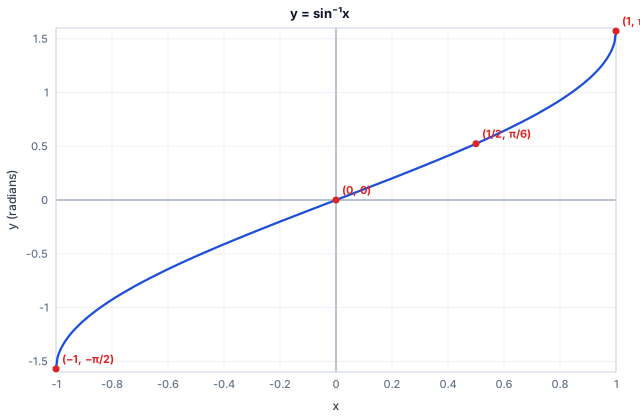
Graph of y = sin inverse x, showing a curve from (-1, -pi/2) to (1, pi/2) passing through the origin, with the principal value range marked on the y-axis.
Graph of y = sin⁻¹x. Domain: [−1, 1]; Principal value range: [−π/2, π/2]. The function is increasing throughout.
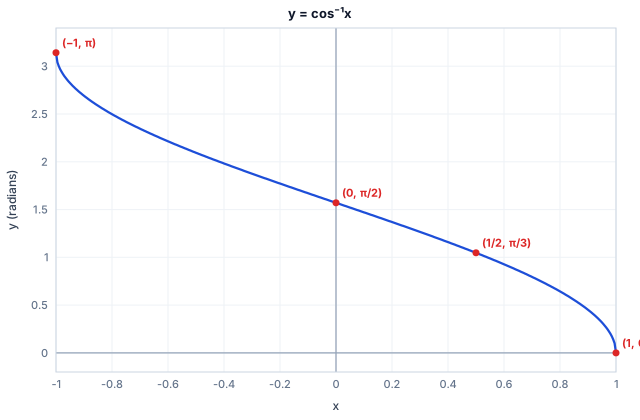
Graph of y = cos inverse x, showing a decreasing curve from (-1, pi) to (1, 0), passing through (0, pi/2), with the principal value range marked on the y-axis.
Graph of y = cos⁻¹x. Domain: [−1, 1]; Principal value range: [0, π]. The function is strictly decreasing.
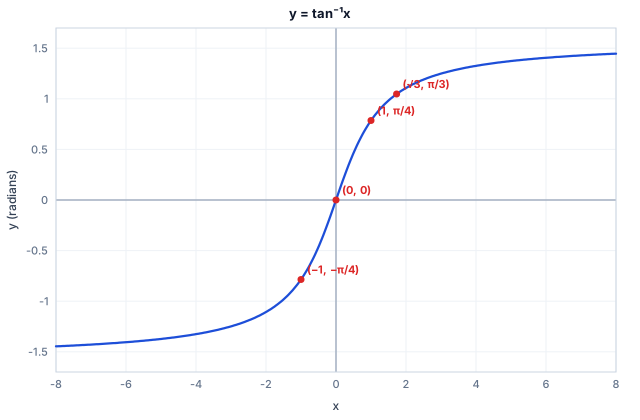
Graph of y = tan inverse x, showing an increasing curve approaching the horizontal asymptotes y = pi/2 and y = -pi/2, passing through the origin.
Graph of y = tan⁻¹x. Domain: all real numbers; Principal value range: (−π/2, π/2). Horizontal asymptotes at y = ±π/2 (dashed).

Keep learning

Explore CAIE A-Level Mathematics tutoring →

View the full Mathematics syllabus →

Part of Novark's free CAIE A-Level Mathematics notes