CAIE A-Level · Mathematics 9709 · Trigonometry

Solving Trigonometric Equations (Pure Mathematics 1)

8 min readSyllabus 1.5FreeBy Uzair Khan

Syllabus objective

Find all the solutions of simple trigonometrical equations lying in a specified interval (general forms of solution are not included).

Introduction

Trigonometric equations appear in almost every 9709 Pure Mathematics 1 paper. Unlike finding a single angle on a calculator, the exam requires you to find all solutions lying within a given interval — typically 0°θ360°0° \le \theta \le 360°, 0θ2π0 \le \theta \le 2\pi, or a shifted/scaled interval such as πθπ-\pi \le \theta \le \pi. The syllabus requires you to solve simple equations (no general formula needed), but the method must be systematic and rigorous to earn full marks.


Core Concept

The CAST Diagram and Symmetry

Every trigonometric equation of the form sinθ=k\sin\theta = k, cosθ=k\cos\theta = k, or tanθ=k\tan\theta = k has a principal value — the value your calculator returns. From this principal value, you use the symmetry of the trigonometric functions to find all other solutions in the required interval.

The CAST diagram summarises which ratios are positive in each quadrant:

QuadrantAngles (degrees)Angles (radians)Positive ratio
1st (Q1)0° to 90°90°00 to π2\tfrac{\pi}{2}All (sin, cos, tan)
2nd (Q2)90°90° to 180°180°π2\tfrac{\pi}{2} to π\piSin only
3rd (Q3)180°180° to 270°270°π\pi to 3π2\tfrac{3\pi}{2}Tan only
4th (Q4)270°270° to 360°360°3π2\tfrac{3\pi}{2} to 2π2\piCos only

Symmetry Rules

Let α\alpha denote the principal value (always taken as a positive acute angle from your calculator, i.e. α=calculator value\alpha = |\text{calculator value}|).

EquationSolutions in [0°,360°][0°, 360°]
sinθ=+k\sin\theta = +kθ=α\theta = \alpha and θ=180°α\theta = 180° - \alpha
sinθ=k\sin\theta = -kθ=180°+α\theta = 180° + \alpha and θ=360°α\theta = 360° - \alpha
cosθ=+k\cos\theta = +kθ=α\theta = \alpha and θ=360°α\theta = 360° - \alpha
cosθ=k\cos\theta = -kθ=180°α\theta = 180° - \alpha and θ=180°+α\theta = 180° + \alpha
tanθ=+k\tan\theta = +kθ=α\theta = \alpha and θ=180°+α\theta = 180° + \alpha
tanθ=k\tan\theta = -kθ=180°α\theta = 180° - \alpha and θ=360°α\theta = 360° - \alpha

The same logic applies in radians, replacing 180°180° with π\pi and 360°360° with 2π2\pi.

Equations with a Transformed Angle

When the equation involves sin(2θ)\sin(2\theta), cos(θ+30°)\cos(\theta + 30°), etc., substitute u=2θu = 2\theta (or the relevant expression), expand the interval for uu, solve for uu, then convert back to θ\theta.


Key Formulae & Definitions

Pythagorean identity (often needed to reduce equations):

sin2θ+cos2θ=1\sin^2\theta + \cos^2\theta = 1

Derived forms:

sin2θ=1cos2θ,cos2θ=1sin2θ\sin^2\theta = 1 - \cos^2\theta, \qquad \cos^2\theta = 1 - \sin^2\theta

Tangent identity (used to simplify mixed sin/cos\sin/\cos equations):

tanθ=sinθcosθ\tan\theta = \frac{\sin\theta}{\cos\theta}

Period reminders:

FunctionPeriod (degrees)Period (radians)
sinθ\sin\theta360°360°2π2\pi
cosθ\cos\theta360°360°2π2\pi
tanθ\tan\theta180°180°π\pi

Worked Examples

Example 1 — Basic equation with a double angle

Solve sin2θ=32\sin 2\theta = \dfrac{\sqrt{3}}{2} for 0°θ360°0° \le \theta \le 360°.

Step 1 — Substitute. Let u=2θu = 2\theta. The interval for θ\theta is [0°,360°][0°, 360°], so the interval for uu is [0°,720°][0°, 720°].

Step 2 — Find the principal value. sinu=32\sin u = \dfrac{\sqrt{3}}{2}, so α=60°\alpha = 60° (exact value).

Step 3 — List all solutions for uu in [0°,720°][0°, 720°]. Since sinu>0\sin u > 0, solutions lie in Q1 and Q2:

u=60°,120°,420°,480°u = 60°,\quad 120°,\quad 420°,\quad 480°

Step 4 — Convert back. θ=u2\theta = \dfrac{u}{2}:

θ=30°,60°,210°,240°\theta = 30°,\quad 60°,\quad 210°,\quad 240°

Answer: θ=30°, 60°, 210°, 240°\theta = 30°,\ 60°,\ 210°,\ 240°


Example 2 — Quadratic in cosθ\cos\theta using an identity

Solve 2cos2θ+cosθ1=02\cos^2\theta + \cos\theta - 1 = 0 for 0θ2π0 \le \theta \le 2\pi. Give answers in radians.

Step 1 — Factorise. Treat cosθ\cos\theta as the variable:

(2cosθ1)(cosθ+1)=0(2\cos\theta - 1)(\cos\theta + 1) = 0

Step 2 — Solve each factor.

Factor 1: 2cosθ1=0cosθ=122\cos\theta - 1 = 0 \Rightarrow \cos\theta = \dfrac{1}{2}

Principal value: α=π3\alpha = \dfrac{\pi}{3}. Since cosθ>0\cos\theta > 0: solutions in Q1 and Q4:

θ=π3,θ=2ππ3=5π3\theta = \frac{\pi}{3}, \quad \theta = 2\pi - \frac{\pi}{3} = \frac{5\pi}{3}

Factor 2: cosθ+1=0cosθ=1\cos\theta + 1 = 0 \Rightarrow \cos\theta = -1

This occurs at the boundary: θ=π\theta = \pi

Step 3 — Collect and order all solutions.

θ=π3,π,5π3\theta = \frac{\pi}{3},\quad \pi,\quad \frac{5\pi}{3}

Example 3 — Mixed equation reduced using tan\tan

Solve 3sinθ=2cosθ3\sin\theta = 2\cos\theta for 0°θ360°0° \le \theta \le 360°.

Step 1 — Rearrange. Divide both sides by cosθ\cos\theta (valid since cosθ=0\cos\theta = 0 gives 0=20 = 2, no solution):

tanθ=23\tan\theta = \frac{2}{3}

Step 2 — Principal value. α=tan1 ⁣(23)=33.69°\alpha = \tan^{-1}\!\left(\dfrac{2}{3}\right) = 33.69° (to 2 d.p.)

Step 3 — Solutions in [0°,360°][0°, 360°]. Since tanθ>0\tan\theta > 0: Q1 and Q3:

θ=33.7°,θ=180°+33.69°=213.7°\theta = 33.7°,\quad \theta = 180° + 33.69° = 213.7°

Answer: θ=33.7°, 213.7°\theta = 33.7°,\ 213.7° (to 1 d.p.)


Common Mistakes & Examiner Pitfalls

  1. Forgetting to expand the interval. When solving sin(2θ)=k\sin(2\theta) = k, candidates solve only in [0°,360°][0°, 360°] instead of [0°,720°][0°, 720°] and miss half the solutions. Always multiply the interval endpoints by the coefficient of θ\theta.

  2. Using the calculator value directly as both answers. The calculator gives only one solution. You must always apply the symmetry rule to find the second (and further) solution(s) in the interval.

  3. Sign errors with negative values. For sinθ=0.5\sin\theta = -0.5, the solutions are in Q3 and Q4 — not Q1 and Q2. Always determine the quadrants using CAST after noting the sign of kk.

  4. Dividing by a trig function without checking for extra solutions. If you divide by sinθ\sin\theta or cosθ\cos\theta, you may lose solutions where that function equals zero. Factorise instead wherever possible.

  5. Mixing degrees and radians. If the interval is given in radians, all solutions must be in radians. Never mix the two in the same answer.

  6. Not checking boundary values. Values like θ=0\theta = 0, π\pi, 2π2\pi are valid solutions if they satisfy the equation — don't discard them.

  7. Rounding prematurely. Keep the principal value to sufficient decimal places (or exact form) before applying symmetry rules; round only the final answers.


Practice Questions

Q1. Solve cosθ=12\cos\theta = -\dfrac{1}{\sqrt{2}} for 0°θ360°0° \le \theta \le 360°.

<details><summary>Show answer</summary>

Principal value: α=cos1 ⁣(12)=45°\alpha = \cos^{-1}\!\left(\dfrac{1}{\sqrt{2}}\right) = 45°

Since cosθ<0\cos\theta < 0: solutions in Q2 and Q3.

θ=180°45°=135°,θ=180°+45°=225°\theta = 180° - 45° = 135°, \qquad \theta = 180° + 45° = 225°

Answer: θ=135°, 225°\theta = 135°,\ 225°

</details>

Q2. Solve tan ⁣(θ30°)=1\tan\!\left(\theta - 30°\right) = 1 for 0°θ360°0° \le \theta \le 360°.

<details><summary>Show answer</summary>

Let u=θ30°u = \theta - 30°. Interval for uu: 30°u330°-30° \le u \le 330°.

tanu=1\tan u = 1, so α=45°\alpha = 45°. Period of tan is 180°180°.

Solutions for uu in [30°,330°][-30°, 330°]:

u=45°,u=45°+180°=225°u = 45°, \qquad u = 45° + 180° = 225°

(Note: u=45°180°=135°u = 45° - 180° = -135° is outside the interval.)

Convert back: θ=u+30°\theta = u + 30°:

θ=75°,θ=255°\theta = 75°, \qquad \theta = 255°

Answer: θ=75°, 255°\theta = 75°,\ 255°

</details>

Q3. Solve 2sin2θsinθ1=02\sin^2\theta - \sin\theta - 1 = 0 for 0θ2π0 \le \theta \le 2\pi. Give exact answers.

<details><summary>Show answer</summary>

Factorise: (2sinθ+1)(sinθ1)=0(2\sin\theta + 1)(\sin\theta - 1) = 0

Factor 1: sinθ=12\sin\theta = -\dfrac{1}{2}, so α=π6\alpha = \dfrac{\pi}{6}. Solutions in Q3 and Q4:

θ=π+π6=7π6,θ=2ππ6=11π6\theta = \pi + \frac{\pi}{6} = \frac{7\pi}{6}, \qquad \theta = 2\pi - \frac{\pi}{6} = \frac{11\pi}{6}

Factor 2: sinθ=1θ=π2\sin\theta = 1 \Rightarrow \theta = \dfrac{\pi}{2}

Answer: θ=π2, 7π6, 11π6\theta = \dfrac{\pi}{2},\ \dfrac{7\pi}{6},\ \dfrac{11\pi}{6}

</details>

Q4. Solve sin2θ=cos2θ\sin 2\theta = -\cos 2\theta for 0°θ180°0° \le \theta \le 180°.

<details><summary>Show answer</summary>

Rearrange: sin2θcos2θ=1\dfrac{\sin 2\theta}{\cos 2\theta} = -1, so tan2θ=1\tan 2\theta = -1.

Let u=2θu = 2\theta. Interval for uu: [0°,360°][0°, 360°].

α=45°\alpha = 45°. Since tanu<0\tan u < 0: solutions in Q2 and Q4:

u=180°45°=135°,u=360°45°=315°u = 180° - 45° = 135°, \qquad u = 360° - 45° = 315°

Convert: θ=u2\theta = \dfrac{u}{2}:

θ=67.5°,θ=157.5°\theta = 67.5°, \qquad \theta = 157.5°

Answer: θ=67.5°, 157.5°\theta = 67.5°,\ 157.5°

</details>

Q5. Solve 3cos2θ+5sinθ1=03\cos^2\theta + 5\sin\theta - 1 = 0 for 0°θ360°0° \le \theta \le 360°. Give answers to 1 decimal place.

<details><summary>Show answer</summary>

Replace cos2θ\cos^2\theta using cos2θ=1sin2θ\cos^2\theta = 1 - \sin^2\theta:

3(1sin2θ)+5sinθ1=03(1-\sin^2\theta) + 5\sin\theta - 1 = 0
33sin2θ+5sinθ1=03 - 3\sin^2\theta + 5\sin\theta - 1 = 0
3sin2θ+5sinθ+2=0-3\sin^2\theta + 5\sin\theta + 2 = 0
3sin2θ5sinθ2=03\sin^2\theta - 5\sin\theta - 2 = 0

Factorise: (3sinθ+1)(sinθ2)=0(3\sin\theta + 1)(\sin\theta - 2) = 0

Factor 1: sinθ=13\sin\theta = -\dfrac{1}{3}, so α=sin1(0.3333)=19.47°\alpha = \sin^{-1}(0.3333…) = 19.47° Solutions in Q3 and Q4:

θ=180°+19.47°=199.5°,θ=360°19.47°=340.5°\theta = 180° + 19.47° = 199.5°, \qquad \theta = 360° - 19.47° = 340.5°

Factor 2: sinθ=2\sin\theta = 2no solution (since 1sinθ1-1 \le \sin\theta \le 1).

Answer: θ=199.5°, 340.5°\theta = 199.5°,\ 340.5°

</details>

Connections

Prerequisite subtopics (assumed known):

  • Exact Trigonometric Values — values of sin\sin, cos\cos, tan\tan at 0°,30°,45°,60°,90°0°, 30°, 45°, 60°, 90° are essential for giving exact answers and recognising principal values without a calculator.
  • Trigonometric Identities — the Pythagorean identity sin2θ+cos2θ=1\sin^2\theta + \cos^2\theta = 1 and the identity tanθ=sinθ/cosθ\tan\theta = \sin\theta/\cos\theta are frequently needed to reduce equations to a single ratio before solving.

Likely next subtopics:

  • Further Trigonometric Identities (A-Level Pure Mathematics 3) — double angle formulae such as sin2θ=2sinθcosθ\sin 2\theta = 2\sin\theta\cos\theta create equations that are solved with exactly this method.
  • Differentiation of Trigonometric Functions — stationary points of sin\sin and cos\cos functions require setting a trigonometric derivative to zero and solving the resulting equation.
  • Integration of Trigonometric Functions — definite integrals over trigonometric curves require finding where curves intersect axes, again using these solving techniques.

Figures
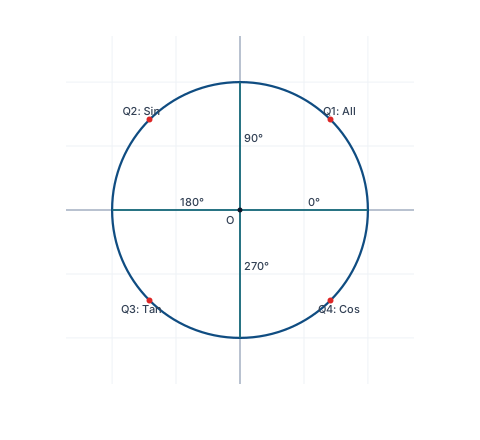
CAST diagram showing four quadrants with labels: All positive in Q1, Sin positive in Q2, Tan positive in Q3, Cos positive in Q4.
The CAST diagram: shows which trigonometric ratios are positive in each quadrant, used to find all solutions from the principal value.
Graph of sin(2theta) = sqrt(3)/2 showing four intersection points at theta = 30, 60, 210, 240 degrees over [0, 360].
Graph illustrating the four solutions of $\sin 2\theta = \tfrac{\sqrt{3}}{2}$ in $[0°, 360°]$ from Worked Example 1.

Keep learning

Explore CAIE A-Level Mathematics tutoring →

View the full Mathematics syllabus →

Part of Novark's free CAIE A-Level Mathematics notes