Introduction
Quadratic equations and inequalities are among the most frequently tested topics across all 9709 papers. Mastery here is non-negotiable: they arise independently as well as embedded within harder problems involving functions, coordinate geometry, and calculus. The syllabus requires you to solve (and the corresponding inequality) using three distinct methods: factorising, completing the square, and the quadratic formula. Examiners expect you to choose the most efficient method and to present solutions with full algebraic justification.
Core Concept
A quadratic equation in one unknown has the form
and has at most two real solutions (roots). A quadratic inequality asks for the set of values of for which , , , or .
Method 1 — Factorising
Express the left-hand side as a product of two linear factors:
Setting each factor to zero gives the roots and . This method is fastest when integer or simple fractional roots exist.
Method 2 — Completing the Square
Rewrite the equation in the form , then isolate :
This method is essential when the equation does not factorise neatly and is the basis for understanding the vertex form of a quadratic (a prerequisite skill you should already have).
Method 3 — The Quadratic Formula
Always applicable. For :
The discriminant determines the nature of the roots (a prerequisite topic). If there are no real solutions.
Solving Quadratic Inequalities
To solve (or ):
- Find the roots by solving .
- Sketch (or reason from) the parabola's shape ( opens upward; opens downward).
- Read off the solution set:
- : the parabola is below the axis between the roots, so .
- : the parabola is above the axis outside the roots, so .
- Reverse the regions when .
Key Formulae & Definitions
| Discriminant | Nature of roots |
|---|---|
| Two distinct real roots | |
| One repeated real root | |
| No real roots |
Solution sets for inequalities (assuming roots , ):
Worked Examples
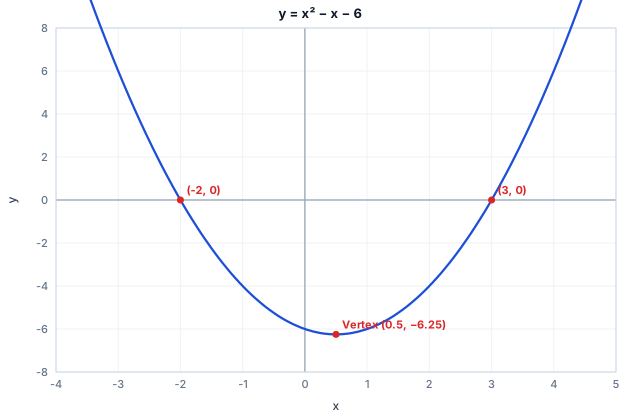
Example 1 — Solving by Factorising
Solve .
Step 1. Identify . We need two numbers that multiply to and add to : these are and .
Step 2. Split the middle term:
Step 3. Factor by grouping:
Step 4. Set each factor to zero:
Example 2 — Solving by Completing the Square
Solve , giving answers in surd form.
Step 1. Divide through by 3:
Step 2. Complete the square on :
Step 3. Take the square root of both sides:
Step 4. Solve for :
Example 3 — Solving a Quadratic Inequality
Solve .
Step 1. Solve the equation :
Step 2. Since the parabola opens upward, so the quadratic is negative between the roots.
Step 3. Write the solution set:
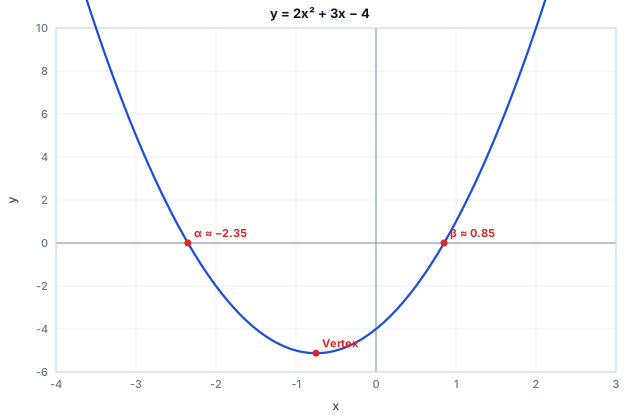
Example 4 — Using the Formula, then an Inequality
Find the set of values of for which .
Step 1. Apply the quadratic formula to :
So and .
Step 2. Since the parabola opens upward, so the quadratic is positive outside the roots:
Common Mistakes & Examiner Pitfalls
-
Dividing by when solving equations. Writing as by dividing through by loses the root . Always factorise: .
-
Wrong inequality direction when multiplying/dividing by a negative. This applies when rearranging, not when using the parabola method. Use the parabola sketch approach to avoid sign errors entirely.
-
Using "" instead of "" for the inner region. The solution to is (a single compound inequality), not or .
-
Forgetting when square-rooting. In completing the square, both the positive and negative square root must be taken.
-
Arithmetic slips in the discriminant. With negative, is always positive — take care with signs when computing under exam pressure.
-
Leaving the answer as two separate equations for an inequality. The final answer must be a set of values (interval notation or inequality notation), not "".
Practice Questions
Q1. Solve by factorising.
Show answer
Find two numbers multiplying to and adding to : these are and .
Q2. Solve by completing the square, leaving your answer in surd form.
Show answer
Q3. Use the quadratic formula to solve , giving your answers correct to 3 significant figures.
Show answer
Q4. Find the set of values of satisfying .
Show answer
Rearrange:
Factorise:
Roots: and . Since , the parabola opens upward, so the expression is non-positive between the roots (endpoints included as the inequality is ):
Q5. Find the set of values of for which .
Show answer
From Example 1, the roots of are and .
Since , the parabola opens upward, so outside the roots:
Connections
Prerequisites you should be confident with:
- Completing the Square — the algebraic technique used directly in Method 2 and for deriving the quadratic formula.
- The Discriminant — determines in advance how many real solutions exist, guiding your choice of method.
Topics this directly enables:
- Quadratic Functions and Graphs — understanding roots as -intercepts of .
- Simultaneous Equations — solving a linear and quadratic pair leads to a quadratic equation.
- Functions: Domain and Range — quadratic inequalities define restricted domains.
- Differentiation Applications — finding intervals where a derivative is positive/negative uses the same inequality technique.
Figures