Introduction
The discriminant is a single expression derived from the coefficients of a quadratic polynomial that instantly reveals how many real roots the corresponding equation has. In the 9709 exam, discriminant questions appear across a wide range of contexts: determining whether a curve intersects a line, proving a quadratic is always positive, and finding unknown constants given information about the nature of roots. Mastering the discriminant is therefore essential, not only as a standalone skill but as a tool woven throughout the Pure Mathematics 1 paper.
Core Concept
Recall from Completing the Square that the general quadratic equation (with ) can be solved by the quadratic formula:
The expression under the square root, , controls whether real solutions exist and how many there are. This expression is called the discriminant.
- If : the square root gives two distinct real values, producing two distinct real roots.
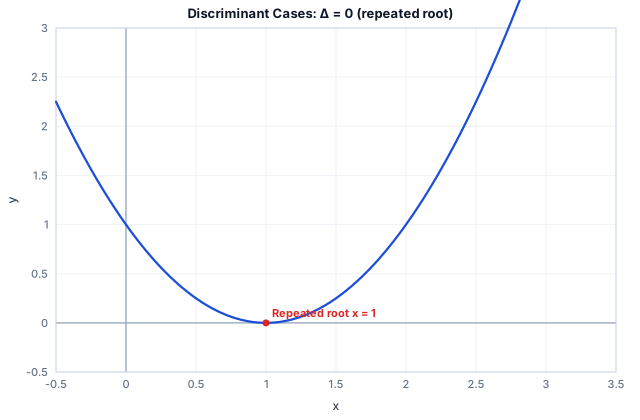
- If : the square root vanishes, and the gives only one value, producing a repeated root (also called an equal root).
- If : the square root of a negative number has no real value, so there are no real roots.
Geometrically, these three cases describe how the parabola relates to the -axis.
Key Formulae & Definitions
The Discriminant:
where is a quadratic polynomial with .
Classification of roots:
| Condition | Nature of roots |
|---|---|
| Two distinct real roots | |
| One repeated (equal) root: | |
| No real roots |
Note: A repeated root is a single value of at which the parabola just touches (is tangent to) the -axis.
Worked Examples
Example 1 — Determining the nature of roots
Determine the nature of the roots of .
Step 1: Identify the coefficients.
Step 2: Calculate the discriminant.
Step 3: Interpret the result.
Since , the equation has no real roots. The parabola lies entirely above the -axis (as ).
Example 2 — Finding an unknown constant given a repeated root
The equation has a repeated root. Find the possible values of .
Step 1: Identify the coefficients.
Step 2: Set the discriminant equal to zero (condition for a repeated root).
Step 3: Solve for .
Step 4: State the repeated roots for each case.
- When : repeated root at .
- When : repeated root at .
Example 3 — Using the discriminant to find a range of values
Find the values of the constant for which has two distinct real roots.
Step 1: Identify the coefficients (noting for a quadratic).
Step 2: Write the condition for two distinct real roots.
Step 3: Solve the inequality.
Step 4: State the full constraint.
Combined with : the equation has two distinct real roots when and .
Common Mistakes & Examiner Pitfalls
-
Sign errors with : The discriminant uses , which is always non-negative regardless of the sign of . A frequent error is computing incorrectly when is negative, e.g. writing . Always square the full signed value.
-
Forgetting : When (or another letter) is the leading coefficient, students often forget that must be excluded separately, since the expression would no longer be quadratic.
-
Using instead of : "Two distinct real roots" requires strictly . The boundary gives a repeated root — a separate case. Read the question wording with care.
-
Confusing "no real roots" with "no roots": The discriminant only classifies real roots. In 9709 Pure 1, "no real roots" is the correct conclusion; do not write "no solutions" without this qualifier.
-
Not simplifying before interpreting: In harder problems, involves the unknown — students sometimes forget to rearrange the inequality correctly, particularly flipping the inequality sign when dividing by a negative value.
Practice Questions
Q1. Find the discriminant of and state the nature of the roots of .
Show answer
Since , the equation has two distinct real roots.
Q2. The equation has a repeated root. Find the possible values of and state the corresponding repeated root in each case.
Show answer
For a repeated root, :
- : repeated root
- : repeated root
Q3. Show that the equation has no real roots.
Show answer
Since , the equation has no real roots.
Q4. Find the range of values of for which has no real roots.
Show answer
For no real roots, :
The quadratic is negative between its roots:
Q5. The line is a tangent to the curve . Find the value of .
Show answer
At a tangency, the line and curve intersect at exactly one point — a repeated root condition.
Set equal:
For a repeated root, :
Connections
Prerequisite: Completing the Square — the quadratic formula (from which the discriminant arises) is derived directly by completing the square on . Understanding this derivation gives the discriminant its meaning.
Closely linked within Quadratics:
- Solving Quadratic Equations — the discriminant predicts what the solving process will yield.
- Quadratic Inequalities — the sign of the discriminant and the factorisation of as a quadratic in an unknown constant both require inequality-solving techniques.
Later topics that use the discriminant:
- Coordinate Geometry: Lines and Curves — tangency conditions between lines and curves reduce to on the resulting quadratic.
- Functions — determining the range of a quadratic function often involves setting and solving for the output variable.
- Further Pure topics — in complex numbers (A2), the discriminant underpins why complex roots occur in conjugate pairs for real-coefficient polynomials.
Figures