Introduction
Completing the square is one of the most versatile algebraic techniques in Pure Mathematics 1. It transforms any quadratic into the form , revealing the structure of the parabola at a glance. On the 9709 exam, you are expected to carry out this process fluently and then use the result to state the vertex of the parabola, determine the line of symmetry, identify the maximum or minimum value, and produce a clear sketch. Questions on this topic appear both as standalone algebra problems and as part of longer questions on functions and graphs.
Core Concept
Every quadratic can be rewritten by completing the square. The goal is to express the quadratic as a perfect square plus (or minus) a constant:
Why does this help?
Because when (or when ), the minimum or maximum value of the whole expression is simply , achieved when . This gives the vertex and the axis of symmetry directly.
Step-by-step process (for general ):
- Factor out from the first two terms.
- Complete the square inside the bracket by adding and subtracting .
- Expand the bracket back out and simplify the constant terms.
- Read off the vertex from the form .
Key Formulae & Definitions
| Feature | Reads directly from |
|---|---|
| Vertex | |
| Axis of symmetry | |
| Minimum value (if ) | |
| Maximum value (if ) | |
| Direction of opening | Upward if ; downward if |
Worked Examples
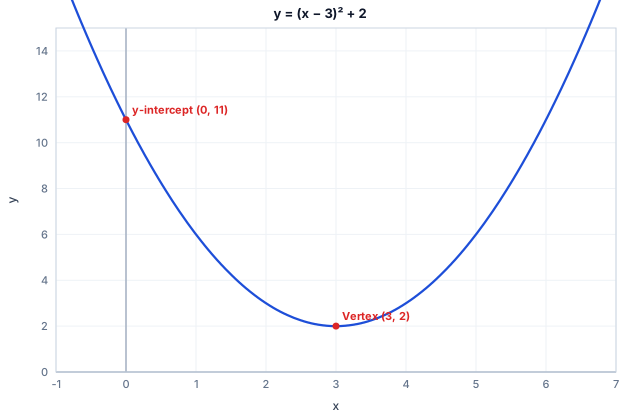
Example 1 — Monic quadratic ()
Rewrite in completed square form and state the vertex.
Step 1. Since , no initial factoring is needed. Focus on .
Step 2. Take half the coefficient of : . Square it: .
Step 3. Add and subtract inside the expression:
Step 4. Write the perfect square trinomial as a squared bracket and simplify:
Conclusion. The completed square form is .
- Vertex:
- Axis of symmetry:
- Minimum value: (since )
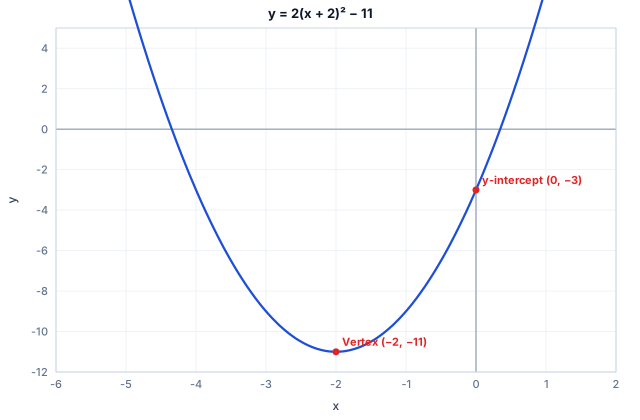
Example 2 — Non-monic quadratic ()
Rewrite in the form and hence sketch the graph.
Step 1. Factor out of the first two terms only:
Step 2. Complete the square inside the bracket. Half of is ; :
Step 3. Separate the from inside the bracket (multiply by the factor of outside):
Step 4. Simplify the constant:
Conclusion. The completed square form is .
- Vertex:
- Axis of symmetry:
- Minimum value: (since )
- -intercept: set : ✓
To sketch: plot the vertex , mark the -intercept , draw the axis of symmetry , and sketch a upward-opening parabola passing through these points.
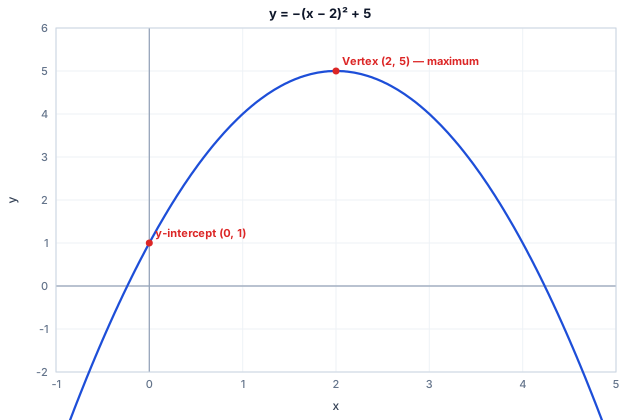
Example 3 — Negative leading coefficient
Find the maximum value of .
Step 1. Factor out from the -terms:
Step 2. Half of is ; . Add and subtract inside the bracket:
Step 3. Simplify:
Conclusion. Since , the parabola opens downward.
- Maximum value is , achieved at .
- Vertex: .
Common Mistakes & Examiner Pitfalls
-
Forgetting to multiply the constant back out. When , after writing , the term is still inside the bracket and must be multiplied by before combining with . This is the most common error in non-monic cases.
-
Sign errors on . The form is , so the vertex is at , not . If the form is , the vertex is — students often write by mistake.
-
Misreading "minimum" vs "maximum". Always check the sign of first. If , the vertex is a maximum, not a minimum.
-
Incomplete sketches. The examiner expects: a labelled vertex, the -intercept, the correct orientation (up or down), and the axis of symmetry marked. Missing any of these costs marks.
-
Squaring half the coefficient incorrectly. Half of must be squared; a common slip is to forget to square, writing instead of subtracting .
Practice Questions
Q1. Write in the form . State the minimum value and the value of at which it occurs.
Show answer
Step 1. Half of is ; .
Minimum value: , occurring at .
Q2. Express in the form .
Show answer
Step 1. Factor out from the -terms:
Step 2. Half of is ; :
Step 3. Simplify:
So , , . Vertex: .
Q3. Find the coordinates of the vertex of the curve .
Show answer
Step 1. Factor out :
Step 2. Half of is ; :
Step 3. Simplify:
Vertex: . Since , this is a maximum.
Q4. The curve has equation , where is a constant. Given that does not intersect the -axis, find the range of values of .
Show answer
Step 1. Complete the square:
Step 2. For not to intersect the -axis, the minimum value must be positive (since , the parabola opens upward):
Q5. Sketch the graph of , labelling the vertex and any intercepts with the axes.
Show answer
Vertex: — read directly from the completed square form.
-intercept: Set :
-intercepts: Set :
Sketch: An upward-opening parabola with vertex , crossing the -axis at and , and the -axis at . Axis of symmetry: .
Connections
Prerequisite topics (build on these first):
- Expanding and factorising quadratics — you must be fluent with bracket expansion and recognising perfect squares before completing the square.
- Index laws and algebraic manipulation — careful handling of coefficients underpins every step.
Topics that follow directly from this:
- Solving quadratic equations — completing the square is an alternative to the quadratic formula and provides its derivation.
- Discriminant and nature of roots — the completed square form makes it easy to count real roots geometrically.
- Quadratic functions and their graphs — sketching, transformations (translations and stretches), and range of a quadratic function all depend on the vertex form derived here.
- Inequalities involving quadratics — knowing the vertex and intercepts allows you to solve quadratic inequalities graphically.
Figures