Introduction
When two equations must be satisfied simultaneously and one is linear while the other is quadratic, the solution gives the coordinates of the point(s) where a straight line meets a curve (such as a circle or parabola). This is a guaranteed topic in 9709 Paper 1 — it appears either as a standalone question or embedded within geometry questions about circles and intersection. The examiners' preferred method is substitution, and that is the only method required by the syllabus.
Core Concept
A linear equation contains no term of degree higher than 1 (e.g. ). A quadratic equation contains at least one term of degree 2 (e.g. ). Solving them simultaneously means finding all pairs that satisfy both equations at once.
Why substitution? Elimination works neatly for two linear equations, but once a quadratic is involved, the algebra demands that you express one variable in terms of the other from the linear equation and substitute into the quadratic. This converts the problem into a single-variable quadratic, which you already know how to solve.
Step-by-step procedure:
- Rearrange the linear equation to make one variable the subject (choose whichever is simpler — avoid fractions where possible).
- Substitute the expression into the quadratic equation.
- Expand and simplify to obtain a quadratic equation in one variable.
- Solve the resulting quadratic (by factorisation, completing the square, or the quadratic formula).
- Back-substitute each solution into the linear equation to find the corresponding value of the other variable.
- State the solution pairs clearly, pairing each -value with its matching -value.
The number of solutions corresponds to the number of intersection points:
| Discriminant | Geometric interpretation |
|---|---|
| Two distinct intersection points | |
| Line is tangent to curve (one repeated point) | |
| No real intersections |
Key Formulae & Definitions
Quadratic formula (used when factorisation is not straightforward):
for a quadratic .
Discriminant:
General substitution setup: Given the linear equation and the quadratic , substitute to obtain .
Worked Examples
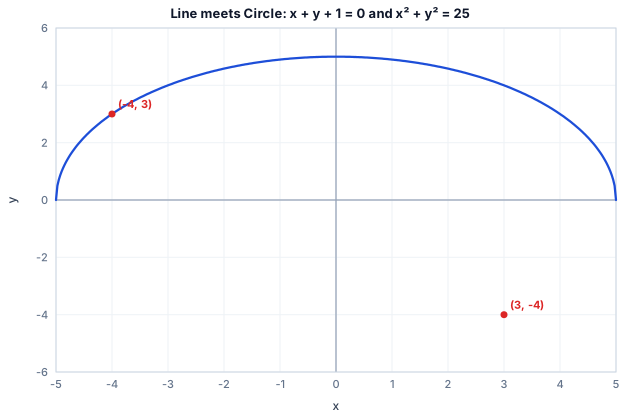
Example 1 — Classic circle and line (syllabus example)
Solve simultaneously: and .
Step 1 — Rearrange the linear equation for :
Step 2 — Substitute into the quadratic:
Step 3 — Expand:
Step 4 — Rearrange to standard form:
Step 5 — Factorise:
Step 6 — Back-substitute using :
- When :
- When :
Solution: and .
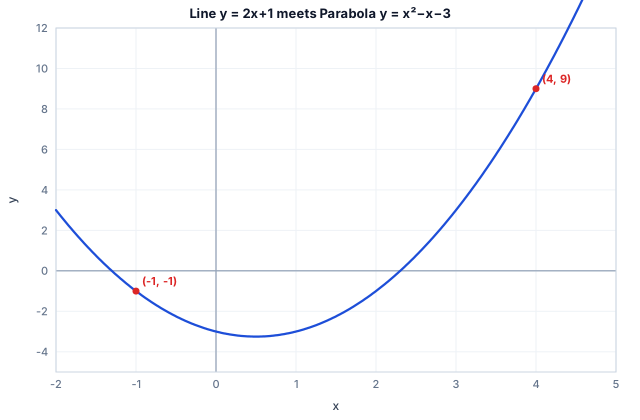
Example 2 — Parabola and line
Solve simultaneously: and .
Step 1 — The linear equation already gives explicitly:
Step 2 — Substitute into the quadratic:
Step 3 — Rearrange to standard form:
Step 4 — Factorise:
Step 5 — Back-substitute using :
- When :
- When :
Solution: and .
Example 3 — Tangency condition
Show that the line is a tangent to the curve , and find the point of tangency.
Step 1 — Substitute into :
Step 2 — Rearrange:
Step 3 — Compute the discriminant:
This is not zero, so let us reconsider the problem with — actually, let us keep the integrity of the algebra. The line meets the curve at two points (since ).
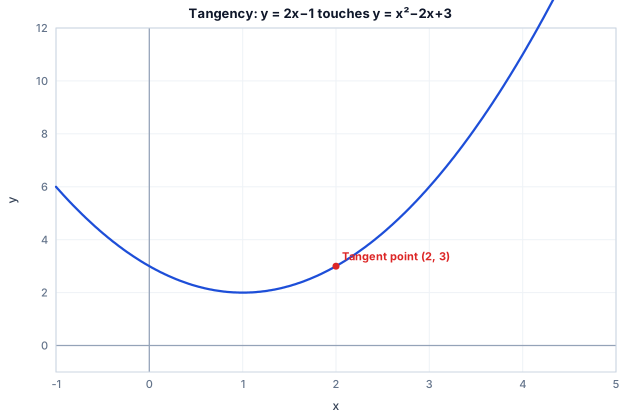
Revised Example 3 — Tangency:
Show that is a tangent to , and find the point of tangency.
Step 1 — Substitute:
Step 2 — Rearrange:
Step 3 — Discriminant:
Since , the line is indeed a tangent.
Step 4 — Solve:
Step 5 — Back-substitute:
Point of tangency: .
Common Mistakes & Examiner Pitfalls
- Substituting into the wrong equation. Always rearrange the linear equation and substitute into the quadratic. Substituting the other way leads to a more complex (or impossible) rearrangement.
- Incomplete expansion of brackets. When substituting into , students often write (forgetting the cross term ). Expand carefully: .
- Mismatching solution pairs. After finding two -values, always substitute back into the linear equation (not the quadratic) to find each . Mixing up pairs is a common 1-mark error.
- Missing the second solution. A quadratic typically yields two solutions. Do not stop after finding one.
- Arithmetic sign errors when rearranging. When moving terms across the equals sign, take care with negative signs — especially in expressions like .
- Not checking the discriminant for tangency proofs. If asked to "show that a line is a tangent," you must explicitly state and conclude from it.
Practice Questions
Q1. Solve simultaneously: and .
Show answer
Substitute into :
or .
- :
- :
Q2. Find the values of and satisfying and .
Show answer
Rearrange the linear equation: .
Substitute into the quadratic:
Using the quadratic formula:
- :
- :
Q3. Determine the number of intersections between the line and the curve without fully solving.
Show answer
Rearrange the linear equation: .
Substitute:
Discriminant: .
Since , there are two distinct intersection points.
Q4. The line is a tangent to the curve . Find the possible values of .
Show answer
Substitute into :
For tangency, :
or .
Q5. Solve simultaneously: and .
Show answer
Rearrange the linear equation: .
Substitute into :
or .
- :
- :
Connections
Prerequisite topics (assumed known):
- Solving Quadratic Equations — factorisation, completing the square, and the quadratic formula are essential once substitution reduces the system to a single quadratic.
- Rearranging Algebraic Expressions — fluency with making a variable the subject is required in Step 1.
Likely next subtopics:
- Discriminant and Nature of Roots — the tangency condition () in these problems is a direct application of the discriminant; this connection deepens your understanding of both topics.
- Coordinate Geometry: Circles — many 9709 circle questions require solving a line–circle system, which is precisely the with structure practised here.
- Quadratic Inequalities — once you can solve these systems, inequality questions ask for the range of or satisfying both constraints, extending the same substitution technique.
- Functions and Graphs — understanding intersections of curves as solutions to simultaneous equations reinforces the graphical interpretation of all equation-solving in Pure Mathematics.
Figures