Introduction
Some equations do not look like quadratics at first glance, yet they share the same underlying structure: a term squared, a term to the first power, and a constant. Recognising this hidden quadratic pattern is a key skill tested in CAIE 9709, appearing in Pure Mathematics questions on algebra and trigonometry alike. The technique is simple — introduce a substitution, solve a familiar quadratic, then translate back — but errors in the final "back-substitution" step are a frequent source of lost marks.
Core Concept
An equation is quadratic in some function of if it can be written in the form
where is any expression involving (e.g. , , , ).
The method is:
- Spot the pattern — identify the function that is being "squared" and also appears to the first power.
- Substitute to obtain a standard quadratic .
- Solve the quadratic in using any appropriate method (factorisation, quadratic formula, completing the square).
- Back-substitute — for each value of , solve for .
- Check validity — some values of may yield no real solutions for , or may fall outside a given domain.
Key Formulae & Definitions
Standard form of a quadratic in :
Substitution rule:
| Original equation | Substitution | Resulting quadratic |
|---|---|---|
Discriminant (to check whether real solutions in exist):
| Condition | Nature of roots |
|---|---|
| Two distinct real roots | |
| One repeated root | |
| No real roots |
Worked Examples
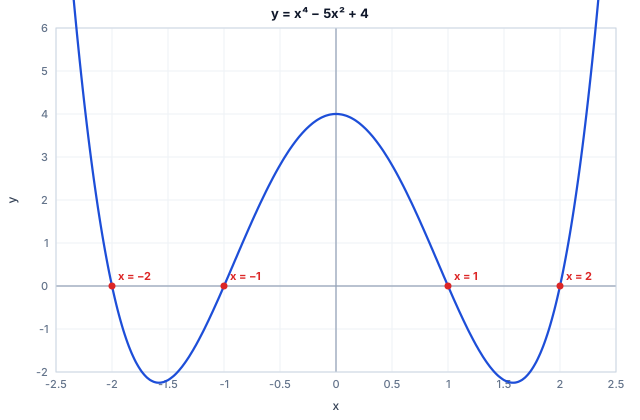
Example 1 — Polynomial equation:
Step 1: Identify the pattern. The terms and differ by a square relationship: . So the equation is quadratic in .
Step 2: Substitute .
Step 3: Factorise.
Step 4: Back-substitute .
For :
For :
Step 5: State all solutions.
Example 2 — Trigonometric equation: , for
Step 1: Rearrange to bring all terms to one side.
Step 2: Identify the pattern. This is quadratic in . Substitute :
Step 3: Solve using the quadratic formula (does not factorise nicely).
Step 4: Back-substitute , solving over .
For :
For :
Adjusting into : or
Step 5: State all solutions (to 1 d.p.).
Example 3 — Equation in :
Step 1: Substitute (valid for ), so .
Step 2: Factorise.
Step 3: Back-substitute .
Step 4: State all solutions.
Common Mistakes & Examiner Pitfalls
-
Forgetting negative roots after back-substitution. In Example 1, gives , not just . Examiners will penalise incomplete solution sets.
-
Ignoring domain restrictions. If , then . Any solution from the quadratic must be discarded. Similarly, if and you find , there is no solution since .
-
Not rearranging before substituting. In Example 2, must be rearranged to before substituting. Applying the substitution to an unbalanced equation is a common slip.
-
Substituting back incorrectly. After finding where , some students write instead of . Always ask: "What does actually mean, and how many values does it imply?"
-
Losing solutions in the trigonometric step. When solving over a given interval, remember that has period . Always use the full interval systematically.
-
Calling the substitution variable . Using for both the substitution and the original variable causes confusion. Always use a distinct letter such as , , or .
Practice Questions
Q1. Solve .
Show answer
Let :
Back-substitute:
Solutions:
Q2. Solve , where .
Show answer
Let , so :
Back-substitute :
Solutions: or
Q3. Solve for .
Show answer
Let :
Back-substitute :
For : or
For : or
Solutions:
Q4. Solve .
Show answer
Let :
Back-substitute :
Solutions: or
Q5. Find the values of in the interval satisfying .
Show answer
Let :
Check validity (): is impossible, discard it.
For :
Solution: (the only solution in )
Connections
Prerequisites — assumed known:
- Solving Quadratic Equations (factorisation, quadratic formula, completing the square) — the core technique applied after substitution.
- Quadratic Inequalities — the same substitution strategy can extend to inequalities of the form .
Leads directly into:
- Trigonometric Equations (Pure Mathematics 2/3) — equations such as over extended or general solution domains rely entirely on this method.
- Exponential and Logarithmic Equations — equations like use the substitution , an identical strategy.
- Further Curve Sketching — roots found here correspond to -intercepts of quartic or composite functions, linking to graph transformations.
Figures