Understand integration as the reverse process of differentiation, and integrate (ax + b)ⁿ (for any rational n except −1), together with constant multiples, sums and differences.
Introduction
Integration is one of the two fundamental operations of calculus. At this stage of the 9709 course, integration is introduced as the reverse process of differentiation — that is, given a derivative, we work backwards to recover the original function. This is sometimes called antidifferentiation, and the result is called an indefinite integral.
This topic forms the foundation for all later integration work in Pure Mathematics 1, including finding areas under curves and solving problems involving displacement, velocity, and acceleration. In the examination, questions may ask you to integrate expressions directly, find a constant of integration using given conditions, or connect integration explicitly to differentiation.
Core Concept
Recall from differentiation that if y=xn, then dxdy=nxn−1.
Integration reverses this: if dxdy=xn−1, then y=nxn+c.
More generally, the indefinite integral of a function f(x) is written
∫f(x)dx
and represents the family of all functions whose derivative is f(x). The constant of integrationc is essential — it accounts for the fact that any constant differentiates to zero, so infinitely many functions share the same derivative.
Integrating (ax+b)n
The syllabus requires integration of expressions of the form (ax+b)n where n is any rational number except −1, and a,b are constants with a=0.
This result follows directly from the chain rule in reverse. When differentiating (ax+b)n+1, the chain rule produces a factor of a(n+1). To reverse this, we divide by that factor.
Key Formulae & Definitions
Power rule for integration:
∫xndx=n+1xn+1+c,n=−1
Integration of (ax+b)n:
∫(ax+b)ndx=a(n+1)(ax+b)n+1+c,n=−1,a=0
Constant multiple rule:
∫kf(x)dx=k∫f(x)dx
Sum and difference rule:
∫[f(x)±g(x)]dx=∫f(x)dx±∫g(x)dx
Note: The formula a(n+1)(ax+b)n+1+c is valid for all rational n except n=−1, including negative integers and fractions. Always divide by both aand(n+1).
Worked Examples
Example 1 — Polynomial and negative power
Find ∫(3x2−x34+5)dx.
Step 1: Rewrite negative powers using index notation.
x34=4x−3
So the integral becomes:
∫(3x2−4x−3+5)dx
Step 2: Integrate term by term using the power rule.
=33x3−−24x−2+5x+c
Step 3: Simplify each term.
=x3+2x−2+5x+c
=x3+x22+5x+c
Justification: Each term uses ∫xndx=n+1xn+1+c. The constant of integration is added once at the end.
Example 2 — Integrating (ax+b)n with a fractional power
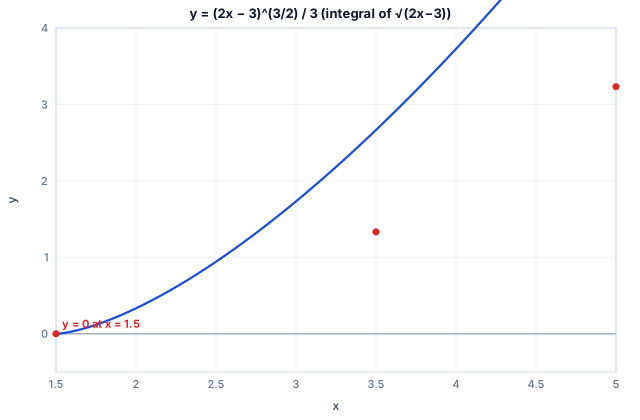
Find ∫(2x−3)1/2dx.
Step 1: Identify a, b, and n.
a=2,b=−3,n=21
Step 2: Apply the formula ∫(ax+b)ndx=a(n+1)(ax+b)n+1+c.
=2⋅23(2x−3)3/2+c
Step 3: Simplify the denominator.
2⋅23=3
=3(2x−3)3/2+c
Verification by differentiation: dxd[3(2x−3)3/2]=31⋅23(2x−3)1/2⋅2=(2x−3)1/2 ✓
Example 3 — Finding a particular function given a condition
A curve has dxdy=(3x+1)−2 and passes through the point (1,2). Find the equation of the curve.
Step 1: Integrate dxdy to find y.
y=∫(3x+1)−2dx=3⋅(−1)(3x+1)−1+c=−3(3x+1)1+c
Step 2: Use the condition (1,2) to find c.
2=−3(3(1)+1)1+c=−121+c
c=2+121=1225
Step 3: Write the equation.
y=−3(3x+1)1+1225
Common Mistakes & Examiner Pitfalls
Mistake
What goes wrong
How to avoid it
Forgetting to divide by a in (ax+b)n
Writing n+1(ax+b)n+1 only
Always divide by botha and (n+1)
Omitting the constant of integration c
Loses a mark in every indefinite integral
Add +c as a matter of habit
Applying the formula when n=−1
Formula breaks down (division by zero)
Recognise (ax+b)−1 needs a different approach (ln) — outside this syllabus objective
Not rewriting roots/fractions as indices first
Inability to apply power rule
Always convert: 3x=x1/3, x21=x−2
Adding c to each term separately
Technically valid but messy, and wastes time
One single +c at the end of the whole integral
Integrating dxdy and forgetting to apply the given point
Equation of curve is wrong
Always substitute coordinates to evaluate c
Practice Questions
Q1. Find ∫(4x3−x3+2)dx.
Show answer
Rewrite:x3=3x−1/2
∫(4x3−3x−1/2+2)dx
=44x4−1/23x1/2+2x+c
=x4−6x1/2+2x+c
=x4−6x+2x+c
Q2. Find ∫(5−2x)4dx.
Show answer
Here a=−2, n=4.
∫(5−2x)4dx=(−2)(5)(5−2x)5+c=−10(5−2x)5+c
=−10(5−2x)5+c
Check by differentiating: −101⋅5(5−2x)4⋅(−2)=(5−2x)4 ✓
Q3. Find ∫(4x−1)36dx.
Show answer
Rewrite:(4x−1)36=6(4x−1)−3
Here a=4, n=−3.
∫6(4x−1)−3dx=6⋅4⋅(−2)(4x−1)−2+c=6⋅−8(4x−1)−2+c
=−43(4x−1)−2+c
=−4(4x−1)23+c
Q4. A curve is such that dxdy=6x2−4x+1. Given that the curve passes through (2,5), find y in terms of x.
Show answer
Integrate:
y=∫(6x2−4x+1)dx=2x3−2x2+x+c
Apply condition (2,5):
5=2(8)−2(4)+2+c=16−8+2+c=10+c
c=−5
y=2x3−2x2+x−5
Q5. Find ∫(3x2+2(3x+2)21)dx.
Show answer
Rewrite:3x2=x2/3 and 2(3x+2)21=21(3x+2)−2
Integrate the first term:
∫x2/3dx=5/3x5/3=53x5/3
Integrate the second term (a=3, n=−2):
∫21(3x+2)−2dx=21⋅3⋅(−1)(3x+2)−1=−61(3x+2)−1
Combine:
53x5/3−6(3x+2)1+c
Connections
Prerequisite topics (assumed known):
Differentiating Powers — the power rule dxd(xn)=nxn−1 is directly reversed here; fluency with it makes integration immediate.
The Chain Rule — differentiating (ax+b)n via the chain rule provides the exact mechanism that the (ax+b)n integration formula undoes. Verifying integration results by differentiating back is strongly recommended.
Topics that follow directly:
Definite Integration and Area — using the same integration techniques with limits to find areas under and between curves.
Integration of x1 and exponential/trigonometric functions (Pure Mathematics 2/3) — extends integration to the case n=−1 and beyond.
Kinematics using Calculus — applying integration to displacement–velocity–acceleration problems, a key application in Mechanics components.
Figures
Figure 2: The result of integrating √(2x − 3). The curve starts at x = 1.5 (where 2x − 3 = 0) and increases smoothly, illustrating how integrating a fractional power raises the power by 1 and produces a less steep initial gradient.