CAIE A-Level · Mathematics 9709 · Integration

The Constant of Integration — Pure Mathematics 1 (9709)

9 min readSyllabus 1.8FreeBy Uzair Khan

Syllabus objective

Solve problems involving the evaluation of a constant of integration.

Introduction

When you reverse the process of differentiation to find an indefinite integral, you cannot recover the original constant term — it vanishes upon differentiation. The result is a family of curves, all differing by a vertical shift, and the constant of integration cc represents this unknown shift. In the 9709 exam, questions regularly supply an additional piece of information — typically a point that lies on the curve — so that you can calculate the exact value of cc and state the unique curve. This skill sits at the heart of the syllabus objective for ref 1.8 and appears in nearly every integration question on Paper 1.


Core Concept

Suppose you are told that dydx=f(x)\dfrac{\mathrm{d}y}{\mathrm{d}x} = f(x). Integrating gives:

y=f(x)dx=F(x)+cy = \int f(x)\, \mathrm{d}x = F(x) + c

where F(x)F(x) is any antiderivative of f(x)f(x) and cc is an arbitrary constant. Without further information, infinitely many curves satisfy this equation — each value of cc produces a distinct curve, all with the same gradient function.

To pin down the unique curve, you need one point (x0,y0)(x_0,\, y_0) that lies on it. Substituting x=x0x = x_0 and y=y0y = y_0 into y=F(x)+cy = F(x) + c gives a single equation in the single unknown cc, which you solve directly. The resulting expression is the particular integral (or particular solution) for that specific curve.

In summary:

  1. Integrate dydx\dfrac{\mathrm{d}y}{\mathrm{d}x} to obtain y=F(x)+cy = F(x) + c.
  2. Substitute the given point (x0,y0)(x_0, y_0).
  3. Solve for cc.
  4. Write the complete equation of the curve.

Key Formulae & Definitions

General power rule for integration:

xndx=xn+1n+1+c,n1\int x^n \, \mathrm{d}x = \frac{x^{n+1}}{n+1} + c, \qquad n \neq -1

Linearity of integration:

[af(x)+bg(x)]dx=af(x)dx+bg(x)dx\int \bigl[af(x) + bg(x)\bigr] \mathrm{d}x = a\int f(x)\,\mathrm{d}x + b\int g(x)\,\mathrm{d}x

Evaluating the constant — the key step:

y0=F(x0)+c    c=y0F(x0)y_0 = F(x_0) + c \implies c = y_0 - F(x_0)
SymbolMeaning
dydx\dfrac{\mathrm{d}y}{\mathrm{d}x}Given gradient function
F(x)F(x)Antiderivative (without constant)
ccConstant of integration (to be found)
(x0,y0)(x_0, y_0)Given point on the curve

Worked Examples

Example 1 — Polynomial gradient function

A curve has gradient function dydx=3x24x+1\dfrac{\mathrm{d}y}{\mathrm{d}x} = 3x^2 - 4x + 1 and passes through the point (2,5)(2,\, 5). Find the equation of the curve.

Step 1 — Integrate the gradient function.

y=(3x24x+1)dxy = \int \left(3x^2 - 4x + 1\right)\mathrm{d}x

Apply the power rule term by term:

y=3x334x22+x+c=x32x2+x+cy = \frac{3x^3}{3} - \frac{4x^2}{2} + x + c = x^3 - 2x^2 + x + c

Step 2 — Substitute the known point (2,5)(2, 5).

5=(2)32(2)2+2+c5 = (2)^3 - 2(2)^2 + 2 + c
5=88+2+c5 = 8 - 8 + 2 + c
5=2+c5 = 2 + c

Step 3 — Solve for cc.

c=3c = 3

Step 4 — Write the equation of the curve.

y=x32x2+x+3\boxed{y = x^3 - 2x^2 + x + 3}

Example 2 — Gradient function involving a negative power

A curve satisfies dydx=6x24x3\dfrac{\mathrm{d}y}{\mathrm{d}x} = 6x^2 - \dfrac{4}{x^3} and passes through the point (1,7)\left(1,\, 7\right). Find the equation of the curve.

Step 1 — Rewrite using index notation and integrate.

dydx=6x24x3\frac{\mathrm{d}y}{\mathrm{d}x} = 6x^2 - 4x^{-3}
y=(6x24x3)dxy = \int \left(6x^2 - 4x^{-3}\right)\mathrm{d}x
y=6x334x22+cy = \frac{6x^3}{3} - \frac{4x^{-2}}{-2} + c
y=2x3+2x2+cy = 2x^3 + 2x^{-2} + c

Step 2 — Substitute the known point (1,7)(1,\, 7).

7=2(1)3+2(1)2+c7 = 2(1)^3 + 2(1)^{-2} + c
7=2+2+c7 = 2 + 2 + c
7=4+c7 = 4 + c

Step 3 — Solve for cc.

c=3c = 3

Step 4 — Write the equation of the curve.

y=2x3+2x2+3\boxed{y = 2x^3 + \frac{2}{x^2} + 3}

Example 3 — Second derivative given

The second derivative of a curve is d2ydx2=6x2\dfrac{\mathrm{d}^2y}{\mathrm{d}x^2} = 6x - 2. The curve passes through (0,4)(0,\, 4) and the gradient at x=1x = 1 is 33. Find the equation of the curve.

Step 1 — Integrate once to find dydx\dfrac{\mathrm{d}y}{\mathrm{d}x}.

dydx=(6x2)dx=3x22x+A\frac{\mathrm{d}y}{\mathrm{d}x} = \int (6x - 2)\,\mathrm{d}x = 3x^2 - 2x + A

Step 2 — Use the gradient condition: dydx=3\dfrac{\mathrm{d}y}{\mathrm{d}x} = 3 when x=1x = 1.

3=3(1)22(1)+A    3=1+A    A=23 = 3(1)^2 - 2(1) + A \implies 3 = 1 + A \implies A = 2

So dydx=3x22x+2\dfrac{\mathrm{d}y}{\mathrm{d}x} = 3x^2 - 2x + 2.

Step 3 — Integrate again to find yy.

y=(3x22x+2)dx=x3x2+2x+By = \int (3x^2 - 2x + 2)\,\mathrm{d}x = x^3 - x^2 + 2x + B

Step 4 — Use the point (0,4)(0,\, 4) to find BB.

4=00+0+B    B=44 = 0 - 0 + 0 + B \implies B = 4

Step 5 — Write the equation of the curve.

y=x3x2+2x+4\boxed{y = x^3 - x^2 + 2x + 4}

Common Mistakes & Examiner Pitfalls

  • Forgetting cc entirely. Omitting the constant of integration and then wondering why the point condition cannot be used — this earns no method marks for the constant.

  • Integrating but not evaluating cc. Writing y=F(x)+cy = F(x) + c and stopping — the question asks you to find cc, so always complete the substitution step.

  • Substituting into the derivative instead of the integral. A very common slip: using dydx=f(x)\dfrac{\mathrm{d}y}{\mathrm{d}x} = f(x) to substitute the point rather than y=F(x)+cy = F(x) + c. Remember, the given point lies on the curve yy, not on the gradient function.

  • Index errors when integrating negative or fractional powers. For example, x3dx=x22\displaystyle\int x^{-3}\,\mathrm{d}x = \dfrac{x^{-2}}{-2}, not x22\dfrac{x^{-2}}{2}. Always add 1 to the power and divide by the new power, carefully tracking signs.

  • Misreading the given point. Ensure you correctly identify which coordinate is xx and which is yy before substituting.

  • For second-derivative problems: each integration introduces a new constant (AA, then BB). Both must be evaluated using the two separate conditions provided. Missing either constant loses marks.


Practice Questions

Q1. A curve has gradient function dydx=4x36x+2\dfrac{\mathrm{d}y}{\mathrm{d}x} = 4x^3 - 6x + 2 and passes through the point (1,0)(1,\, 0). Find the equation of the curve.

<details><summary>Show answer</summary>

Integrate:

y=(4x36x+2)dx=x43x2+2x+cy = \int (4x^3 - 6x + 2)\,\mathrm{d}x = x^4 - 3x^2 + 2x + c

Substitute (1,0)(1,\, 0):

0=13+2+c=0+c    c=00 = 1 - 3 + 2 + c = 0 + c \implies c = 0

Equation of curve:

y=x43x2+2xy = x^4 - 3x^2 + 2x
</details>

Q2. A curve satisfies dydx=x+1x\dfrac{\mathrm{d}y}{\mathrm{d}x} = \sqrt{x} + \dfrac{1}{\sqrt{x}} and passes through (4,10)(4,\, 10). Find yy in terms of xx.

<details><summary>Show answer</summary>

Rewrite in index form:

dydx=x1/2+x1/2\frac{\mathrm{d}y}{\mathrm{d}x} = x^{1/2} + x^{-1/2}

Integrate:

y=x3/232+x1/212+c=23x3/2+2x1/2+cy = \frac{x^{3/2}}{\tfrac{3}{2}} + \frac{x^{1/2}}{\tfrac{1}{2}} + c = \frac{2}{3}x^{3/2} + 2x^{1/2} + c

Substitute (4,10)(4,\, 10):

10=23(8)+2(2)+c=163+4+c=283+c10 = \tfrac{2}{3}(8) + 2(2) + c = \tfrac{16}{3} + 4 + c = \tfrac{28}{3} + c
c=10283=30283=23c = 10 - \frac{28}{3} = \frac{30 - 28}{3} = \frac{2}{3}

Equation of curve:

y=23x3/2+2x1/2+23y = \frac{2}{3}x^{3/2} + 2x^{1/2} + \frac{2}{3}
</details>

Q3. The gradient of a curve at any point is dydx=2x3x2\dfrac{\mathrm{d}y}{\mathrm{d}x} = 2x - \dfrac{3}{x^2}. Given that the curve passes through (3,8)(3,\, 8), find the equation of the curve.

<details><summary>Show answer</summary>

Rewrite and integrate:

y=(2x3x2)dx=x2+3x1+c=x2+3x+cy = \int \left(2x - 3x^{-2}\right)\mathrm{d}x = x^2 + 3x^{-1} + c = x^2 + \frac{3}{x} + c

Substitute (3,8)(3,\, 8):

8=9+1+c=10+c    c=28 = 9 + 1 + c = 10 + c \implies c = -2

Equation of curve:

y=x2+3x2y = x^2 + \frac{3}{x} - 2
</details>

Q4. A curve has d2ydx2=12x6\dfrac{\mathrm{d}^2y}{\mathrm{d}x^2} = 12x - 6. The curve passes through (2,5)(2,\, 5) and has gradient 44 at x=0x = 0. Find the equation of the curve.

<details><summary>Show answer</summary>

Integrate once:

dydx=6x26x+A\frac{\mathrm{d}y}{\mathrm{d}x} = 6x^2 - 6x + A

Use gradient condition at x=0x = 0:

4=00+A    A=44 = 0 - 0 + A \implies A = 4

So dydx=6x26x+4\dfrac{\mathrm{d}y}{\mathrm{d}x} = 6x^2 - 6x + 4.

Integrate again:

y=2x33x2+4x+By = 2x^3 - 3x^2 + 4x + B

Substitute (2,5)(2,\, 5):

5=1612+8+B=12+B    B=75 = 16 - 12 + 8 + B = 12 + B \implies B = -7

Equation of curve:

y=2x33x2+4x7y = 2x^3 - 3x^2 + 4x - 7
</details>

Q5. The gradient function of a curve is dydx=kx2+2\dfrac{\mathrm{d}y}{\mathrm{d}x} = kx^2 + 2, where kk is a constant. The curve passes through both (0,1)(0,\, 1) and (3,16)(3,\, 16). Find the value of kk and hence the equation of the curve.

<details><summary>Show answer</summary>

Integrate:

y=k3x3+2x+cy = \frac{k}{3}x^3 + 2x + c

Substitute (0,1)(0,\, 1):

1=0+0+c    c=11 = 0 + 0 + c \implies c = 1

So y=k3x3+2x+1y = \dfrac{k}{3}x^3 + 2x + 1.

Substitute (3,16)(3,\, 16):

16=k3(27)+6+1=9k+716 = \frac{k}{3}(27) + 6 + 1 = 9k + 7
9k=9    k=19k = 9 \implies k = 1

Equation of curve:

y=13x3+2x+1y = \frac{1}{3}x^3 + 2x + 1
</details>

Connections

Prerequisite — Integration as the Reverse of Differentiation: The power rule xndx=xn+1n+1+c\displaystyle\int x^n\,\mathrm{d}x = \dfrac{x^{n+1}}{n+1} + c is used at every step here; ensure fluency with it, including negative and fractional indices.

Next subtopic — Definite Integration: Once limits are introduced, the constant of integration cancels between the bounds, but understanding why it cancels relies on knowing what cc represents here.

Connected topic — Kinematics (displacement, velocity, acceleration): In applied contexts, integrating a(t)a(t) gives v(t)+cv(t) + c, and an initial condition such as v=uv = u at t=0t = 0 is used to evaluate cc — a direct application of exactly this skill.

Connected topic — Finding the Equation of a Curve from a Tangent/Normal: In coordinate geometry, you may be given a tangent line gradient and a point; combining this with integration to recover y=F(x)+cy = F(x) + c links directly to this objective.

Figures
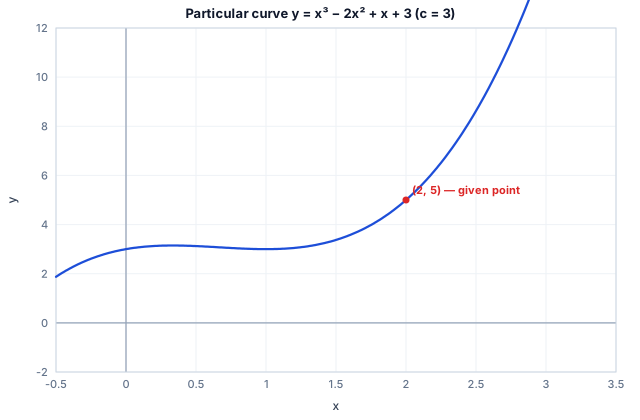
Graph showing a family of curves y = x^3 - 2x^2 + x + c for three values of c (0, 3, and -2), illustrating how the constant of integration shifts the curve vertically. The particular curve with c = 3 is highlighted and passes through the point (2, 5).
Figure 1: A family of curves sharing the same gradient function dy/dx = 3x² − 4x + 1, differing only by the constant c. The highlighted curve (c = 3) is the unique member passing through (2, 5), as found in Worked Example 1.

Keep learning

Explore CAIE A-Level Mathematics tutoring →

View the full Mathematics syllabus →

Part of Novark's free CAIE A-Level Mathematics notes