CAIE A-Level · Mathematics 9709 · Differentiation

Stationary Points: Location, Nature, and Curve Sketching

9 min readSyllabus 1.7FreeBy Uzair Khan

Syllabus objective

Locate stationary points and determine their nature, and use information about stationary points in sketching graphs (including use of the second derivative for identifying maxima and minima; points of inflexion are not included).

Introduction

A stationary point is any point on a curve where the gradient is zero. These points are fundamental in curve sketching and optimisation problems, both of which appear regularly in 9709 Paper 1. The syllabus requires you to locate stationary points (find their coordinates), determine their nature (maximum or minimum), and use this information when sketching graphs. Points of inflexion are explicitly excluded from this syllabus objective and will not be tested here.


Core Concept

Recall from differentiating powers that dydx\dfrac{dy}{dx} gives the gradient function of a curve y=f(x)y = f(x). At a stationary point, the curve is momentarily flat — neither increasing nor decreasing — so:

dydx=0\frac{dy}{dx} = 0

Setting this equal to zero and solving for xx locates all stationary points. Substituting each xx-value back into y=f(x)y = f(x) gives the full coordinates.

Determining the Nature

Once a stationary point is found, you must decide whether it is a local maximum or a local minimum. There are two reliable methods:

Method 1 — Second Derivative Test

Differentiate dydx\dfrac{dy}{dx} again to obtain d2ydx2\dfrac{d^2y}{dx^2}, then evaluate it at the stationary point.

Value of d2ydx2\dfrac{d^2y}{dx^2} at the pointNature of stationary point
d2ydx2<0\dfrac{d^2y}{dx^2} < 0Local maximum
d2ydx2>0\dfrac{d^2y}{dx^2} > 0Local minimum
d2ydx2=0\dfrac{d^2y}{dx^2} = 0Test is inconclusive — use Method 2

The reasoning: a negative second derivative means the gradient is decreasing through zero (the curve is concave down, i.e. a peak); a positive second derivative means the gradient is increasing through zero (concave up, i.e. a trough).

Method 2 — First Derivative Sign Change

Examine the sign of dydx\dfrac{dy}{dx} just to the left and right of the stationary point.

Sign of dydx\dfrac{dy}{dx}: left → rightNature
++ \to -Local maximum
+- \to +Local minimum

This method is always valid, including when the second derivative test is inconclusive.


Key Formulae & Definitions

Stationary point: dydx=0\text{Stationary point: } \frac{dy}{dx} = 0
Second derivative: d2ydx2=ddx ⁣(dydx)\text{Second derivative: } \frac{d^2y}{dx^2} = \frac{d}{dx}\!\left(\frac{dy}{dx}\right)

Local maximum at x=ax = a:

dydxx=a=0andd2ydx2x=a<0\frac{dy}{dx}\bigg|_{x=a} = 0 \quad \text{and} \quad \frac{d^2y}{dx^2}\bigg|_{x=a} < 0

Local minimum at x=ax = a:

dydxx=a=0andd2ydx2x=a>0\frac{dy}{dx}\bigg|_{x=a} = 0 \quad \text{and} \quad \frac{d^2y}{dx^2}\bigg|_{x=a} > 0

Worked Examples

Example 1 — Polynomial Curve

Find the stationary points of y=2x39x2+12x1y = 2x^3 - 9x^2 + 12x - 1 and determine their nature.

Step 1: Differentiate.

dydx=6x218x+12\frac{dy}{dx} = 6x^2 - 18x + 12

Step 2: Set equal to zero and solve.

6x218x+12=06x^2 - 18x + 12 = 0
x23x+2=0(divide through by 6)x^2 - 3x + 2 = 0 \quad \text{(divide through by 6)}
(x1)(x2)=0(x-1)(x-2) = 0
x=1orx=2x = 1 \quad \text{or} \quad x = 2

Step 3: Find the yy-coordinates.

x=1:y=2(1)9(1)+12(1)1=4x = 1: \quad y = 2(1) - 9(1) + 12(1) - 1 = 4
x=2:y=2(8)9(4)+12(2)1=1636+241=3x = 2: \quad y = 2(8) - 9(4) + 12(2) - 1 = 16 - 36 + 24 - 1 = 3

Stationary points are (1,4)(1,\, 4) and (2,3)(2,\, 3).

Step 4: Find the second derivative.

d2ydx2=12x18\frac{d^2y}{dx^2} = 12x - 18

Step 5: Apply the second derivative test.

At x=1x = 1: d2ydx2=12(1)18=6<0local maximum\quad \dfrac{d^2y}{dx^2} = 12(1) - 18 = -6 < 0 \quad \Rightarrow \quad \textbf{local maximum}

At x=2x = 2: d2ydx2=12(2)18=6>0local minimum\quad \dfrac{d^2y}{dx^2} = 12(2) - 18 = 6 > 0 \quad \Rightarrow \quad \textbf{local minimum}

Conclusion: Local maximum at (1,4)(1,\,4); local minimum at (2,3)(2,\,3).


Example 2 — Involving the Chain Rule

A curve has equation y=(3x1)48xy = (3x - 1)^4 - 8x. Find any stationary points and determine their nature.

Step 1: Differentiate using the chain rule.

dydx=4(3x1)338=12(3x1)38\frac{dy}{dx} = 4(3x-1)^3 \cdot 3 - 8 = 12(3x-1)^3 - 8

Step 2: Set equal to zero.

12(3x1)3=812(3x-1)^3 = 8
(3x1)3=23(3x-1)^3 = \frac{2}{3}
3x1=(23) ⁣133x - 1 = \left(\frac{2}{3}\right)^{\!\frac{1}{3}}
x=13[1+(23) ⁣13]x = \frac{1}{3}\left[1 + \left(\frac{2}{3}\right)^{\!\frac{1}{3}}\right]

Evaluating numerically: (23)1/30.874\left(\tfrac{2}{3}\right)^{1/3} \approx 0.874, so x1+0.87430.625x \approx \dfrac{1+0.874}{3} \approx 0.625.

Step 3: Find yy.

y=(3(0.625)1)48(0.625)=(0.874)450.5845=4.416y = (3(0.625)-1)^4 - 8(0.625) = (0.874)^4 - 5 \approx 0.584 - 5 = -4.416

Stationary point approximately at (0.625,  4.416)(0.625,\; -4.416).

Step 4: Find the second derivative.

d2ydx2=123(3x1)23=108(3x1)2\frac{d^2y}{dx^2} = 12 \cdot 3(3x-1)^2 \cdot 3 = 108(3x-1)^2

Step 5: Apply the test.

At the stationary point, (3x1)2=(23)2/3>0(3x-1)^2 = \left(\tfrac{2}{3}\right)^{2/3} > 0, so:

d2ydx2=108(23) ⁣23>0local minimum\frac{d^2y}{dx^2} = 108\left(\frac{2}{3}\right)^{\!\frac{2}{3}} > 0 \quad \Rightarrow \quad \textbf{local minimum}

Common Mistakes & Examiner Pitfalls

  • Forgetting the yy-coordinate. Solving dydx=0\dfrac{dy}{dx} = 0 gives only the xx-value. Examiners award a mark specifically for the full coordinate — always substitute back.

  • Stopping at location. The question almost always says "find and determine the nature of"; omitting the nature test loses marks.

  • Misreading the second derivative sign. Remember: d2ydx2<0\dfrac{d^2y}{dx^2} < 0 is a maximum (many students instinctively reverse this). Think of a hill: the curve curves downwards, so the rate of change of gradient is negative.

  • Arithmetic slips when factorising dydx=0\dfrac{dy}{dx} = 0. Always check your roots by substitution before proceeding.

  • Using the second derivative test when it gives zero. If d2ydx2=0\dfrac{d^2y}{dx^2} = 0 at the stationary point, the test tells you nothing — switch immediately to the sign-change method.

  • Sketching without stationary point information. When sketching, mark the stationary points with their coordinates, indicate whether each is a max or min, and show the general shape of the curve in each region. Intercepts with the axes should also be shown where possible.


Practice Questions

Q1. Find the coordinates of the stationary point of y=x26x+11y = x^2 - 6x + 11 and state its nature.

<details><summary>Show answer</summary>
dydx=2x6=0    x=3\frac{dy}{dx} = 2x - 6 = 0 \implies x = 3
y=918+11=2y = 9 - 18 + 11 = 2
d2ydx2=2>0    minimum at (3,2)\frac{d^2y}{dx^2} = 2 > 0 \implies \textbf{minimum at } (3,\,2)
</details>

Q2. A curve is defined by y=2x3+3x236x+5y = 2x^3 + 3x^2 - 36x + 5. Find the coordinates of both stationary points and determine their nature.

<details><summary>Show answer</summary>
dydx=6x2+6x36=6(x2+x6)=6(x+3)(x2)=0\frac{dy}{dx} = 6x^2 + 6x - 36 = 6(x^2 + x - 6) = 6(x+3)(x-2) = 0
x=3orx=2x = -3 \quad \text{or} \quad x = 2

At x=3x = -3: y=2(27)+3(9)36(3)+5=54+27+108+5=86y = 2(-27) + 3(9) - 36(-3) + 5 = -54 + 27 + 108 + 5 = 86

At x=2x = 2: y=2(8)+3(4)36(2)+5=16+1272+5=39y = 2(8) + 3(4) - 36(2) + 5 = 16 + 12 - 72 + 5 = -39

d2ydx2=12x+6\frac{d^2y}{dx^2} = 12x + 6

At x=3x = -3: 12(3)+6=30<0    local maximum at (3,86)12(-3)+6 = -30 < 0 \implies \textbf{local maximum at }(-3,\,86)

At x=2x = 2: 12(2)+6=30>0    local minimum at (2,39)12(2)+6 = 30 > 0 \implies \textbf{local minimum at }(2,\,-39)

</details>

Q3. The curve y=x+4xy = x + \dfrac{4}{x} has a stationary point for x>0x > 0. Find it and determine its nature.

<details><summary>Show answer</summary>

Rewrite: y=x+4x1y = x + 4x^{-1}

dydx=14x2=0    x2=4    x=2  (since x>0)\frac{dy}{dx} = 1 - \frac{4}{x^2} = 0 \implies x^2 = 4 \implies x = 2 \; (\text{since } x > 0)
y=2+42=4y = 2 + \frac{4}{2} = 4
d2ydx2=8x3;at x=2:88=1>0    minimum at (2,4)\frac{d^2y}{dx^2} = \frac{8}{x^3}; \quad \text{at } x=2: \frac{8}{8} = 1 > 0 \implies \textbf{minimum at }(2,\,4)
</details>

Q4. A curve has equation y=3x416x3+24x2+5y = 3x^4 - 16x^3 + 24x^2 + 5. Find all stationary points and determine their nature.

<details><summary>Show answer</summary>
dydx=12x348x2+48x=12x(x24x+4)=12x(x2)2=0\frac{dy}{dx} = 12x^3 - 48x^2 + 48x = 12x(x^2 - 4x + 4) = 12x(x-2)^2 = 0
x=0orx=2x = 0 \quad \text{or} \quad x = 2

At x=0x = 0: y=5y = 5. At x=2x = 2: y=3(16)16(8)+24(4)+5=48128+96+5=21y = 3(16) - 16(8) + 24(4) + 5 = 48 - 128 + 96 + 5 = 21

d2ydx2=36x296x+48\frac{d^2y}{dx^2} = 36x^2 - 96x + 48

At x=0x = 0: 48>0    local minimum at (0,5)48 > 0 \implies \textbf{local minimum at }(0,\,5)

At x=2x = 2: 36(4)96(2)+48=144192+48=036(4) - 96(2) + 48 = 144 - 192 + 48 = 0second derivative test inconclusive.

Use sign change for x=2x = 2: dydx=12x(x2)2\frac{dy}{dx} = 12x(x-2)^2. Since (x2)20(x-2)^2 \geq 0 always and 12x>012x > 0 for x>0x > 0, the sign of dydx\frac{dy}{dx} is positive on both sides of x=2x = 2. There is no sign change, so (2,21)(2, 21) is neither a maximum nor a minimum (it is a stationary point of inflexion — but note this type of identification is not required by the syllabus; recognising the second derivative is inconclusive and the sign test shows no change is sufficient).

</details>

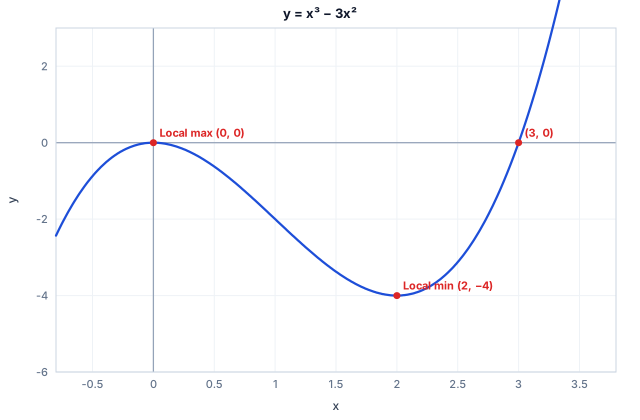
Q5. Sketch the curve y=x33x2y = x^3 - 3x^2, marking the coordinates of all stationary points and any intercepts with the axes.

<details><summary>Show answer</summary>

Stationary points:

dydx=3x26x=3x(x2)=0    x=0 or x=2\frac{dy}{dx} = 3x^2 - 6x = 3x(x-2) = 0 \implies x = 0 \text{ or } x = 2

At x=0x=0: y=0y = 0. At x=2x=2: y=812=4y = 8 - 12 = -4.

d2ydx2=6x6\frac{d^2y}{dx^2} = 6x - 6

At x=0x = 0: 6<0    -6 < 0 \implies local maximum at (0,0)(0,\,0) At x=2x = 2: 6>0    6 > 0 \implies local minimum at (2,4)(2,\,-4)

Axis intercepts: y=0y=0: x33x2=x2(x3)=0    x=0x^3 - 3x^2 = x^2(x-3) = 0 \implies x = 0 (repeated) and x=3x = 3.

Sketch shows: curve rising from bottom-left, reaching a local max at (0,0)(0,0), falling to a local min at (2,4)(2,-4), then rising through (3,0)(3,0) to the top-right.

</details>

Connections

Prerequisite subtopics you should be confident with:

  • Differentiating Powers of xx — essential for forming dydx\dfrac{dy}{dx} and d2ydx2\dfrac{d^2y}{dx^2} from polynomial and rational expressions.
  • The Chain Rule — needed whenever the function involves a composite expression such as (ax+b)n(ax+b)^n, as seen in Example 2 above.

Likely next subtopics:

  • Increasing and Decreasing Functions — uses the sign of dydx\dfrac{dy}{dx} on intervals, extending the sign-change ideas developed here.
  • Applications of Differentiation (Optimisation) — real-world maximum/minimum problems (e.g. maximising volume, minimising cost) rely entirely on the stationary point techniques in this note.
  • Curve Sketching (further) — combining stationary point analysis with knowledge of asymptotes and transformations for more complete sketches.

Figures
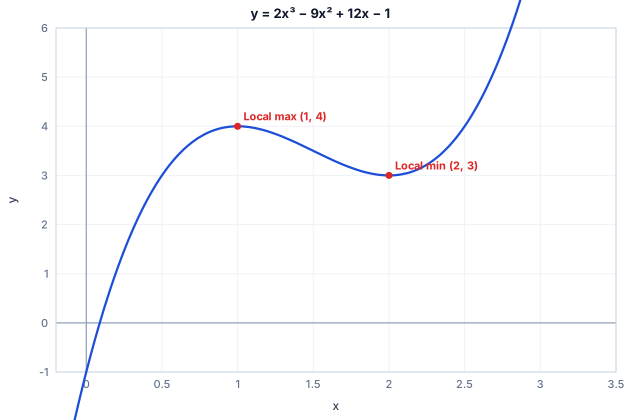
Graph of y = 2x³ − 9x² + 12x − 1 showing a local maximum at (1, 4) and a local minimum at (2, 3).
Figure 1: The cubic curve y = 2x³ − 9x² + 12x − 1 from Worked Example 1. The local maximum at (1, 4) and local minimum at (2, 3) are clearly visible.
Graph of y = x³ − 3x² showing a local maximum at (0, 0) and a local minimum at (2, −4), with an x-intercept at x = 3.
Figure 2: The curve y = x³ − 3x² from Practice Question 5. The local maximum is at (0, 0), the local minimum at (2, −4), and the curve crosses the x-axis again at (3, 0).

Keep learning

Explore CAIE A-Level Mathematics tutoring →

View the full Mathematics syllabus →

Part of Novark's free CAIE A-Level Mathematics notes