Introduction
Differentiation transforms a function into its gradient function — and this section is where that tool is put to direct use. In CAIE 9709 Paper 1, questions on tangents and normals, increasing/decreasing intervals, and rates of change are among the most consistently examined applications of calculus. Mastering this topic unlocks several marks across a range of question styles, from short "find the equation of the tangent" problems to multi-step connected rates of change scenarios involving related quantities.
Core Concept
Gradient at a Point
If , then gives the gradient of the curve at any point. To find the gradient at a specific point , substitute into .
Tangents
The tangent at a point on a curve has the same gradient as the curve at . Using the gradient and the coordinates of , the equation is found via the straight-line formula.
Normals
The normal at point is perpendicular to the tangent at . If the tangent has gradient , the normal has gradient .
Increasing and Decreasing Functions
A function is increasing on an interval when throughout that interval, and decreasing when . Examiners frequently ask you to find these intervals by solving inequalities involving .
Rates of Change
The derivative represents the rate of change of with respect to . When quantities change with respect to time , we write , , etc.
Connected rates of change use the chain rule to link two rates:
More generally, for any chain of related variables:
This is the key technique when one quantity changes at a known rate and you must find the rate of change of a related quantity.
Key Formulae & Definitions
Gradient of curve at :
Equation of tangent at point with gradient :
Gradient of normal (perpendicular to tangent):
Equation of normal at :
Increasing/decreasing conditions:
| Condition | Behaviour of |
|---|---|
| on an interval | is increasing on that interval |
| on an interval | is decreasing on that interval |
| at a point | stationary point (neither increasing nor decreasing there) |
Connected rates of change (chain rule):
Worked Examples
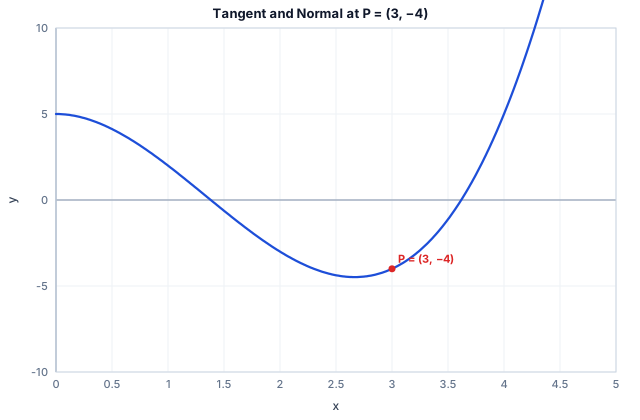
Example 1 — Tangent and Normal to a Curve
The curve has equation . Find the equations of the tangent and normal to at the point where .
Step 1 — Find the -coordinate.
So the point is .
Step 2 — Differentiate.
Step 3 — Find the gradient of the tangent at .
Step 4 — Equation of the tangent.
Step 5 — Gradient of the normal.
Step 6 — Equation of the normal.
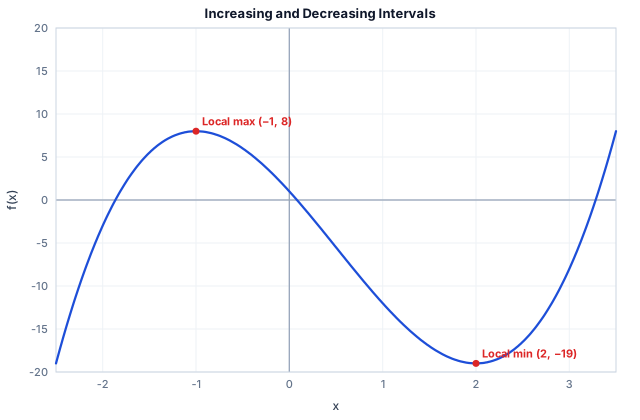
Example 2 — Increasing and Decreasing Intervals
Find the values of for which is a decreasing function.
Step 1 — Differentiate.
Step 2 — Set (decreasing condition).
Step 3 — Solve the inequality. The roots are and . Since the parabola opens upwards, the product is negative between the roots:
Conclusion: is decreasing for .
Example 3 — Connected Rates of Change
A spherical balloon is being inflated so that its radius cm increases at a constant rate of cm s. Find the rate at which the volume cm³ is increasing when .
Step 1 — Write the known rate.
Step 2 — Write the formula for volume.
Step 3 — Differentiate with respect to .
Step 4 — Apply the chain rule.
Step 5 — Substitute .
Common Mistakes & Examiner Pitfalls
-
Using the tangent gradient for the normal. Always take the negative reciprocal: . Forgetting the negative sign or the reciprocal are both common errors.
-
Not evaluating before writing the line equation. You need both coordinates of the point. Substituting only into gives the gradient, not the -coordinate — both are required.
-
Weak inequality vs. strict inequality. When asked for "increasing" or "decreasing", the condition is strict: or . A stationary point is neither increasing nor decreasing.
-
Chain rule inversion errors. In connected rates problems, check carefully whether you need or . Setting up ensures the 's cancel correctly.
-
Not simplifying the line equation. Examiners often award the final mark only for a fully simplified equation ( form or equivalent). Leaving the answer as may lose a mark.
-
Forgetting units in rates of change. In applied problems, quote the units of your answer (e.g. cm³ s⁻¹).
Practice Questions
Q1. The curve has equation . Find the equation of the tangent to at the point .
Show answer
Differentiate:
Gradient at :
Tangent equation:
Q2. Find the values of for which is increasing.
Show answer
Differentiate:
Condition:
Solution: or
Q3. The curve has equation . Find the equation of the normal to at the point where .
Show answer
Find at : . Point: .
Differentiate using the chain rule:
Gradient of tangent at :
Gradient of normal:
Normal equation:
Q4. The area cm² of a circle is increasing at a rate of cm² s⁻¹. Find the rate of increase of the radius when cm.
Show answer
Chain rule:
cm s⁻¹
Q5. The curve has equation . The tangent at point on is parallel to the line . Find the coordinates of and the equation of the normal at .
Show answer
Tangent gradient equals :
-coordinate: . So .
Normal gradient:
Normal equation:
Connections
Prerequisites you should be confident with:
- Differentiating Powers of — the power rule is used in every example above to find .
- The Chain Rule — essential for differentiating composite functions such as and for building the connected rates of change formula.
Likely next subtopics to study:
- Stationary Points and the Second Derivative — extends the idea of into classifying maxima, minima and points of inflection.
- Further Integration — the reverse process of differentiation, needed for areas and definite integrals.
- Optimisation Problems — applies tangents and stationary points to maximise/minimise real-world quantities, a major exam question type in Paper 1.
Figures