Introduction
Percent change questions appear throughout the SAT's Problem-Solving and Data Analysis domain (≈15% of the test). You'll encounter prices rising and falling, populations growing, quantities depreciating — and the SAT loves to chain two or more changes together or ask you to work backward to an original value. Mastering the growth-factor approach makes every one of these problems fast and error-proof.
This note covers percent increase and decrease, multipliers (growth factors), successive percent changes, and reversing a percent change. For the foundational idea of finding the part, whole, or percent from the other two, see the sibling note Percent Basics: Part, Whole, and Percent.
Core Concept
From percent to multiplier
Any percent change can be written as a single multiplication:
- Increase by → multiply by
- Decrease by → multiply by
These multipliers are called growth factors (sometimes scale factors or multipliers). For example:
| Situation | Growth factor |
|---|---|
| 5% increase | |
| 15% decrease | |
| 100% increase (doubling) | |
| 125% of original | |
| 8% decrease |
Key ideaKey ideaKey insight: "125% of original" means growth factor 1.25, not 0.25. Percentages ≥ 100% mean the new value is at least as large as the original.
Successive percent changes — always multiply the factors
If a quantity undergoes two back-to-back percent changes, multiply both growth factors:
Critical trap: You cannot add or subtract the percents. A 15% increase followed by a 10% decrease is not a net 5% increase. The actual net factor is , a 3.5% net increase.
Reversing a percent change to find the original
If you know the value after a percent change and need the original, divide by the growth factor:
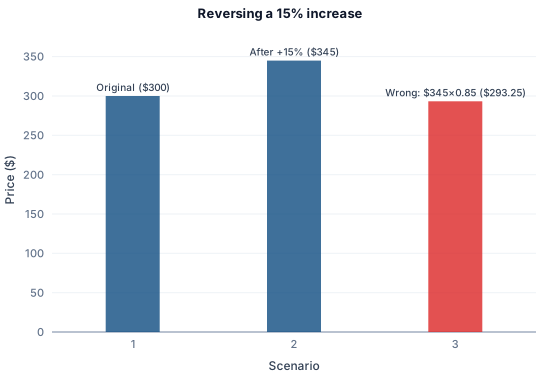
For example, if a price after a 15% increase is $345:
Do not subtract 15% from the new value — that gives 15% of the new price, not the original.
Key Formulas & Rules
Must memorize (not on the reference sheet):
where each (use for a decrease).
Worked Examples
Example 1
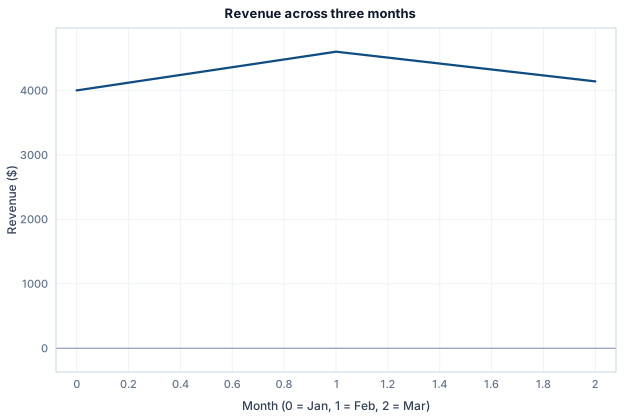
A store's monthly revenue was $4,000 in January. In February, revenue increased by 15% from January's amount. In March, revenue decreased by 10% from February's amount. What was the store's revenue in March?
A) $3,600
B) $4,140
C) $4,200
D) $4,600
Solution
Step 1 — February: apply a 15% increase.
Step 2 — March: apply a 10% decrease to February's revenue.
Verify: ✓
Why each distractor fails:
- A) $3,600 — applies only the 10% decrease to the original, ignoring the February increase: .
- C) $4,200 — adds the percents: net, then . Percents in successive changes must be multiplied, not combined.
- D) $4,600 — stops after February's increase: .
Answer: B) $4,140
Desmos check: Type 4000 * 1.15 * 0.90 in the expression bar to confirm 4140 instantly.
Example 2
A price increased by 15%, reaching $345. What was the original price?
A) $293.25
B) $300
C) $330
D) $396.75
Solution
The new value equals the original times the growth factor:
Verify: ✓
Why each distractor fails:
- A) $293.25 — subtracts 15% of the new price: . This removes 15% of the wrong base.
- C) $330 — subtracts the percent number as a raw dollar amount: .
- D) $396.75 — applies another 15% increase to the new price instead of reversing: .
Answer: B) $300
Common Mistakes & Traps
| Mistake | What it looks like | Correct approach |
|---|---|---|
| Adding percents in successive changes | then treated as net | Multiply the factors: |
| Subtracting % from the new value to reverse | to find original | Divide: |
| Treating "125% of original" as a 125% increase | Multiplying by | "125% of" means multiply by |
| Applying a change to the wrong base | Subtracting 10% of January to find March | Always apply the decrease to February's value |
| Stopping one step early | Reporting the intermediate value | Read the question: it asks for the final value |
| Treating a percent as a dollar/unit amount | Subtracting 15 dollars for "15% increase" | Convert to decimal, multiply by the whole |
Practice Questions
Question 1
A laptop originally cost $X. Its price dropped by 30%, and the new price is $630. What was the original price?
A) $441
B) $660
C) $819
D) $900
Show answer
Answer: D) $900
Set up the equation: , so .
Verify: ✓
- A) $441 — multiplies the new price by 0.70 again: .
- B) $660 — adds $30 (the percent as a number) to 630: .
- C) $819 — adds 30% of the new price: (this inflates the new value instead of recovering the original).
Question 2 (Student-produced response)
A car was worth $25,000. It depreciated by 20% in year 1, then by 10% in year 2. What is the car's value (in dollars) at the end of year 2?
Show answer
Answer: 18000
Year 1:
Year 2:
Combined: ✓
Desmos check: Enter 25000 * 0.80 * 0.90 to confirm $18,000.
Question 3
A company's year 2 sales were 125% of its year 1 sales. If year 1 sales were $80,000, what were year 2 sales?
A) $20,000
B) $100,000
C) $160,000
D) $180,000
Show answer
Answer: B) $100,000
"125% of $80,000" means multiply by the growth factor 1.25:
Verify: ✓
- A) $20,000 — takes only the 25% increase portion: .
- C) $160,000 — doubles the original (confuses 125% with 200%): .
- D) $180,000 — adds 125% to the original: .
Question 4
A quantity grows by 8% each month. Which expression correctly represents its value after 3 months, starting from an initial value of ?
A)
B)
C)
D)
Show answer
Answer: B)
Each month the value is multiplied by the growth factor 1.08. After 3 months:
- A) Adds 8% of the original three times (simple, non-compound growth): . This underestimates because it doesn't let each month's growth build on the previous month's value.
- C) Uses only the rate , not the growth factor .
- D) Multiplies the factor by 3 instead of raising it to the 3rd power: , which vastly overstates the result.
Desmos check: Enter V = 1000 then compute 1000 * 1.08^3 and 1000 + 3*(0.08*1000) to see they differ (1259.71 vs. 1240).
Question 5 (Student-produced response)
A school had 840 students in September. By October, enrollment rose to 882. By what percent did enrollment increase? (Enter a number only; do not enter a percent sign.)
Show answer
Answer: 5
Verify: ✓
Connections
- Prerequisite: Percent Basics: Part, Whole, and Percent — you need to be comfortable converting between fractions, decimals, and percents before using growth factors.
- Algebra overlap: Percent change equations like are linear equations in one variable; the same solve-by-dividing technique appears throughout the Algebra domain.
- Exponential growth/decay (Advanced Math): When a growth factor is applied repeatedly over time — — the skill here is the foundation. The SAT may set up a table or scenario where you must identify the growth factor before writing the exponential model.
- Data analysis questions: Percent change appears in two-way tables and data displays where you compare categories; always identify the correct base (denominator) before computing.
- Real-world contexts: Roughly 30% of SAT math questions are set in context. Percent change is one of the most common "real-world wrappers" — look for price changes, population growth, survey data, and scientific measurements.
Figures