Introduction
Percent problems appear throughout the Problem-Solving and Data Analysis domain, which makes up about 15% of the SAT Math section. You will see them in realistic settings — store discounts, sales tax, restaurant tips, and bank interest — and the same four core skills cover virtually every variant: finding a percent of a number, finding what percent one number is of another, finding the whole when you know a part, and applying a percent of a percent. This note covers those four skills in depth. Percent change, growth factors, and exponential models are addressed in the sibling note Percent Change and Growth Factors.
Core Concept
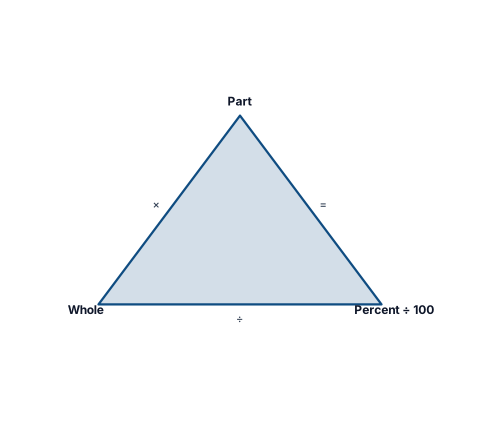
The word "percent" means per hundred, so every percent problem reduces to a proportion:
Cross-multiply or convert the percent to a decimal () and you have a one-step equation. The three quantities — part, whole, and percent — always obey the same relationship; the algebra just depends on which one is unknown.
Quick illustration. A meal costs $50. A 15% tip is added.
- Tip amount (part): , so the tip is $7.50
- Tip as a percent of bill:
- Bill (whole) from tip: , so the original bill is $50
All three rearrangements use the same numbers and the same equation.
Key Formulas & Rules
All four formulas below must be memorized — none appear on the reference sheet.
| Skill | Formula |
|---|---|
| Percent of a number | |
| What percent? | |
| Whole from a part | |
| Percent of a percent | Multiply the decimal factors: |
Key decimal conversions to recognize instantly:
| Percent | Decimal | Fraction |
|---|---|---|
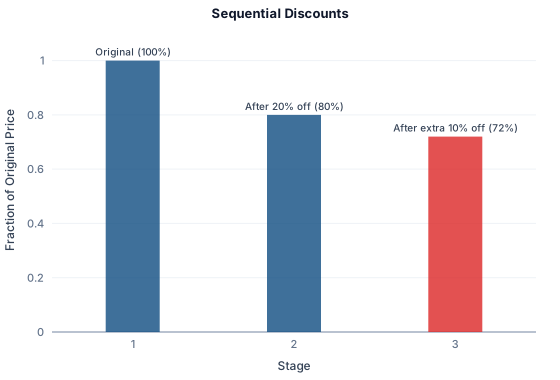
Percent-of-a-percent rule: when two successive percents are applied, multiply the decimal multipliers — never add or subtract the percent numbers.
where and are successive discounts as decimals.
Worked Examples
Example 1
A jacket has an original price of $280. The store applies a discount. What is the sale price?
A) $70 B) $210 C) $255 D) $350
Solution.
Step 1 — Find the discount amount.
Step 2 — Subtract from the original price.
Check: , meaning the customer pays 75% of the original — exactly what a 25% discount produces. ✓
Why the distractors fail:
- A) $70 — This is the discount amount, not the sale price. The student stopped one step early.
- C) $255 — The student subtracted the percent number directly: . Percent numbers are not dollar amounts.
- D) $350 — The student added the discount instead of subtracting: .
Answer: B) $210
Example 2
A restaurant bill totals $64 before tip. A customer leaves $16 as a tip. The tip is what percent of the pre-tip bill?
A) B) C) D)
Solution.
Use the "what percent?" formula with part = 16 and whole = 64:
Check: ✓
Why the distractors fail:
- A) — The student used the total (bill + tip = $80) as the whole: . The whole must be the pre-tip bill.
- C) — The student found the complement: . That is the percent of the bill not covered by the tip.
- D) — The student inverted the fraction: , giving .
Answer: B)
Desmos check: Type 16/64*100 in the Desmos calculator to confirm .
Common Mistakes & Traps
-
Using the wrong base as "the whole." In a tip problem, the whole is the pre-tip bill — not the final total. In a discount problem, the whole is the original price. Always ask: percent of what?
-
Subtracting the percent number directly. A discount on $280 is not . Convert the percent to a decimal first.
-
Adding successive discounts. A off followed by a off is not off. The second discount applies to the already-reduced price, so the combined effect is , or off — not .
-
Taking a percent of the final amount instead of the original. When finding the whole from a part (e.g., reversing tax or interest), don't multiply the given amount by the rate and subtract — divide by the rate factor instead.
-
Stopping one step early. Finding the discount amount is not the answer if the question asks for the sale price, and finding the interest earned is not the answer if the question asks for the final balance.
Practice Questions
Question 1 (Student-produced response)
A customer pays $13.50 in sales tax on a purchase. The tax rate is . What was the pre-tax price of the purchase, in dollars?
Show answer
Answer: 150
Set up the equation:
Check: ✓
The pre-tax price is $150.
Question 2 (Multiple choice)
A store offers a discount on all items. Loyalty members receive an additional off the already-discounted price. What percent of the original price does a loyalty member pay?
A) B) C) D)
Show answer
Answer: B)
Apply the discounts sequentially as decimal multipliers:
A loyalty member pays 72% of the original price.
- A) — Added the discounts: off, paying . Successive discounts must be multiplied, not added.
- C) — Applied only the first discount, ignoring the second.
- D) — This is the combined discount amount (), not the percent paid.
Desmos check: Evaluate 0.80 * 0.90 to confirm .
Question 3 (Multiple choice)
After earning simple interest for one year at an annual rate of , a bank account balance grew to $2,120. What was the original principal?
A) $1,992.80 B) $2,000 C) $2,114 D) $2,247.20
Show answer
Answer: B) $2,000
After one year of simple interest at , the balance equals :
Check: ; ✓
- A) $1,992.80 — Took of the final balance and subtracted: . The rate must be applied to the original, not the final amount.
- C) $2,114 — Subtracted the percent number directly: .
- D) $2,247.20 — Added another year of interest: , going forward instead of reversing.
Question 4 (Student-produced response)
A school has 450 students. On a particular day, 63 students are absent. What percent of the student body is absent?
Show answer
Answer: 14
Check: ✓
Enter 14 (or 14%).
Question 5 (Multiple choice)
A laptop has a listed price of $800. A buyer receives a discount and then pays sales tax on the discounted price. What is the buyer's total payment?
A) $680 B) $734.40 C) $744 D) $864
Show answer
Answer: B) $734.40
Step 1 — Apply the discount:
Step 2 — Apply tax to the discounted price:
Check: Combined multiplier ; ✓
- A) $680 — Stopped after the discount, forgot to add tax.
- C) $744 — Combined percentages linearly: net discount → . Successive operations on different bases cannot be added.
- D) $864 — Applied the tax to the original $800 with no discount: .
Desmos check: Type 800 * 0.85 * 1.08 to get .
Connections
- Prerequisite: Comfort with decimal multiplication and basic equation solving (one variable, one step) is all you need to start.
- Sibling note — Percent Change and Growth Factors: Once you have these basics, that note extends them to percent increase/decrease, multipliers, and repeated-growth models (compound interest, population growth). The idea that "after a discount you pay " is the direct bridge between these two topics.
- Ratios and proportional relationships: Percent problems are a special case of proportions. If you see a table of values or a rate problem, the same logic applies.
- Linear equations (Algebra): Finding the whole from a part almost always becomes a one-step linear equation. Recognizing that structure () makes the algebra automatic.
- On test day: When a word problem mentions discount, tax, tip, or interest, immediately identify which of the three quantities (part, whole, percent) is unknown. Write that single equation and solve — the arithmetic is rarely the hard part.
Figures