Introduction
One of the most powerful ideas in A-Level Mathematics is the ability to find the exact gradient of a curve at a single point. Unlike a straight line — whose gradient is constant everywhere — a curve has a gradient that changes from point to point. Differentiation is the process that computes this gradient precisely, and it underpins a huge portion of the 9709 Pure Mathematics 1 paper: from finding stationary points and sketching curves, to solving optimisation and connected-rates-of-change problems. This note establishes the conceptual foundation and the notation you will use throughout.
Core Concept
Gradient of a straight line (recap)
The gradient of a straight line through two points and is:
This is a fixed number for any straight line.
Why a curve is different
For a curve , the steepness changes at every point, so no single fraction can describe the gradient everywhere. Instead, we need to find the gradient at one specific point — say .
The chord approach — an informal idea of a limit
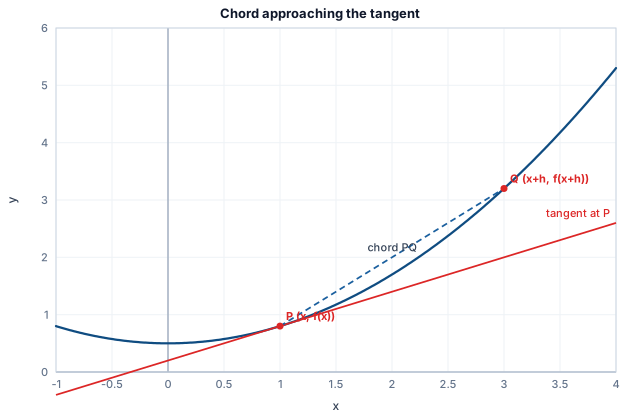
Draw a chord (a straight line joining two points on the curve) from to a nearby point , where is a small positive or negative number.
The gradient of this chord is:
Now imagine sliding along the curve closer and closer to , so gets smaller and smaller (approaching zero, but never actually equalling zero). The chord rotates and approaches the tangent to the curve at . The gradient of this tangent is the gradient of the curve at .
Key idea (informal limit): As , the gradient of chord approaches the gradient of the curve at . This limiting value is called the derivative.
You are not required to perform this limiting process algebraically (that is called differentiation from first principles, which is outside the scope of this syllabus objective). You need to understand the idea conceptually and apply the derivative rules taught in subsequent topics.
Key Formulae & Definitions
First derivative
The first derivative of measures the gradient of the curve at any point . It is written in two equivalent notations:
| Notation | Read as | Used when… |
|---|---|---|
| "f prime of x" | the function is written as | |
| "dy by dx" | the function is written as |
Both mean exactly the same thing: the instantaneous rate of change of with respect to .
Second derivative
Differentiating the first derivative again gives the second derivative, which measures the rate of change of the gradient itself (related to the curvature of the curve):
| Notation | Read as |
|---|---|
| "f double-prime of x" | |
| "d two y by dx squared" |
Power rule (the key differentiation rule for this course)
This applies for any constant (integer, fraction, or negative).
Derivative of a constant
Worked Examples
Example 1 — Finding and interpreting and
Question: Given , find and , and state the gradient of the curve at .
Step 1 — Differentiate term by term to find :
Each term: multiply by the power, then reduce the power by 1. The constant 7 differentiates to 0.
Step 2 — Differentiate to find :
Step 3 — Evaluate the gradient at :
Conclusion: The gradient of the curve at is .
Example 2 — Using notation with negative and fractional powers
Question: Given , find and .
Step 1 — Rewrite in index form:
Always convert roots and fractions to index notation before differentiating.
Step 2 — Find using the power rule:
Step 3 — Find by differentiating again:
Step 4 — You may rewrite in a tidy form if required:
Common Mistakes & Examiner Pitfalls
-
Forgetting to convert before differentiating. You cannot apply the power rule to or directly — always rewrite as or first.
-
Confusing with . The expression is a function (the gradient at a general point). The value is the gradient at the specific point . Examiners often ask for the gradient "at " — you must substitute after differentiating.
-
Differentiating the constant term incorrectly. A common error is writing or . The derivative of any constant is zero.
-
Mixing up first and second derivative notation. and are not the same; the superscripts in do not mean squaring either or separately.
-
Applying the power rule to products/quotients without expanding first. At this stage, always expand brackets or separate fractions before differentiating — do not try to differentiate a product like as two separate pieces without expanding.
-
Sign errors with negative powers. When differentiating , the result is (negative multiplied by the existing coefficient), not .
Practice Questions
Q1. Given , find and .
Show answer
Differentiate term by term:
The constant 9 disappears (derivative = 0).
Substitute :
The gradient of the curve at is .
Q2. Given , find .
Show answer
Rewrite in index form:
Apply power rule to each term:
Which may be written as:
Q3. Given , find and .
Show answer
First derivative:
Second derivative (differentiate ):
Q4. A curve has equation . Find and hence find the gradient of the curve at the point where .
Show answer
Expand the brackets first:
Differentiate:
Substitute :
The gradient of the curve at is .
Q5. Given , , find and .
Show answer
Simplify by dividing each term by :
First derivative:
Second derivative:
Connections
-
Prerequisite — Coordinate Geometry (straight-line gradients): The chord-gradient formula is a direct extension of the straight-line gradient formula. A secure understanding of gradient as "rise over run" is essential before this topic.
-
Prerequisite — Index Laws: Rewriting terms in index form (e.g. , ) is a critical algebraic skill needed at every stage of differentiation.
-
Next — Differentiating Polynomials and Applying the Power Rule: This note establishes the concept and notation; the next step is fluent, systematic differentiation of a wide range of polynomial and rational expressions.
-
Next — Tangents and Normals: Once you can compute , you can find equations of tangents (gradient ) and normals (gradient ) at a given point.
-
Next — Stationary Points and Curve Sketching: Setting locates stationary points; the sign of at those points determines whether each is a maximum, minimum, or point of inflection.
-
Next — Increasing and Decreasing Functions: The sign of over an interval tells you whether the function is increasing () or decreasing ().
Figures