Introduction
Definite integration is the engine behind two of the most frequently examined geometric applications in 9709 Pure Mathematics 1: finding areas of regions bounded by curves and straight lines, and computing volumes of revolution when a region is rotated about a coordinate axis. These topics appear in virtually every examination sitting and typically carry 7–12 marks. Mastery requires careful attention to limits, signs, and the geometry of the region involved — errors in any of these are the most common source of lost marks.
Core Concept
Areas of Regions
The definite integral gives the signed area between the curve and the -axis over . For exam purposes, the following cases must all be handled:
Case 1 — Between a curve and the -axis:
If on , the area is simply .
If the curve dips below the -axis on part of , split the integral at every root and take the absolute value of each part before summing.
Case 2 — Between a curve and a line parallel to the -axis (integrating with respect to ):
When a boundary is a horizontal line or the region is better described in terms of , express as a function of and use:
Case 3 — Between a curve and a straight line, or between two curves:
If on (upper curve minus lower curve):
The limits and are found by solving (or the given intersection conditions).
Volumes of Revolution
When a region is rotated through radians (a full turn) about the -axis:
When rotated about the -axis:
For rotation of the region between two curves (outer) and (inner) about the -axis:
Key Formulae & Definitions
Area under a curve ():
Area between two curves ():
Area integrating with respect to :
Volume of revolution about the -axis:
Volume of revolution about the -axis:
Washer/shell method (between two curves about the -axis):
Note: Volumes are always positive. If your answer is negative, check your limits or which curve is outer/inner.
Worked Examples
Example 1 — Area between a curve and a straight line
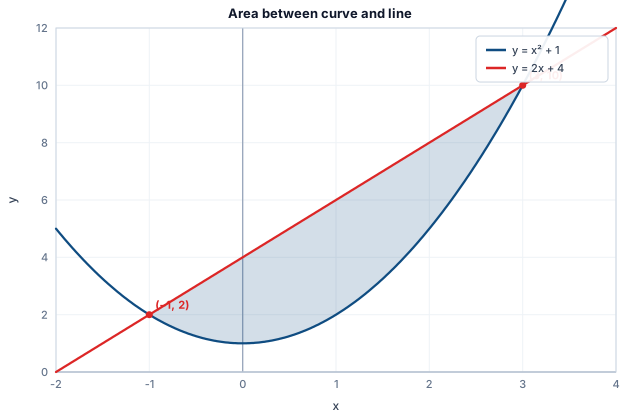
Find the area of the region enclosed by the curve and the line .
Step 1 — Find intersection points.
Set :
Step 2 — Identify which is the upper curve on .
Test : line gives , curve gives . So is above .
Step 3 — Set up and evaluate the integral.
At :
At :
Example 2 — Volume of revolution about the -axis
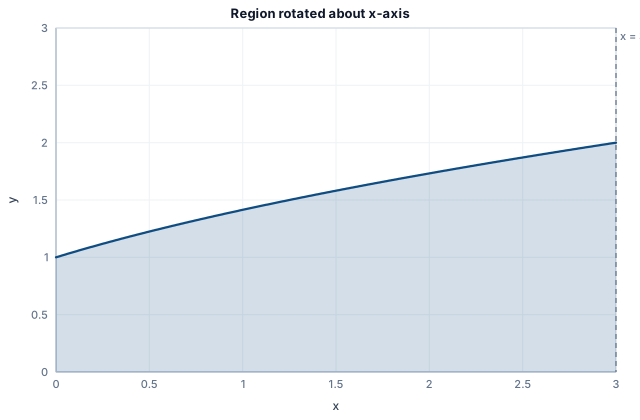
The region bounded by the curve , the -axis, and is rotated through radians about the -axis. Find the exact volume of the solid formed.
Step 1 — Write down the formula.
Step 2 — Substitute .
Since , we have .
Step 3 — Integrate.
Example 3 — Volume of revolution about the -axis
The region enclosed by , , and is rotated fully about the -axis. Find the volume generated.
Step 1 — Express in terms of .
From : .
Step 2 — Apply the formula for rotation about the -axis.
Step 3 — Integrate.
Common Mistakes & Examiner Pitfalls
| Mistake | What goes wrong | How to avoid it |
|---|---|---|
| Wrong sign for area below -axis | Negative integral treated as area | Always sketch; use for portions below axis |
| Forgetting in volume formula | Volume answer is off by a factor of | Write from the outset |
| Using instead of in the volume integral | Computes area, not volume | Remember: rotation gives |
| Swapping upper and lower curve | Area comes out negative | Always verify which curve is greater with a test point |
| Incorrect limits when integrating w.r.t. | Limits are -values, not -values | Check that limits match the variable of integration |
| Not squaring correctly when using washer method | E.g. writing | Expand each term separately before subtracting |
| Omitting absolute value for a region split by the -axis | Positive and negative parts cancel | Split the integral at the roots and add magnitudes |
Practice Questions
Q1. Find the area enclosed between the curve and the -axis.
Show answer
The curve meets the -axis where .
On : ; on : . By symmetry the two parts have equal magnitude.
Q2. The region is bounded by the curve and the line . Find the area of .
Show answer
Intersections: , so .
Curve is above line on :
At :
At :
Q3. The curve and the lines , bound a region which is rotated fully about the -axis. Find the exact volume of revolution.
Show answer
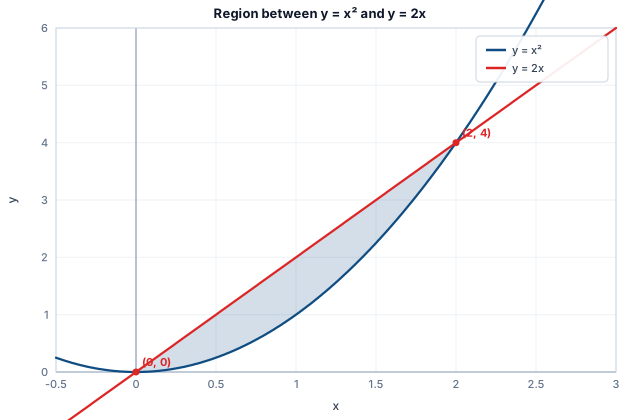
Q4. The region bounded by and is rotated radians about the -axis. Find the volume of the solid formed.
Show answer
Intersections: or .
On : , so is the outer curve.
Q5. Find the volume generated when the region enclosed by , , and is rotated completely about the -axis.
Show answer
Connections
Prerequisite knowledge relied upon:
- Definite Integrals — evaluating using the Fundamental Theorem of Calculus; handling polynomial, power, and simple composite integrands.
- Coordinate Geometry — finding intersection points of lines and curves by solving simultaneous equations.
- Curve Sketching — identifying which curve lies above the other and locating roots, essential for setting up correct limits.
Natural next steps within 9709:
- Integration by substitution and integration by parts (A2 Pure) — needed for more complex integrands in area/volume problems.
- Differential Equations — another major application of integration techniques.
- Further volumes of revolution at A2 level may involve parametric equations as limits or integrands.
Figures